Category: Guide

  • St Augustine Creole Festival: 3 October Days in Cane River

    St Augustine Creole Festival: 3 October Days in Cane River

    October brings Isle Brevelle home. Families who moved away return for the St Augustine fair, and the church grounds fill with cousins who see each other once a year.

    St Augustine Creole Festival runs on the second weekend of October, Friday to Sunday. It is a church fair, a family reunion, and a music weekend in one.

    This article walks the three days, then shows how the same culture lives on in records, classrooms, and kitchens. Look here first for the living side of Cane River Creole life.

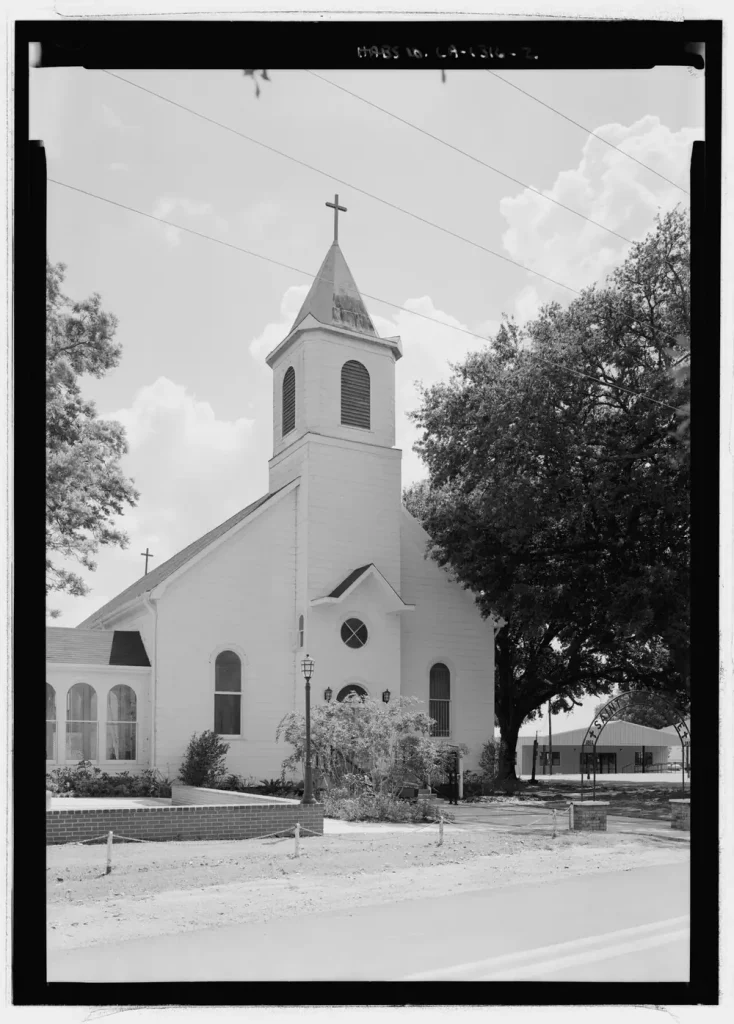
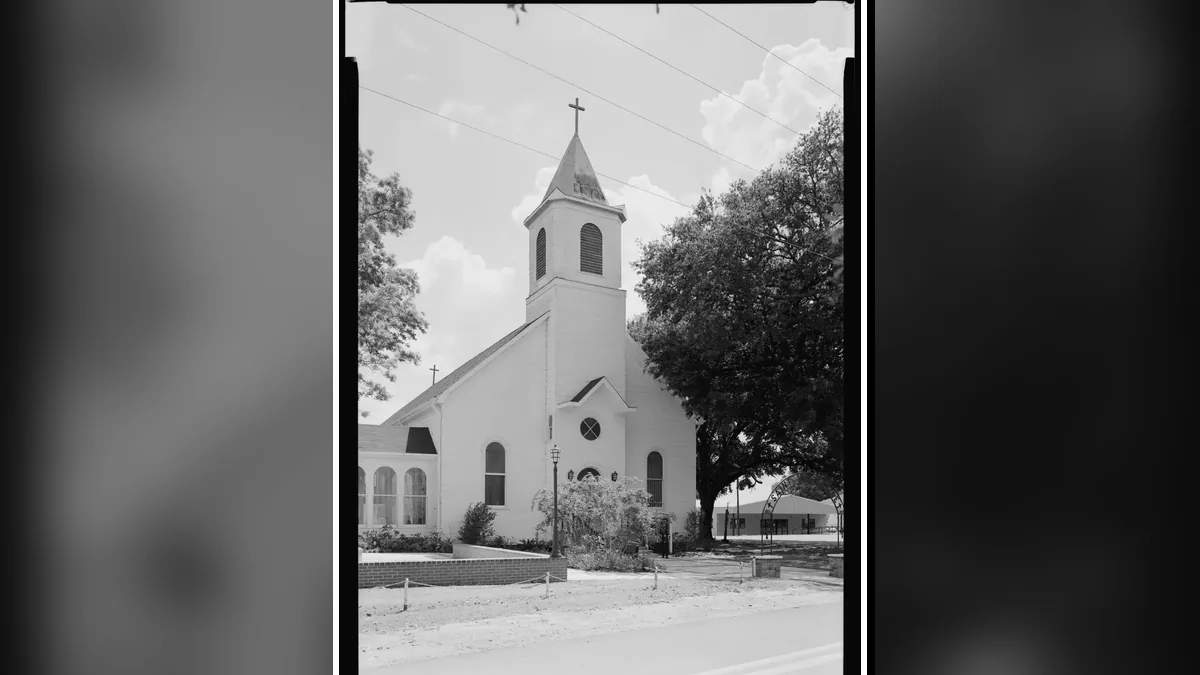
    See the full guide for the festival’s background: Cane River Creole Culture and History. The church at the center of the festival has its own guide: St. Augustine Catholic Church: The First Church Built by Free People of Color.

    Summary

    • On October’s second weekend the festival runs Friday to Sunday, every year.
    • In 2026 the dates were 9–11 October, with free admission, at the church on Isle Brevelle (Louisiana Life, 2026).
    • Across the weekend, the church grounds serve fish fry and Creole cooking beside live music and games.
    • Genealogy runs beside the party: the Creole Heritage Center holds more than 5,000 items and 9,500 names in its family database (Northwestern State University, 2026).
    • October is Creole Heritage Month in Louisiana, marked by a legislative resolution since 2005 (Louisiana Creole Heritage Center, 2024).

    Three Days on Isle Brevelle

    Three days carry the festival, and each one has its own shape. Friday opens the weekend, Saturday fills it, and Sunday closes it with prayer.

    1. Friday opens with a fish fry on the church grounds, as families arrive and the weekend begins.
    2. Saturday brings bingo, carnival games, Creole food, and an evening zydeco concert by Gerard Delafose and the Zydeco Gators (Louisiana Creole Heritage Center, 2024).
    3. Sunday centers on Mass, then the festival resumes for a closing afternoon of food and visiting.
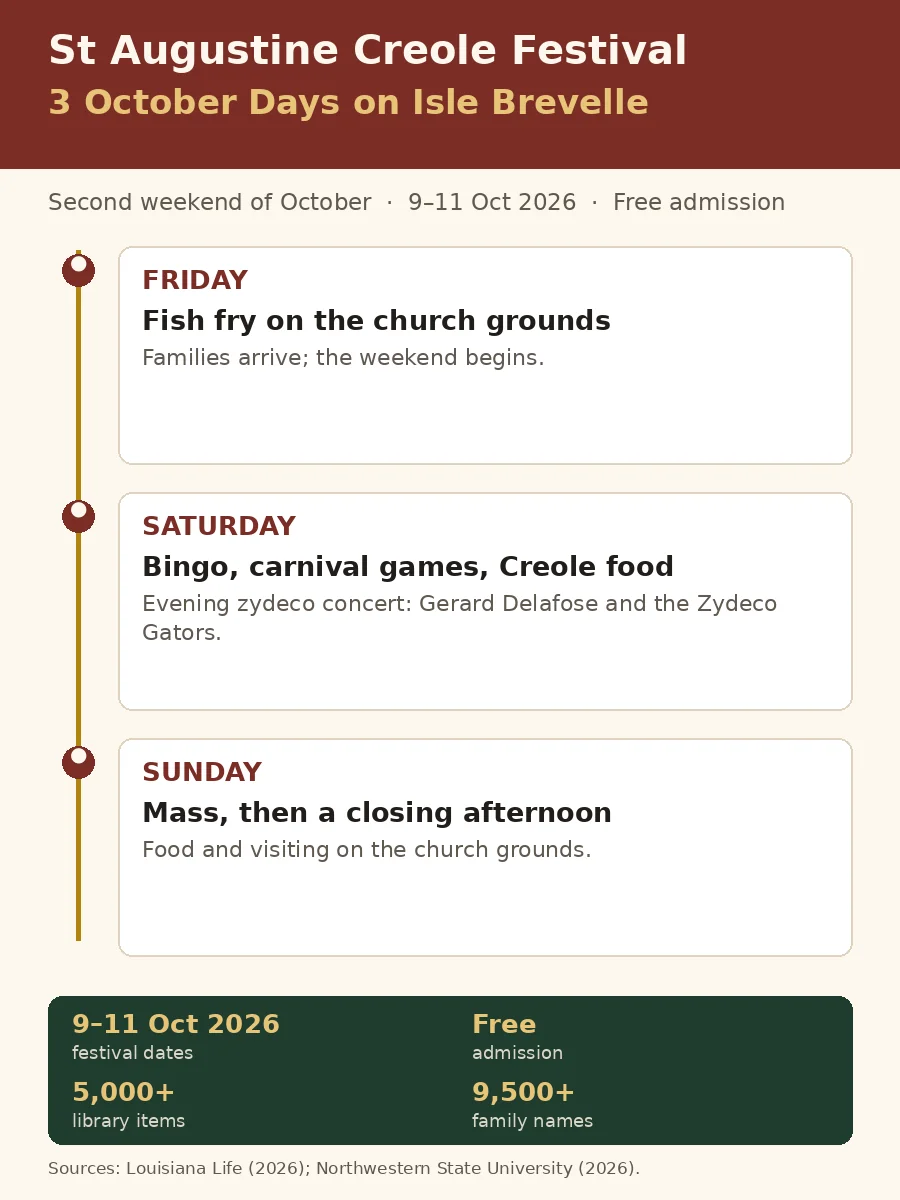
    Three-day festival timeline: 9-11 October 2026, free admission

    Three days on Isle Brevelle: fish fry Friday, bingo and zydeco Saturday, Mass and closing Sunday.

    Bingo and carnival games run through the weekend, and the Center displays its Métoyer family work (Louisiana Creole Heritage Center, 2024). Food stays Creole throughout: fish fry, gumbo, meat pies, and tamales.

    Dates shift by year, so the rule matters more than any single weekend. Second weekend of October is the pattern; check the parish or the visitors bureau before travelling.

    A Family Reunion, Not Just a Festival

    Country Roads Magazine calls the festival a family reunion for generations of local families (Country Roads Magazine, 2025). Relatives gather to visit over entertainment, crafts, games, and storytelling, meeting family members and new visitors alike.

    Families scattered across the country treat the weekend as a homecoming. They come back to the ground their ancestors bought, to a church their ancestors built, and to cousins they see once a year.

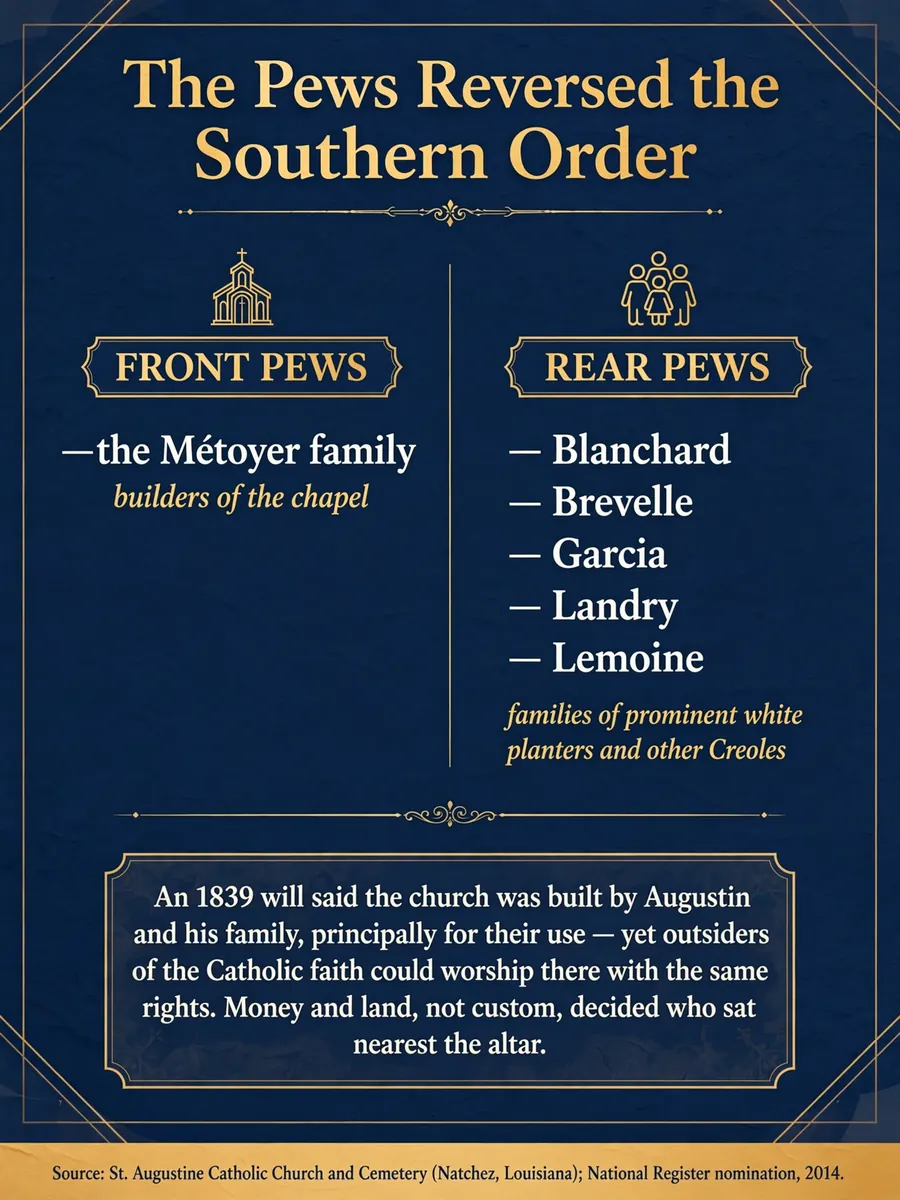
    Walking tours of the church and cemetery run during the festival (Country Roads Magazine, 2025). Guides tell the pew story: Creole families in front, white planters behind, the Southern order reversed.
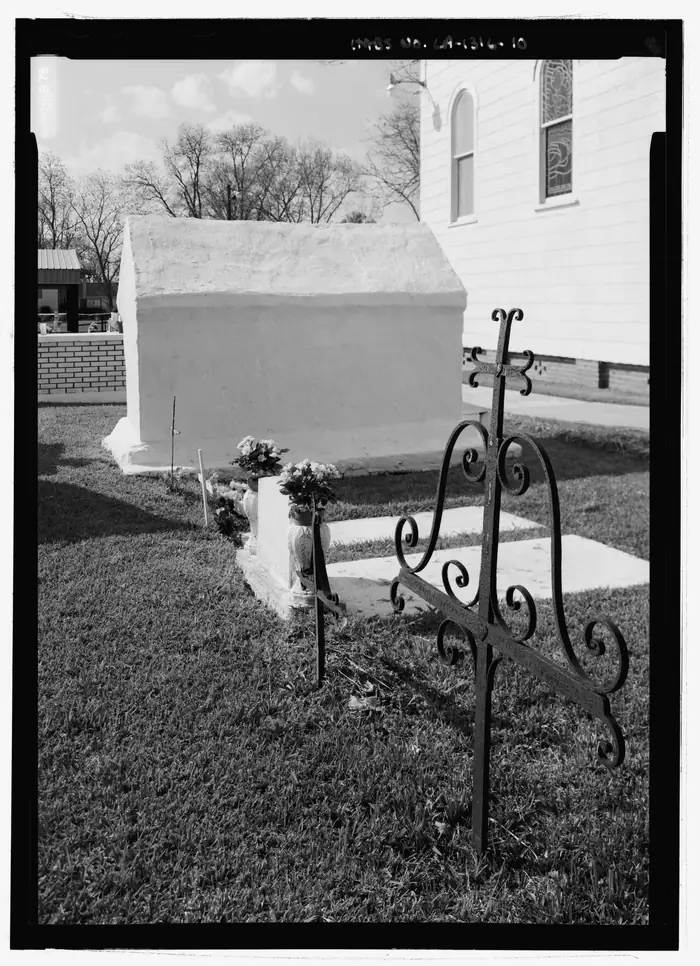
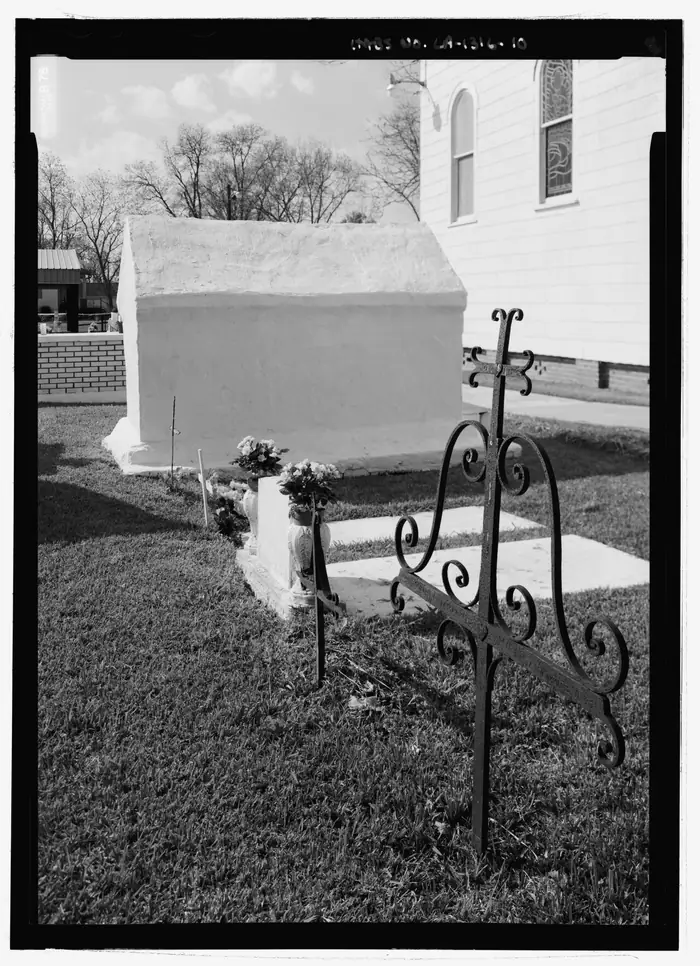
    Iron cross grave markers and a mausoleum in the cemetery behind St. Augustine Catholic Church

    Iron cross grave markers and a mausoleum in the cemetery behind St. Augustine Catholic Church (HABS LA-1316-10, Historic American Buildings Survey, public domain).

    Fifteen miles south of Natchitoches, near Melrose, the church stands at the cultural center of the river community (Country Roads Magazine, 2025). French, Spanish, Native American, and Black Creole threads meet in the parish the church has anchored since 1829 (Country Roads Magazine, 2025).

    The Music You Will Hear

    Zydeco leads the festival stage, and the older sounds are never far behind. Juré singing, la la, and zydeco form one family tree, and the festival weekend shows all three branches Creole music of Cane River.

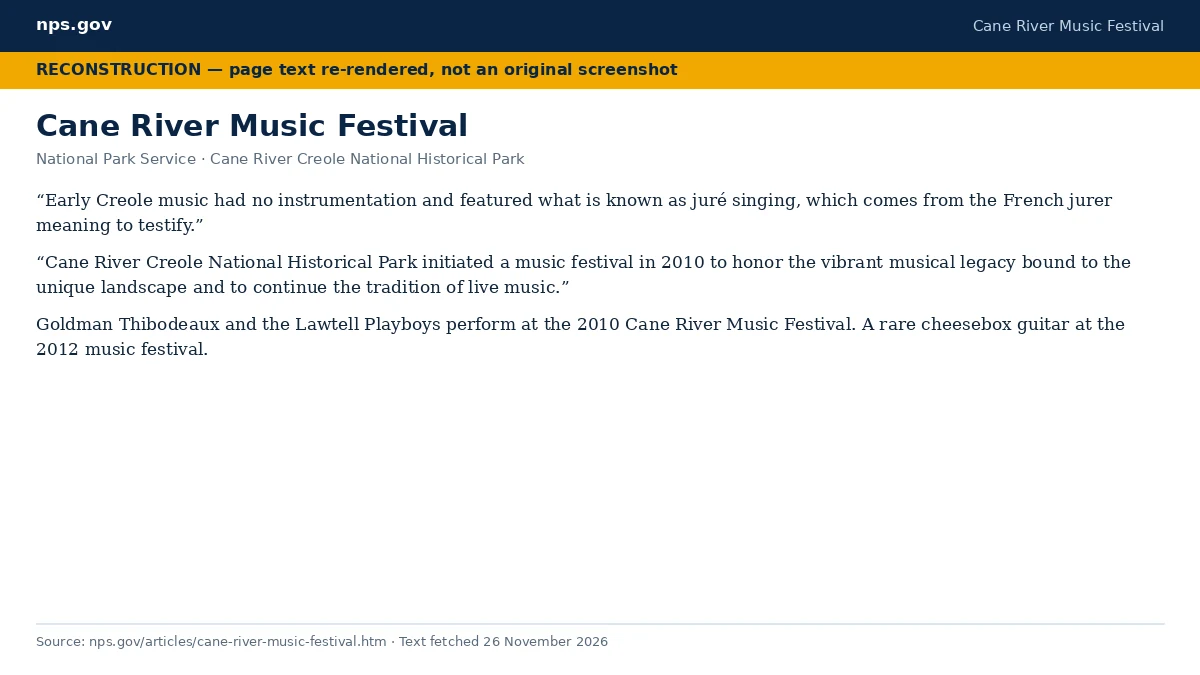
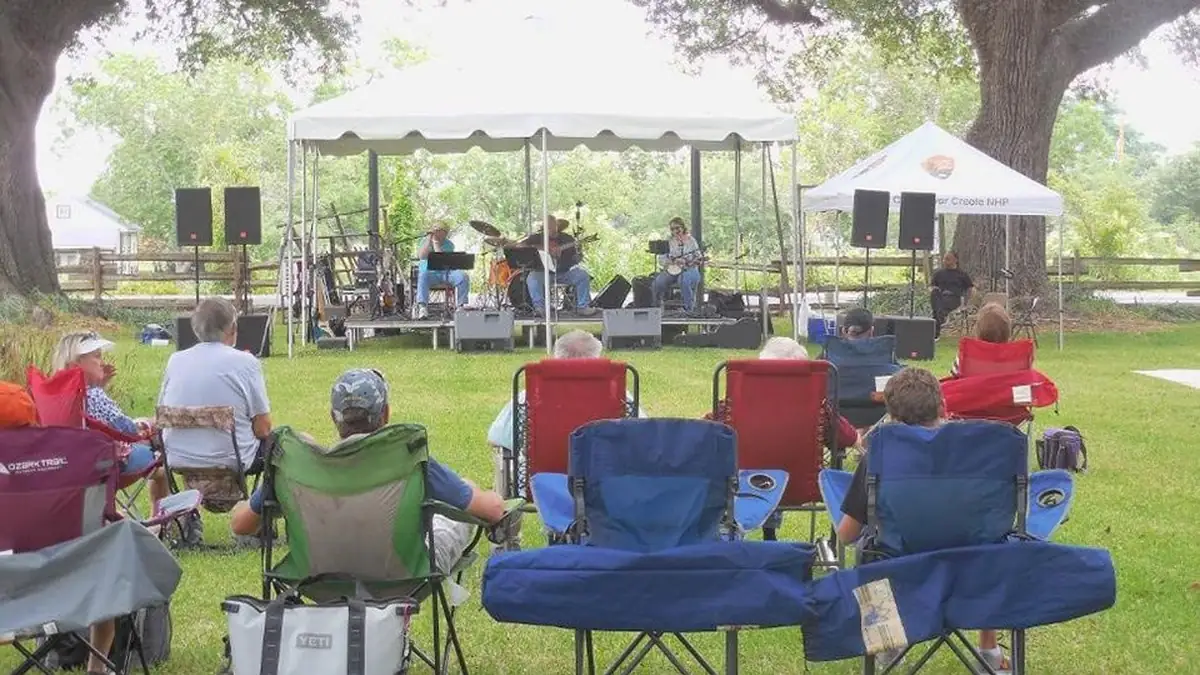
    Oakland Plantation hosts the park’s music festival, begun in 2010 and held every year since. Local artists play on the plantation ground where the tradition grew (National Park Service, 2019).

    Church dances and trail rides carry the same music between festivals. French and Kouri-Vini words still ride the dance tunes, a reminder that the music began as voices alone.

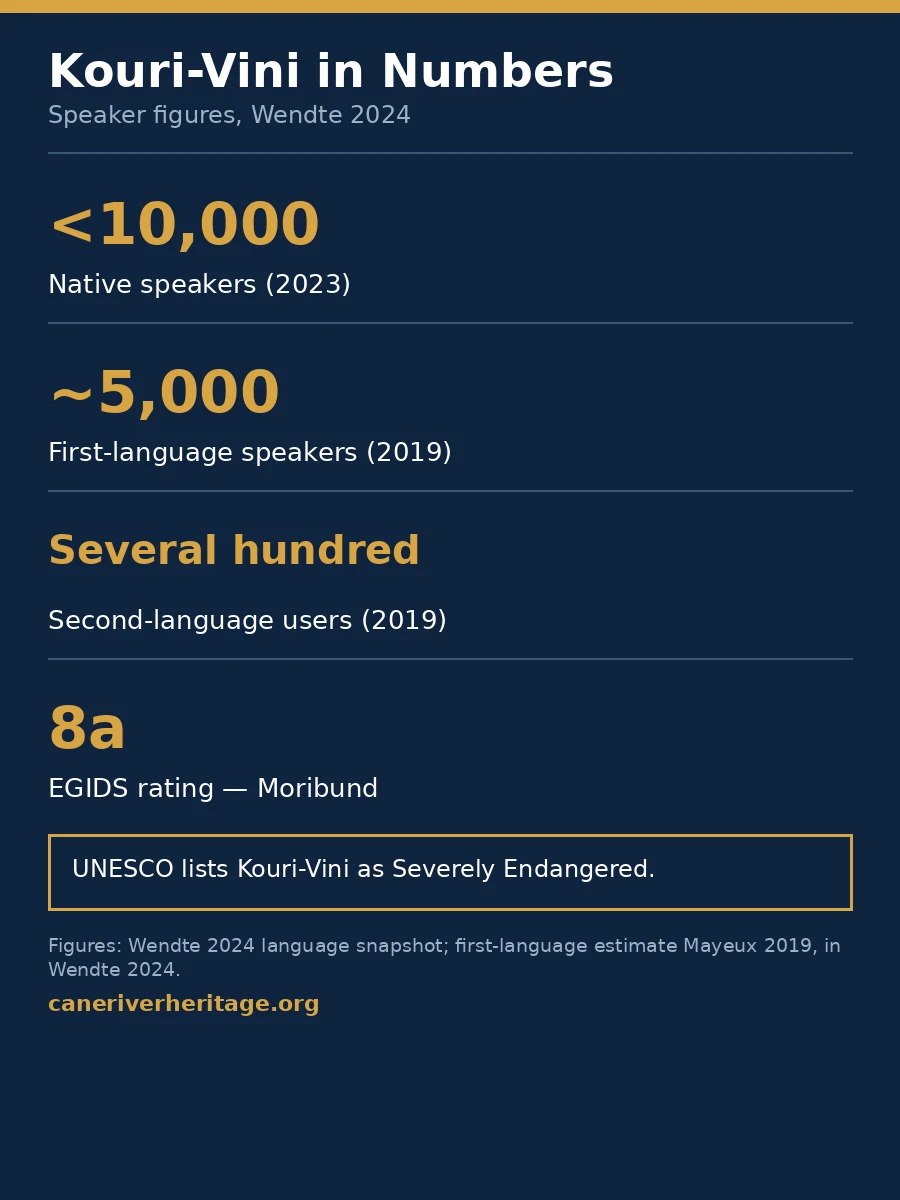
    Kouri-Vini, the language of many juré songs, counts fewer than 10,000 speakers today, about 5,000 of them first-language speakers (Cane River Heritage, 2026).

    Tracing Your Family at the Creole Heritage Center

    Northwestern State University keeps the paper trail at its Creole Heritage Center. For nearly thirty years the Center has collected items documenting Louisiana Creole lives back to the eighteenth century (Northwestern State University, 2026).

    More than 5,000 items fill the Center’s resource library (Northwestern State University, 2026). Records of churches, funerals and celebrations, cemeteries, family histories, and transcribed state files fill the shelves, alongside Ancestry.com and Newspapers.com access.
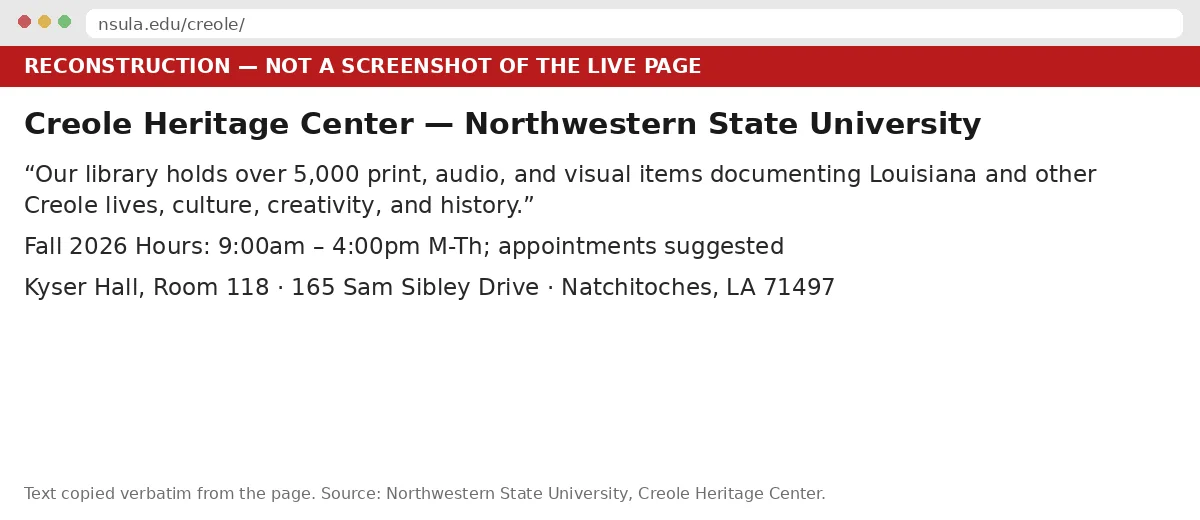
    Creole Heritage Center library at Northwestern State University - reconstruction

    Open Monday to Thursday in Fall 2026, the Center library holds more than 5,000 items. Rebuilt from the live page text, not a screenshot.

    More than 9,500 names fill the online National Creole Family database, with basic family details for each (Northwestern State University, 2026). Most items connect to Natchitoches Parish families, and some follow migrants to California, Illinois, and Texas.
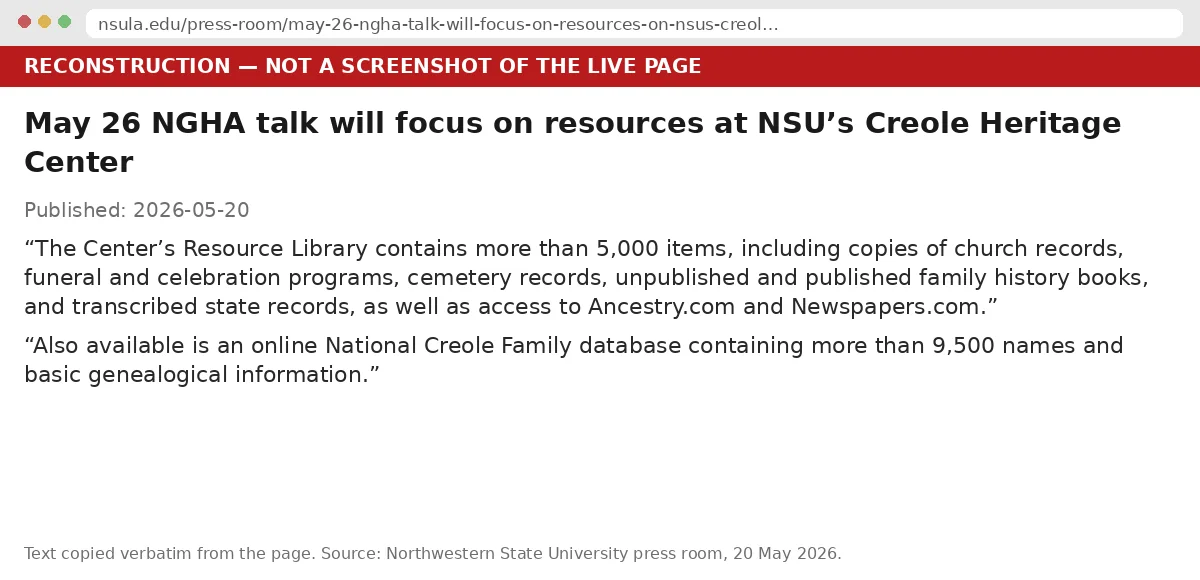
    May 26 press release about resources at NSU's Creole Heritage Center - reconstruction

    The May 26 talk preview counts more than 5,000 items and 9,500 names in the family database. Built from the press release text, not a screenshot.

    Start with what your family already knows, then bring names and dates to the Center. Staff help visitors match those names to registers, cemetery records, and family histories held on site.

    Appointments are encouraged, and visitors should confirm staff availability in advance. Fall 2026 hours run Monday to Thursday, 9 in the morning to 4 in the afternoon (Northwestern State University, undated).

    Donations of family papers help the Center help the next searcher. Copies of genealogical materials are welcome, so the collection keeps growing with the families it serves.

    October Is Creole Heritage Month

    Louisiana gives October a second title: Creole Heritage Month, marked each year since 2005 (Louisiana Creole Heritage Center, 2024). State lawmakers passed a unanimous resolution in 2005, spurred by the Creole Heritage Center (Louisiana Creole Heritage Center, 2024).

    Governor John Bel Edwards reaffirmed the month in 2023, while recognising the Center’s twenty-fifth anniversary (Louisiana Creole Heritage Center, 2024). That recognition mirrors festivities honoring Creoles around the world each October.

    A month of Center events filled October 2026, from a 1 October kickoff to an open house on 27–28 October (Northwestern State University, 2026). Cane River sites hosted a scavenger hunt that tied the month together, with prizes for finishers (Northwestern State University, 2026).

    Campus programming joins the parish calendar. In 2025 the Gail Metoyer Jones Center held Recipes, Rhythm and Roots, an evening of zydeco dancing and family-history storytelling (Northwestern State University, 2025).

    The Rest of October in Natchitoches

    Fall Tour of Homes runs on the same second weekend, inviting guests into eight of the oldest homes in the state (Country Roads Magazine, 2025). Candlelight tours open Friday, and Saturday opens four more houses (Country Roads Magazine, 2025).

    Christmas lights close the season, not October. Ninety-nine years of Christmas lights marked the 2025 festival, with more than 300,000 lights burning from 22 November to 6 January (Country Roads Magazine, 2025).

    Before You Go

    Check the parish or the visitors bureau before travelling, since dates and times change. This guide gives the pattern, not the program for a single year.

    Mass times and parish events change, so confirm them with the Diocese of Alexandria before you travel. Practical details are left out here because they change.

    The Culture Is Still Alive

    Festivals end, but the culture they celebrate does not. Records stay open at the university, the church fair returns each October, and the music plays on.

    Plan a visit around the second weekend of October. You will find the parish at its fullest: worship, food, music, and family on the same ground.

    Frequently Asked Questions

    When is the St Augustine Creole Festival?

    Every year on the second weekend of October, Friday to Sunday. Dates in 2026 ran 9–11 October, with free admission (Louisiana Life, 2026).
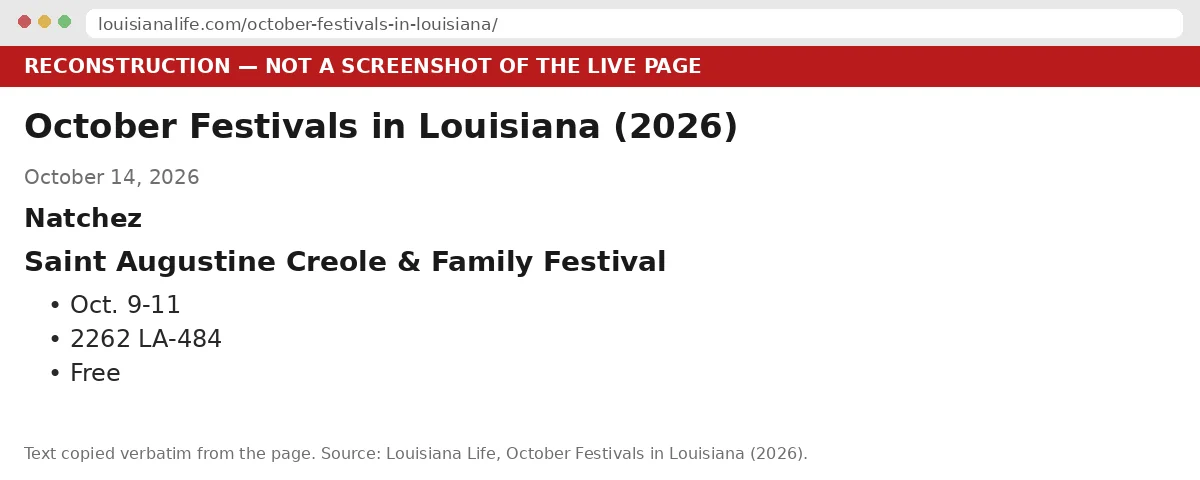
    Louisiana Life festival listing for the St Augustine Creole Festival, 9-11 October 2026 - reconstruction

    Free admission, 9–11 October 2026, at 2262 LA-484 — Louisiana Life’s festival listing. Reconstruction of the live page, not a screenshot.

    What happens at the festival?

    Church grounds fill with fish fry, live music, bingo, carnival games, and Creole cooking. A walking tour of the church and cemetery runs during the weekend.

    Is the festival free?

    Yes, admission is free (Louisiana Life, 2026). Bring money for food and raffles.

    Where do I start tracing Creole family roots?

    Start your search at Northwestern State University’s Creole Heritage Center. Its library holds more than 5,000 items, and its family database holds more than 9,500 names (Northwestern State University, 2026).

    What else happens in Natchitoches in October?

    Tour of Homes runs on the same second weekend, and the university marks Creole Heritage Month all month. Christmas lights follow in November, with the Christmas Festival running to early January.

    Methodology

    Sources were read in full before any of this was written. Louisiana Life, Country Roads Magazine, Northwestern State University, and the Creole Heritage Center supplied the facts.

    Speaker counts for Kouri-Vini come from the site’s statistics article, linked in the text.

    Checks ran on 26 November 2026, with every date and figure traced to at least one source. Disagreements between sources are shown, not settled here.

    Limits: the Center’s October 2026 program comes from the university press release. University press pages supplied the 2025 celebration, after a rate limit blocked the direct open.

    Hours and prices are not listed here because they change.

    References

    1. October Festivals in Louisiana — Louisiana Life
    2. From Pews to Pints — Country Roads Magazine
    3. Creole Heritage Center — Northwestern State University
    4. May 26 NGHA talk will focus on resources at NSU’s Creole Heritage Center — Northwestern State University
    5. October is Creole Heritage Month — Louisiana Creole Heritage Center
    6. Cane River Music Festival — National Park Service
    7. Recipes, Rhythm & Roots: A Creole Heritage Celebration brings culture to life Oct. 23 — Northwestern State University
    8. Cane River Creole in Numbers 2026 — Cane River Heritage
    9. Bon Temps & Living Traditions – A month-long celebration of Louisiana Creoles at Northwestern State — Northwestern State University
  • Clementine Hunter: 9 Murals From the Melrose Art Colony

    Clementine Hunter: 9 Murals From the Melrose Art Colony

    One room at Melrose Plantation holds the whole Cane River story on its walls. Nine murals wrap the upper floor of the African House, and every scene in them comes from a life lived on the river.

    Clementine Hunter painted them in the summer of 1955 (Smithsonian American Art Museum, 2022). She was about 67, a cook and former field worker who painted after her kitchen work (Louisiana Office of Culture, Recreation and Tourism, 2015).

    The Clementine Hunter African House murals fill one room with work, worship, weddings, and wakes. This article reads the nine scenes one by one, then tells the life behind them and the art colony around her.

    For the land and the families behind these murals, see the full guide, Cane River Creole Culture and History: The Complete Guide. For the music itself — juré singing, la la, zydeco — see the guide Creole music of Cane River.

    Summary

    • Nine room-size murals line the upper room of the African House. Painting ran from 8 June to 21 July 1955, mostly night work after kitchen duties (Louisiana Office of Culture, Recreation and Tourism, 2015).
    • Night work, mostly, from her own sketches and memory — 44 days in all (Louisiana Office of Culture, Recreation and Tourism, 2015).
    • About 67 then, a cook and former cotton picker who had never learned to read or write (Louisiana Office of Culture, Recreation and Tourism, 2015).
    • Melrose was an artists’ colony as well as a plantation, and its guests supplied the paint Hunter began with.
    • François Mignon, the plantation curator, proposed the murals and kept Hunter supplied with paint and brushes.

    Nine African House Murals, One Room

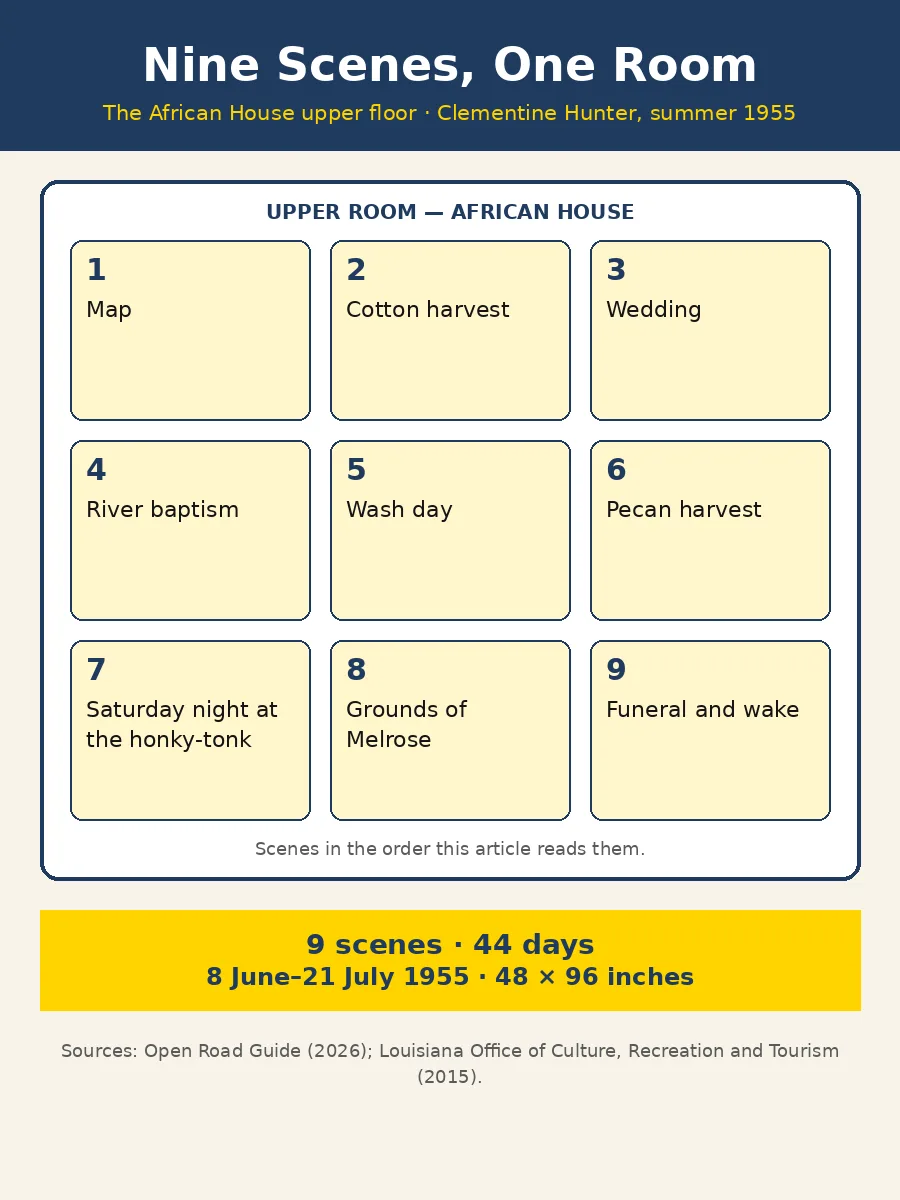
    Large panels ring the upper room, nine of them, with smaller panels between doors and windows. At 48 by 96 inches, the two largest panels set the scale (Louisiana Office of Culture, Recreation and Tourism, 2015).

    Mignon proposed the project in 1955 (Open Road Guide, 2026), and Hunter painted from 8 June to 21 July. Work ran from her own sketches, mostly at night, after her kitchen work ended.

    Eight panels are named scene by scene in the published accounts. Funeral and wake fill the ninth, subjects her paintings return to again and again.

    1. Map: a disc-shaped view of Cane River country, with its cotton, pecans, and churches (Open Road Guide, 2026).
    2. Cotton harvest: the work Hunter knew firsthand, picking 150 to 200 pounds a day for 75 cents.
    3. Wedding: one of the gatherings her paintings return to, beside baptisms and wakes.
    4. River baptism: the river rite that welcomed new members into the church.
    5. Wash day: laundry work done outdoors, in the open air of the plantation yard.
    6. Pecan harvest: the autumn gathering that followed the cotton season.
    7. Saturday night at the honky-tonk: music and dancing after the week’s work ended.
    8. Grounds of Melrose: the plantation buildings and yard Hunter lived among.
    9. Funeral and wake: the community gathers to mourn, as it gathers to celebrate.
    Nine scenes ring one room: map, cotton, wedding, baptism, wash day, pecans, honky-tonk, Melrose grounds, and wake.

    Nine scenes ring one room: map, cotton, wedding, baptism, wash day, pecans, honky-tonk, Melrose grounds, and wake.

    African House itself rose between 1800 and 1830 (SAH Archipedia, 2026). Brick below and timber above, its hipped roof reaches ten feet past the walls.

    Design sources for the building are still debated. Long held African in origin, the house is now read as local practice by some scholars (SAH Archipedia, 2026).

    Together the nine scenes form a room-size narrative, not nine separate pictures. Viewers stand inside the life Hunter remembered, instead of looking at it from outside.

    Panels built for the room carry the scenes, and the room itself is part of the work. Conservation brought the murals down in 2014; the roof was rebuilt in 2015 and new lighting followed in 2016 (Open Road Guide, 2026).

    A Life Before the Brush

    Hidden Hill Plantation was her birthplace, in late December 1886 or early January 1887 (64 Parishes, undated). Eldest of seven children of French-speaking Creoles of color, she grew up near Cloutierville on the river.

    Her time at school lasted under a year, and reading and writing never came. Field work began at eight, picking cotton beside her father.

    The family moved to Melrose Plantation in 1902, when she was about fifteen (Wikipedia, 2026). John Hampton Henry, the plantation owner, had hired her father as a wage laborer (Wikipedia, 2026).

    Six days a week she picked cotton, 150 to 200 pounds a day for 75 cents (Wikipedia, 2026). Pecan harvests filled the autumn, and night classes with other workers filled some evenings.

    Cooking and housekeeping for Cammie Henry came in the late 1920s (Wikipedia, 2026). Creole recipes, clothes, dolls, and the vegetable garden all passed through her hands.

    Two children came with Charles Dupre, and marriage to Emmanuel Hunter followed in 1924 (64 Parishes, undated). Five more children followed, and she spoke only Creole French until her husband taught her American English (Wikipedia, 2026).

    The Melrose Art Colony

    Melrose owes its fame as much to its people as to its buildings. Cammie Henry, widow of John Hampton Henry, turned the plantation into an artists’ colony after her husband died (64 Parishes, undated).

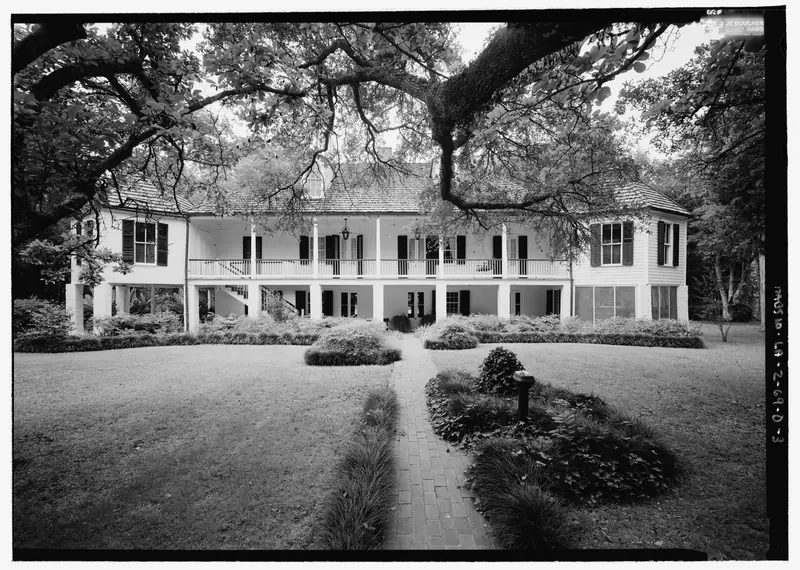
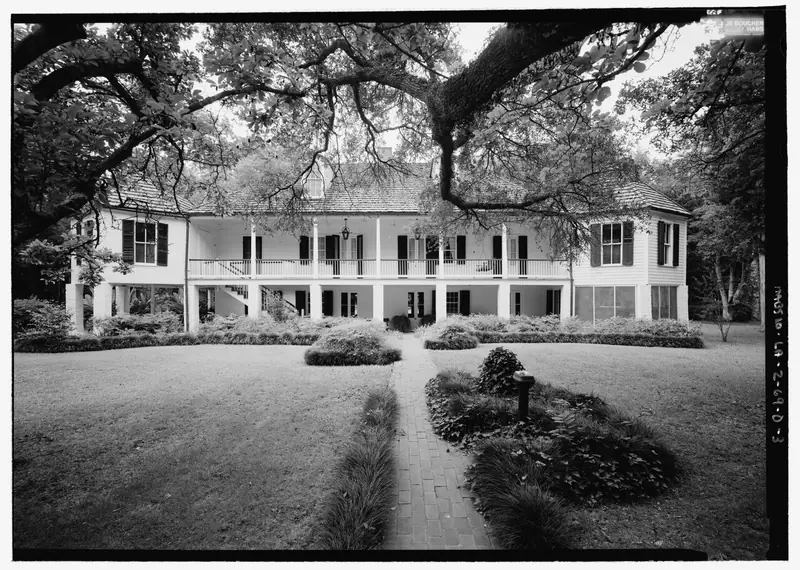
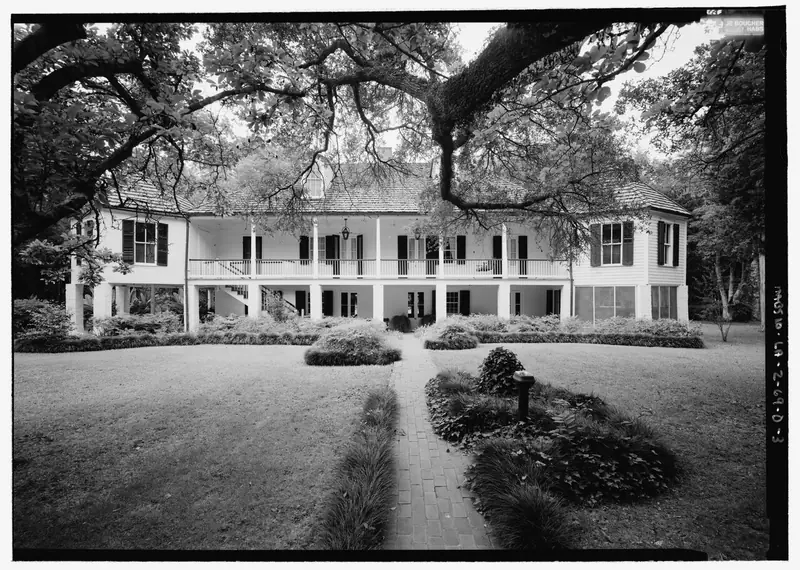
    Big House at Melrose Plantation, built under Louis Métoyer and finished by his son in 1833.

    Big House at Melrose Plantation, built under Louis Métoyer and finished by his son in 1833.

    Source: Historic American Buildings Survey, public domain.

    Artists and writers stayed at Melrose, often in the Yucca House. Guests included Lyle Saxon, Gwen Bristow, Erskine Caldwell, Caroline Dorman, William Faulkner, Alberta Kinsey, William Spratling, and John Steinbeck (SAH Archipedia, 2026).

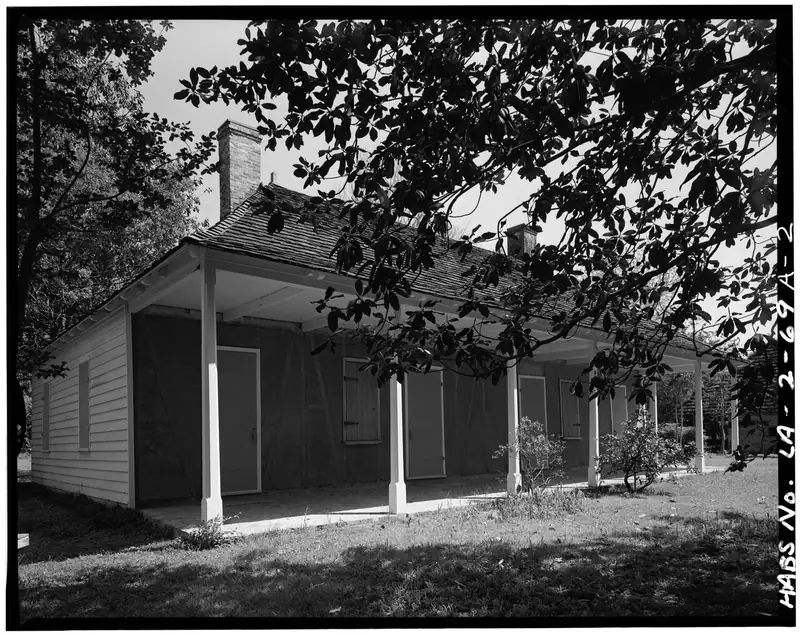
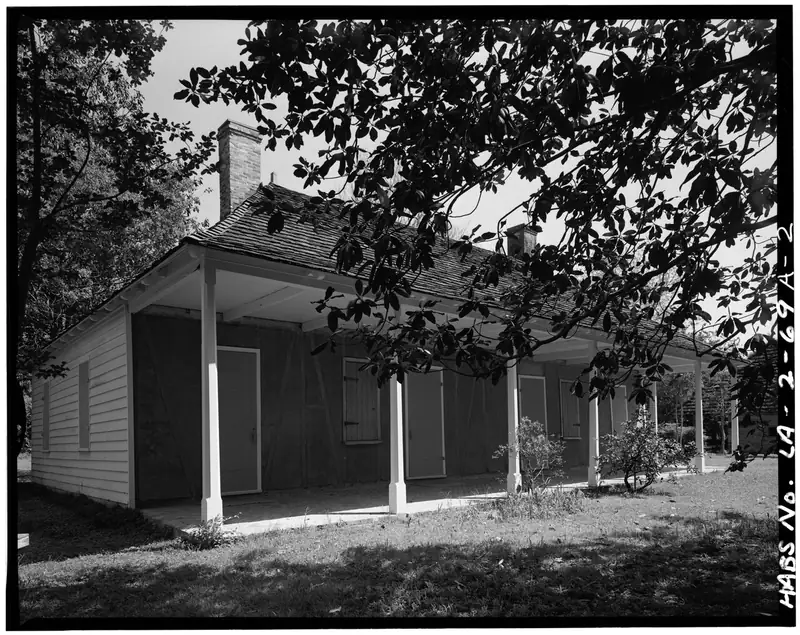
    Yucca House at Melrose, one of the plantation's oldest surviving buildings.

    Yucca House at Melrose, one of the plantation’s oldest surviving buildings.

    Source: Historic American Buildings Survey, public domain.

    Lyle Saxon’s novel Children of Strangers (1937) portrays the Cane River area (SAH Archipedia, 2026). His book carried the river’s story to readers who never saw the plantation.

    At Melrose she worked as an employee, not a guest. Cotton picking, cooking, laundry, and childcare filled her days while the colony’s visitors painted.

    Contact with the visiting artists inspired Hunter to begin marking pictures. Discarded paint tubes left by Alberta Kinsey in 1939 gave her the first materials she painted with (Open Road Guide, 2026).

    Hunter herself said she had painted earlier than that. Kinsey’s visit marks the moment others noticed, not necessarily the moment she began.

    François Mignon: The Man Beside the Murals

    François Mignon served as curator and librarian at Melrose. A friend of Cammie Henry, he arrived for a six-week visit and stayed thirty-two years (SAH Archipedia, 2026).

    Mignon supplied Hunter with paint and materials and promoted her work widely. He hosted her first Cane River Valley show in 1949, in the upstairs African House (Wikipedia, 2026).

    He proposed the African House murals in 1955, and Hunter accepted at an age when most people retire (Open Road Guide, 2026). Together they produced the nine panels that depict the history of the Cane River Valley.

    Cookbook work followed in 1956, when Mignon and Hunter coauthored the Melrose Plantation Cookbook (Wikipedia, 2026). Recipes from her kitchen, photographs of the plantation, and her own illustrations filled its pages (Wikipedia, 2026).

    Warnings travel with Mignon’s name. National Register papers for St Augustine say no primary source proves Louis Métoyer designed the church.

    They suggest Mignon may have supplied the idea (National Register nomination, 2014).

    1955: The Breakthrough Year

    Look magazine gave Hunter national exposure in June 1953 (Open Road Guide, 2026). In 1955 the Delgado Museum gave her a solo show, the first for an African American artist there (64 Parishes, undated).

    Segregation kept her from attending her own opening. Jim Crow law barred her from the room where her work hung.

    That museum is now the New Orleans Museum of Art.

    First shows had come earlier, in Texas in 1945 (Wikipedia, 2026). Rosenwald Grant, Brownwood, and Waco hosted her work before New Orleans did (Wikipedia, 2026).

    Beyond the valley, her work drew notice at a 1949 New Orleans Arts and Crafts Show exhibit (Wikipedia, 2026). Four years later Look carried her name across the country.

    How to Read the Murals

    Memory, not a model, supplied every scene. No model stood before her; the whole valley lived in her head instead.

    Black women stand large in the work, strong and caring, holding the community together (Smithsonian American Art Museum, 2022). Fleming notes that Hunter painted women large and men small (Open Road Guide, 2026).

    Protest runs under the pretty surfaces (Smithsonian American Art Museum, 2022). Race and gender shape the scenes, and the paintings carry undertones the artist never announced outright.

    Religion anchors the cycle. Revival meetings, weddings, wakes, funerals, and crucifixion scenes mark the community’s calendar of faith (64 Parishes, undated).

    What the murals leave out matters as much as what they show. No white guest of the salon appears on the walls; the room belongs to the Black community alone.

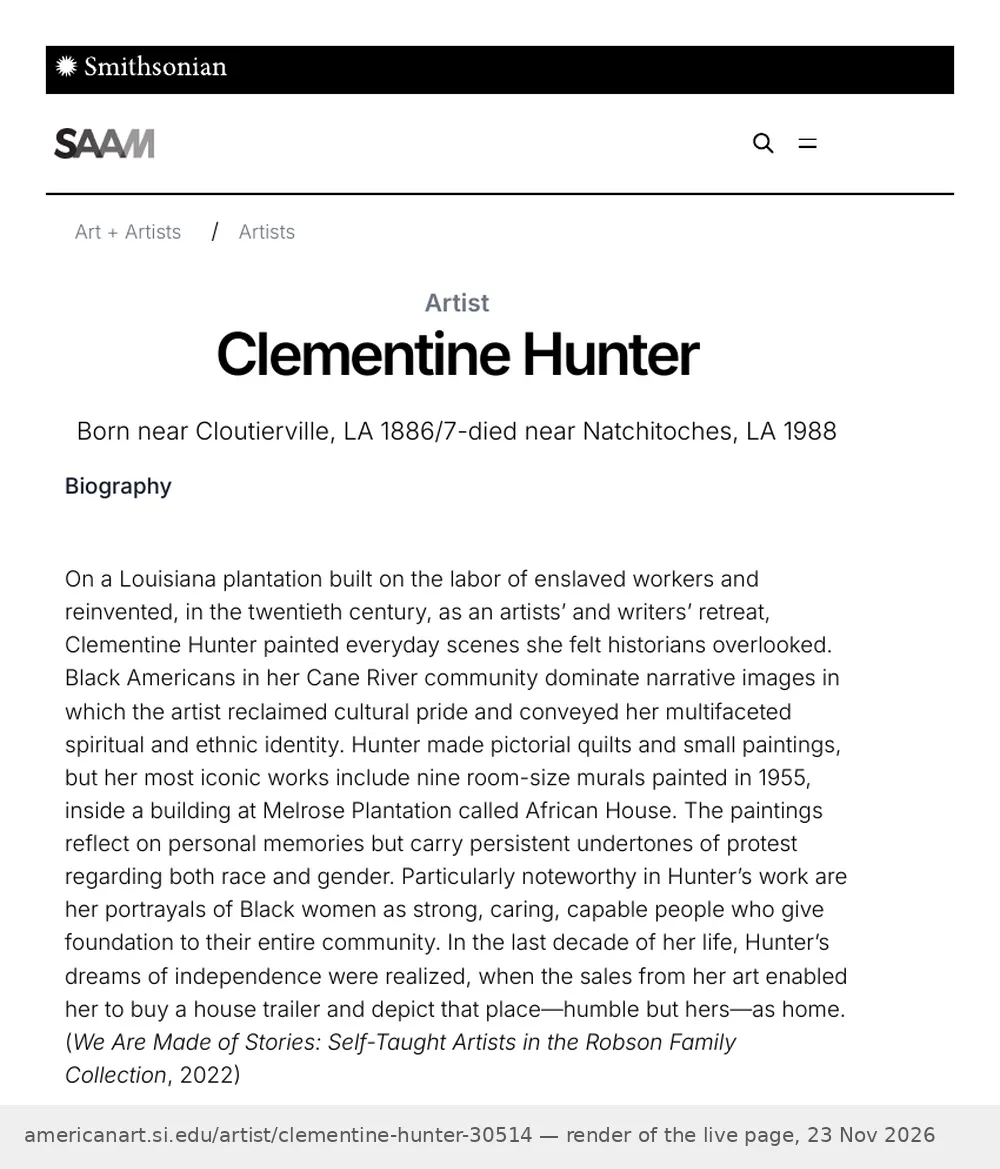
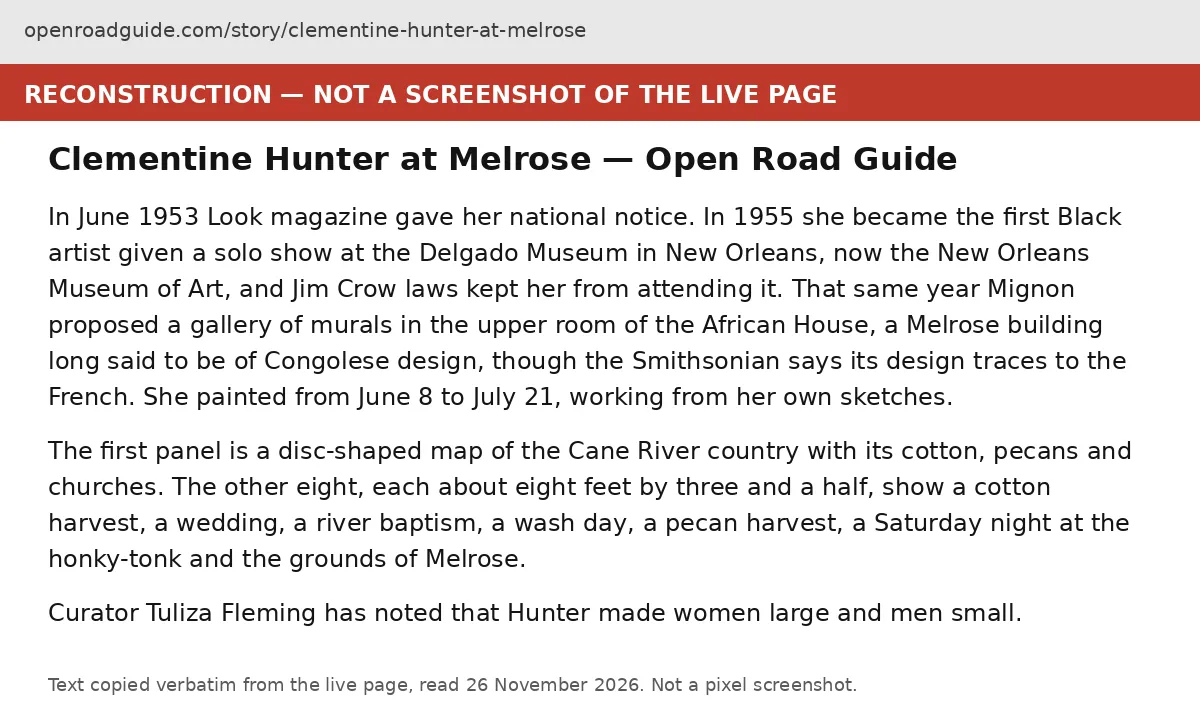
    Smithsonian calls the nine murals Hunter's most iconic work, painted in 1955.

    Smithsonian calls the nine murals Hunter’s most iconic work, painted in 1955.

    Source: Smithsonian American Art Museum, Clementine Hunter (render of the live page, 23 November 2026).

    Two Counts of One Summer

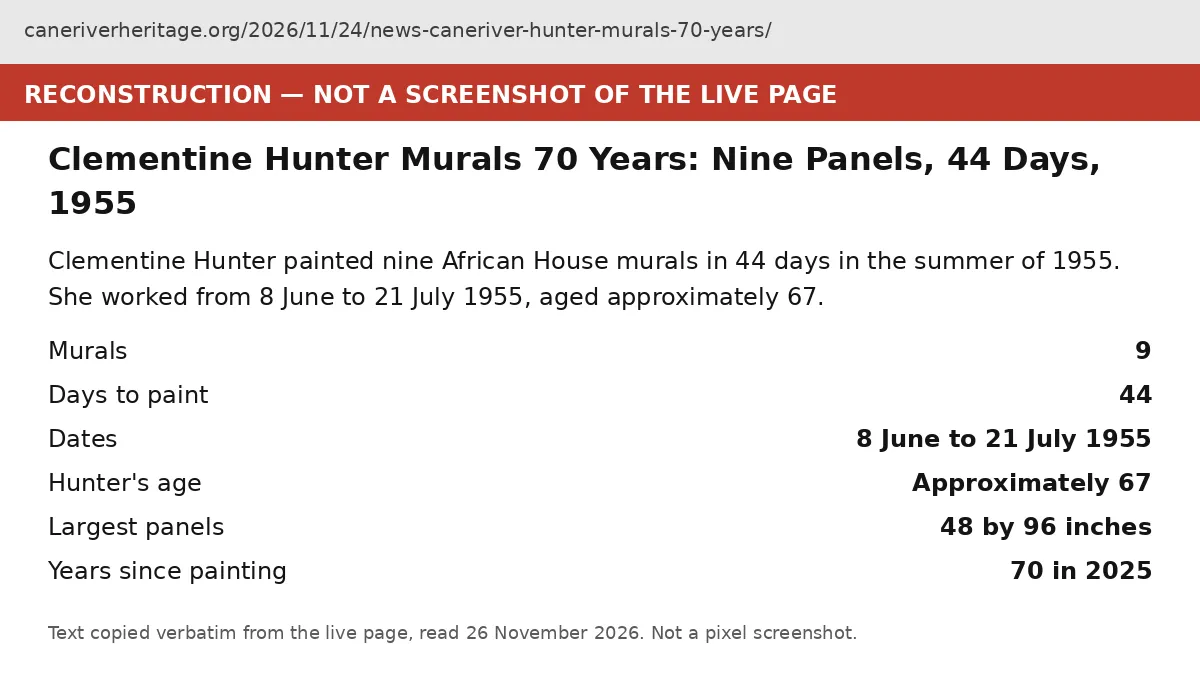
    Counts of the same summer differ, and this article follows the dated one. Dated 8 June–21 July 1955, the work spans 44 days (Louisiana Office of Culture, Recreation and Tourism, 2015).

    Those dates come from the press release (Louisiana Office of Culture, Recreation and Tourism, 2015). About 67 that summer, she worked mostly at night.

    Another account stretches the work to three months and puts her age at 68 (Wikipedia, 2026).

    Dated days beat round months as evidence. This article keeps the 44 days, and it records the disagreement here instead of hiding it (Louisiana Office of Culture, Recreation and Tourism, 2015).

    Open Road Guide names eight scenes and dates the painting 8 June to 21 July 1955.

    Open Road Guide names eight scenes and dates the painting 8 June to 21 July 1955.

    Source: Open Road Guide, Clementine Hunter at Melrose (reconstruction).

    After 1955: Recognition and Return

    Honours accumulated late. An honorary Doctor of Fine Arts came from Northwestern State University in 1986 (Wikipedia, 2026).

    Cane River Baptism sold for 19,980 dollars at a New Orleans auction in 2007 (Open Road Guide, 2026). That price set a record for her work at the time.

    She turned down a White House invitation from President Jimmy Carter. Travel outside Louisiana did not appeal to her, so the honour stayed unclaimed (Open Road Guide, 2026).

    Death came on 1 January 1988, when she was about 101 (Open Road Guide, 2026). Lifetime output runs past 5,000 paintings (64 Parishes, undated), with some estimates reaching 10,000 (Wikipedia, 2026).

    In 2025 the murals marked seventy years, and they still tell the Black community’s story on Cane River (Smithsonian American Art Museum, 2022). Our news report on the 70th anniversary carries the counts behind the panels: Clementine Hunter Murals 70 Years: Nine Panels, 44 Days, 1955.

    Our 24 November report carries the counts: nine panels, 44 days, 1955.

    Our 24 November report carries the counts: nine panels, 44 days, 1955.

    Source: Cane River Heritage, Clementine Hunter Murals 70 Years (reconstruction).

    Before You Visit

    South of Natchitoches stands the plantation Hunter painted for a lifetime. Check the plantation’s own pages before travelling, since hours and access change.

    African House murals hang where Hunter painted them, on the upper floor. Photography rules, tour times, and entry fees change, so confirm them before you go.

    The Room Still Speaks

    Panels turned one worker’s memory into a public record. Museums do not own the room; the plantation keeps it, and the river keeps the story.

    Go to Melrose to stand inside the work, not just to look at it. Standing inside the work, rather than looking at it, is the point of everything Hunter painted.

    Frequently Asked Questions

    How many murals did Hunter paint in the African House?

    Large panels number nine, plus smaller panels between doors and windows on the upper floor. Two of the nine panels (Louisiana Office of Culture, Recreation and Tourism, 2015) run 48 by 96 inches; the rest fall just short.

    How long did Hunter take to paint them?

    Forty-four days covered the work (Louisiana Office of Culture, Recreation and Tourism, 2015), from 8 June to 21 July 1955. Night work carried most of it, with scenes painted from memory.

    Who was François Mignon?

    Curator and librarian at Melrose, he was a friend of Cammie Henry. His thirty-two years at Melrose included proposing the murals, supplying Hunter with paint, and promoting her work.

    Was Hunter a guest of the art colony?

    Employee, not guest, describes her place at Melrose. Picking cotton, cooking, laundry, and childcare filled her days while visitors painted.

    Where can the murals be seen today?

    Still in the African House at Melrose Plantation, the murals hang where they were painted. Conservation work in 2014–2016 took them down and returned them to the upper floor (Open Road Guide, 2026).

    Methodology

    Seven sources read in full stand behind this article, all opened in November 2026. Smithsonian, 64 Parishes, SAH Archipedia, and Open Road Guide supplied the facts, with Wikipedia as a secondary check.

    Dates and figures were verified one by one against those sources on 26 November 2026. When sources disagreed about the summer of 1955, both sides appear here instead of a single verdict.

    Limits: the Louisiana culture office press release was read through the live news report quoting it, after a rate limit blocked the direct open. One caution about Mignon comes from the gate-passed St Augustine draft’s reading of the National Register nomination, not from a fresh opening.

    References

    1. Clementine Hunter — Smithsonian American Art Museum
    2. Clementine Hunter — 64 Parishes
    3. Clementine Hunter — Wikipedia
    4. Melrose Plantation — SAH Archipedia
    5. Clementine Hunter at Melrose — Open Road Guide
    6. Clementine Hunter Murals — Louisiana Office of Culture, Recreation and Tourism
    7. St. Augustine Catholic Church and Cemetery — National Register of Historic Places Inventory-Nomination Form (National Park Service)
  • Creole Music of Cane River: 7 Stages From Juré to Zydeco

    Creole Music of Cane River: 7 Stages From Juré to Zydeco

    On Cane River, Creole music started with nothing but voices. No instrument joined them, only hands clapping and feet stamping time.

    That bare sound has a name: juré singing. It comes from the French jurer, meaning to testify, and it still shapes every Creole dance tune on the river.

    This guide follows the sound from its first shouted verses to the zydeco bands of today. Along the way it names the singers, the instruments, and the dance floors that carried it.

    Behind this music stand the people and places of Cane River Creole Culture and History. Figures in this article point to Cane River Creole in Numbers 2026 wherever a count appears.

    Summary

    • Juré singing is unaccompanied call-and-response, sung in French or Louisiana Creole to handclaps and foot stomps.
    • House dances carried juré into la la, an accordion dance music of one-steps, two-steps, and waltzes.
    • Born near Basile in 1898, Ardoin put that sound on Columbia records in 1929.
    • Clifton Chenier built zydeco from la la and juré in the early 1950s, adding the vest frottoir and electric instruments to the old dance sound.
    • Cane River still hears the tradition at its park music festival, begun in 2010, and at church dances and trail rides.

    What Juré Singing Is

    Juré singing means voices and nothing else (National Park Service, 2019). One lead singer calls a line, the group answers, and hands and feet keep the beat.

    French gives the form its name. Jurer means to testify, and the songs testify in French or Louisiana Creole.

    Rhythms behind the voices came from Afro-Caribbean traditions (National Park Service, 2019). Themes ran both ways, sacred and worldly, sometimes inside one song.

    Lent gave juré its season (Genrology, 2026). Instruments and dance halls were frowned upon then, so singing carried the community through the fast.

    Voices carried farther than instruments could. Kouri-Vini, the French-based Creole language of Louisiana, gave many juré songs their words.

    Fewer than 10,000 people speak Kouri-Vini today, and about 5,000 speak it as a first language (Cane River Heritage, 2026).

    National Park Service page about juré singing and the Cane River Music Festival

    According to the National Park Service page, juré singing is defined and the park music festival dates to 2010. Re-rendered page text here; it is not an original screenshot.

    Where Juré Came From

    Ring shouts stand behind juré. Enslaved Africans and their descendants sang them in circles, clapping and stomping while a leader called and the circle answered.

    New Orleans gave the shout a public square. Congo Square hosted Sunday gatherings from 1817, with calenda, Congo, counjai, and bamboula dances from the Caribbean and Africa (Genrology, 2026).

    White opposition ended the square’s prominence by 1830. Upcountry, the shout lived on in simpler forms, and juré became its French-language voice.

    Lomax’s 1934 recording from Jennings, Louisiana, preserves a ring shout (Genrology, 2026). Field recordings like his kept the sound on record long before juré reached a stage.

    Social need shaped the music as much as African memory did. Jim Hobbs, a librarian at Loyola University New Orleans, calls Creole music social music above all (National Park Service, 2019).

    Farm work filled the week, and Saturday dancing emptied it. Music gave neighbours a reason to gather, and gathering gave the music its reason to live.

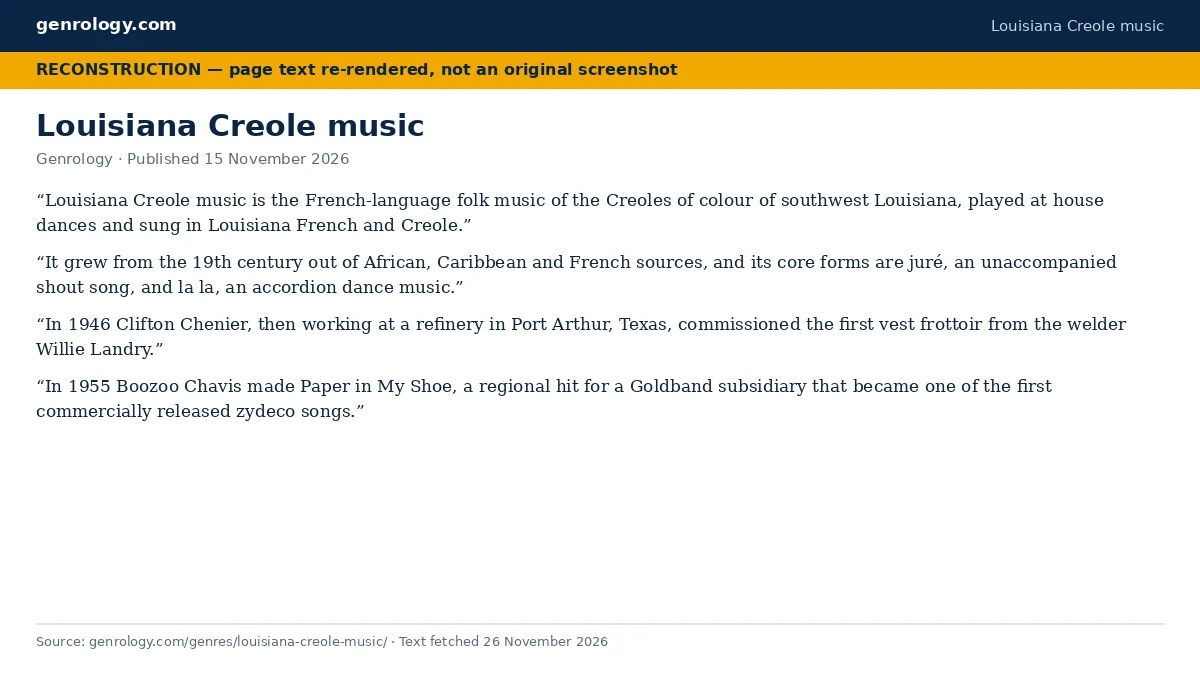
    Genrology page about Louisiana Creole music

    Genrology traces Louisiana Creole music from juré and la la to zydeco, naming Chenier’s 1946 frottoir and Chavis’s 1955 record. Page text re-rendered here; it is not an original screenshot.

    Seven Stages From Juré to Zydeco

    Seven stages carry the story from bare voices to electric zydeco. Each stage kept something from the one before it, and each one added a sound the river had not heard.

    StageWhenWhat changed
    Juré, voices only1800sCall-and-response singing, no instruments, French or Kouri-Vini words
    Saturday house dancesEarly 1900sFamilies clear a room, neighbours gather, a horseman rides out to announce the dance
    La la takes the accordion1920sOne-row button accordion leads one-steps, two-steps, and waltzes beside the fiddle
    Ardoin records1929–1930Columbia sessions in New Orleans put Creole accordion music on records for a national audience
    Dance halls replace house dances1930sKirk Hall and Wood Hall draw Creole crowds, and Sunday dances fill Isle Brevelle
    Chenier builds zydeco1946–1955Vest frottoir, blues, and rhythm and blues turn la la into a louder dance-band sound
    Festival era2010–todayPark festival, church dances, and trail rides carry the tradition to new listeners

    Seven stages from juré to zydeco (Table 1). Dates follow the National Park Service and Genrology.

    Seven stages carry Creole music from juré singing to zydeco

    From juré singing to zydeco, seven stages carry Creole music from bare voices in the 1800s to the park festival of today.

    Notice what never disappears. Call-and-response survives in zydeco choruses, and the frottoir still scrapes the beat hands once clapped.

    Dancing explains the changes better than recording does. Every new instrument arrived because dancers wanted a louder floor, not because musicians tired of the old sound.

    Amédé Ardoin: The Voice That Left Home

    Rougeau Farm, near Basile, Louisiana, was Ardoin’s birthplace in 1898 (National Park Service, 2019). He grew up in a French-speaking Black Creole farming family, and he spoke no English.

    A high voice and swinging rhythm set him apart from every other player on the floor. Self-taught on the accordion, he played house dances with fiddlers while still young.

    New Orleans hosted his first Columbia Records session in 1929, and it produced his first solo album (National Park Service, 2019). Six songs from the December 1929 session were among the first Acadiana recordings, and more sessions with McGee followed in 1930 (Genrology, 2026).

    Ardoin and McGee had met as children, working on a farm near Eunice. In the segregated South, those records found listeners across the colour line.

    About three dozen Ardoin recordings survive, on Brunswick, Vocalion, Decca, Melotone, and Bluebird (Genrology, 2026). European song forms mixed with African swing in his playing, and that mix set the template for Creole and Cajun music alike.

    Acadiana, not Cane River, was Ardoin’s home ground. Yet his records remade the music Cane River dances to, so his story belongs in this guide.

    Violence cut his career short. Relatives and fellow players said he was beaten in a racial attack around 1939 and never fully recovered (Genrology, 2026).

    Reports of his death in 1942 differ from one another. What no account disputes is the debt later players owe him: his songs remain core repertoire for Creole and Cajun musicians.

    Amédé Ardoin in 1912

    Amédé Ardoin in 1912, the only known photograph of him.

    La La: The House-Dance Sound

    La la is the sound of a cleared front room. An accordion leads, a fiddle answers, and a triangle rings above the dancers’ feet.

    German makers built the one-row button accordion for this music. By the 1920s it came in the keys of C and D, so it could pair with the fiddle (Genrology, 2026).

    One-steps, two-steps, and waltzes filled the evening. Until the Second World War, the repertoires ran close together, and Creole players often played for white audiences.

    Parish halls, rural dance halls, and nightclubs took over from house parties (Genrology, 2026). Saturday dances stayed the heart of the week, wherever the floor stood.

    Kitchens and dance floors kept French alive after schools banned it. Louisiana’s 1864 constitution ordered English-only schooling, and the bans of 1916 and 1921 kept French out of classrooms (National Park Service, 2019).

    Only the 1974 constitution acknowledged the right to preserve French origins. Song, not schoolbooks, had carried the language for a century by then.

    Zydeco: The New Name for an Old Party

    Zydeco grew from la la and juré in the early 1950s. Blues, rhythm and blues, jazz, and gospel joined the old dance tunes, and electric instruments followed.

    Opelousas country produced the man who led the change. Working at a refinery in Port Arthur, Texas, Clifton Chenier commissioned the first vest frottoir in 1946 (Genrology, 2026).

    Welder Willie Landry built that first rubboard from corrugated metal. Worn on the chest, it became zydeco’s signature percussion.

    Boozoo Chavis cut Paper in My Shoe in 1955. A Goldband subsidiary released it in 1955, among the earliest zydeco songs sold commercially (Genrology, 2026).

    Spelling followed sound. Musicologist Mack McCormick used zydeco in 1960 liner notes.

    Its likely source is les haricots ne sont pas salés, an idiom for hardship (Genrology, 2026).

    Mainstream success arrived in 1983, when Chenier won a Grammy Award (Genrology, 2026). Rounder Records later released Chavis through the 1980s and 1990s, and zydeco acts now play roots festivals worldwide.

    Do not mistake zydeco for the whole Creole tradition. La la and juré still live beside their electrified child, played in the old style at festivals and family dances.

    Creole and Cajun Are Not the Same Sound

    Two traditions share a dance floor here, but they are not the same thing. They overlapped heavily before the Second World War, then split into separate dance-band sounds.

    Acadian settlers farther south built the Cajun tradition. African American rhythm and the blues run through Creole music, and that weight pulled it toward zydeco.

    Ardoin’s songs belong to both repertoires. Fiddler Canray Fontenot and accordionist Alphonse Ardoin kept the old house-dance style alive on records and film into the 1990s (Genrology, 2026).

    Listeners who want the old style should start with the Fontenot-Ardoin duo. Folklorist Ralph Rinzler arranged their 1966 Newport appearance, which carried house-dance music outside Louisiana for the first time (Genrology, 2026).

    Where to Hear It Today

    Cane River Creole National Historical Park began its music festival in 2010 (National Park Service, 2019). Held annually at Oakland Plantation, it features local artists on the ground the music came from.

    Goldman Thibodeaux and the Lawtell Playboys played the 2010 festival (National Park Service, 2019). Cheesebox guitars, rare and round-bodied, appeared at the 2012 festival, a reminder that homemade instruments still shape the sound.

    Between festivals, the music lives on at church dances and trail rides. The St Augustine fair brings zydeco back to Isle Brevelle each October.

    Hunter’s paintings show the singers of this music, at house dances and church gatherings. Her nine African House murals hang at Melrose, a short drive from the festival grounds.

    Contemporary bands play traditional Creole music with new influences. Electric guitar and drums now join the accordion, yet the call-and-response heart stays audible.

    Before You Listen

    Start with a juré recording, then a la la two-step, then a zydeco band. Hearing the three in order makes the family resemblance hard to miss.

    Check the park’s own pages before travelling, since festival dates change. Hours, prices, and addresses are skipped here; all three change too often to print.

    The Sound Carries On

    Testimony without instruments became house-dance music, then records, then zydeco. It still gathers neighbours on a Saturday night, on ground their grandparents danced.

    Keep listening for the voices underneath the accordion. They are the oldest sound on Cane River, and they have never stopped.

    Frequently Asked Questions

    What is juré singing?

    Unaccompanied call-and-response, sung in French or Louisiana Creole, is juré singing. Hands and feet provide the rhythm, and the name comes from the French jurer, meaning to testify.

    How is la la different from zydeco?

    Early twentieth-century house-dance music, led by a one-row accordion and fiddle, is la la. From that house-dance base came zydeco, plugging in electric instruments and adding the vest frottoir to blues and rhythm and blues.

    Who was Amédé Ardoin?

    Born in 1898 near Basile, Ardoin sang and played accordion, cutting his first Columbia sides in New Orleans in 1929. Local players still call him the father of French music, and his songs sit at the core of both repertoires.

    Is Creole music the same as Cajun music?

    The two traditions overlapped heavily before the Second World War, then split apart. Creole music carries African American rhythm and the blues, while Cajun music descends from Acadian settlers farther south.

    Where can I hear Creole music on Cane River today?

    Start at the park music festival at Oakland Plantation, held annually since 2010. Church dances, trail rides, and the St Augustine fair in October carry the same tradition.

    Methodology

    National Park Service pages supplied the Cane River facts, and Genrology supplied the wider Louisiana lineage. Speaker counts for Kouri-Vini come from the site’s statistics article, linked in the text.

    Verification ran on 26 November 2026: every date and figure below traces to at least one of the two sources read in full. When sources disagreed, both versions appear here and the reader can judge.

    Limits: no verified attendance figures exist for the park festival or the St Augustine fair. His death in 1942 is reported differently by different accounts, so this article gives the year both agree on.

    References

    1. Cane River Music Festival — National Park Service
    2. Louisiana Creole music — Genrology
    3. Cane River Creole in Numbers 2026 — Cane River Heritage
  • Kouri-Vini: The Endangered Language of the Cane River Creoles

    Kouri-Vini: The Endangered Language of the Cane River Creoles

    Say the name slowly, and it runs: Kouri-Vini, from the French verbs for “to run” and “to come”.

    Fewer than 10,000 people still speak it as a native tongue.

    About 5,000 of them learned it first, at home, before any other language.

    This river once spoke it too, from the founding of Natchitoches to the last generation of fluent elders.

    Summary

    • Under ten thousand native speakers remain as of 2023, about five thousand of them first-language (Wendte, 2024).
    • Its name comes from the Creole pronunciation of the French verbs “courir” (to run) and “venir” (to come).
    • Born from French words and West African grammar on Louisiana plantations in the 18th century.
    • UNESCO lists it as severely endangered, and the EGIDS scale rates it 8a, Moribund.
    • Speakers cluster in three pockets of south Louisiana, while Cane River has nearly stopped passing it to children.
    • A revival movement now teaches younger speakers through classes, music, radio, and an online guide.

    How Many Speakers Are Left

    Start with the count, because the count frames everything else.

    Wendte’s 2023 count puts native speakers under ten thousand (Wendte, 2024).

    Several hundred more use it as a second language, while roughly five thousand speak it from birth (Mayeux, 2019, in Wendte, 2024).

    Nathan Wendte’s 2024 language snapshot, in Language Documentation and Description, supplies the figures.

    MeasureFigure
    Native speakersFewer than 10,000 (2023)
    First-language speakersAbout 5,000 (2019)
    Second-language usersSeveral hundred (2019)
    EGIDS vitality rating8a, Moribund
    UNESCO listingSeverely Endangered
    Table 1. Kouri-Vini speaker figures.

    Under 10,000 people still speak Kouri-Vini, and about 5,000 learned it first. EGIDS rates it 8a, Moribund, and UNESCO lists it as severely endangered.

    Every figure above comes from the same snapshot, and the first-language figure rests on Mayeux’s 2019 estimate.

    No count exists for Natchitoches Parish alone, so the statewide figures stand here.

    What Kouri-Vini Is

    Kouri-Vini grew from French words and African grammar on the plantations of 18th-century Louisiana, and it belongs to no other place.

    Enslaved Africans from many peoples needed one tongue to speak to each other, and French supplied the words.

    Their own languages supplied much of the grammar, and the mixture hardened into a full language within a few generations.

    That makes Kouri-Vini a creole language, not a dialect of French.

    Louisiana French is its sister, not its twin: a dialect of French, carried by white Creoles and Cajuns alike.

    Confusing the two hides the story, since one grew from the plantation and the other from the colony.

    A Name That Means “To Run, To Come”

    For most of its life, the language had no single name.

    Speakers called it Kréyòl most often, and French speakers called it Créole.

    Both names blurred into everything else called Creole: the people, the food, the music, the houses.

    Language activists in the 2010s began promoting “Kouri-Vini” to end that blur.

    Creole speakers turned the French verbs “courir” (to run) and “venir” (to come) into the name (BBC Travel, 2023).

    Today the name marks the language as its own thing, separate from the ethnicity and the cuisine.

    Born on the Plantations

    Louisiana came under French rule in 1699, and plantations followed within a generation.

    Enslaved labourers arrived from many West African peoples, each with its own tongue.

    French served as the shared vocabulary, and African grammar shaped how the words fit together.

    Pidgin carried the first conversations, and children born on the plantations turned it into a creole.

    By the late 18th century, the language belonged to the whole colony, spoken by Black, white, mixed, and Native Louisianans alike.

    How the Language Was Silenced

    Stigma did the damage first, and law finished it.

    Slavery tied Kouri-Vini to the plantation in white minds, and speakers learned to hide it for fear of ridicule.

    After the Louisiana Purchase, American officials pushed English, and French tongues of every kind lost ground.

    Louisiana’s 1921 constitution made English the language of public schools, and French vanished from classrooms (Wikipedia, 2026).

    Children who spoke Creole at school faced punishment, fines, and public shame.

    Parents stopped teaching it, hoping English would open doors for their children.

    Each generation spoke less, and the youngest fluent speakers are now the exception.

    Where Speakers Remain

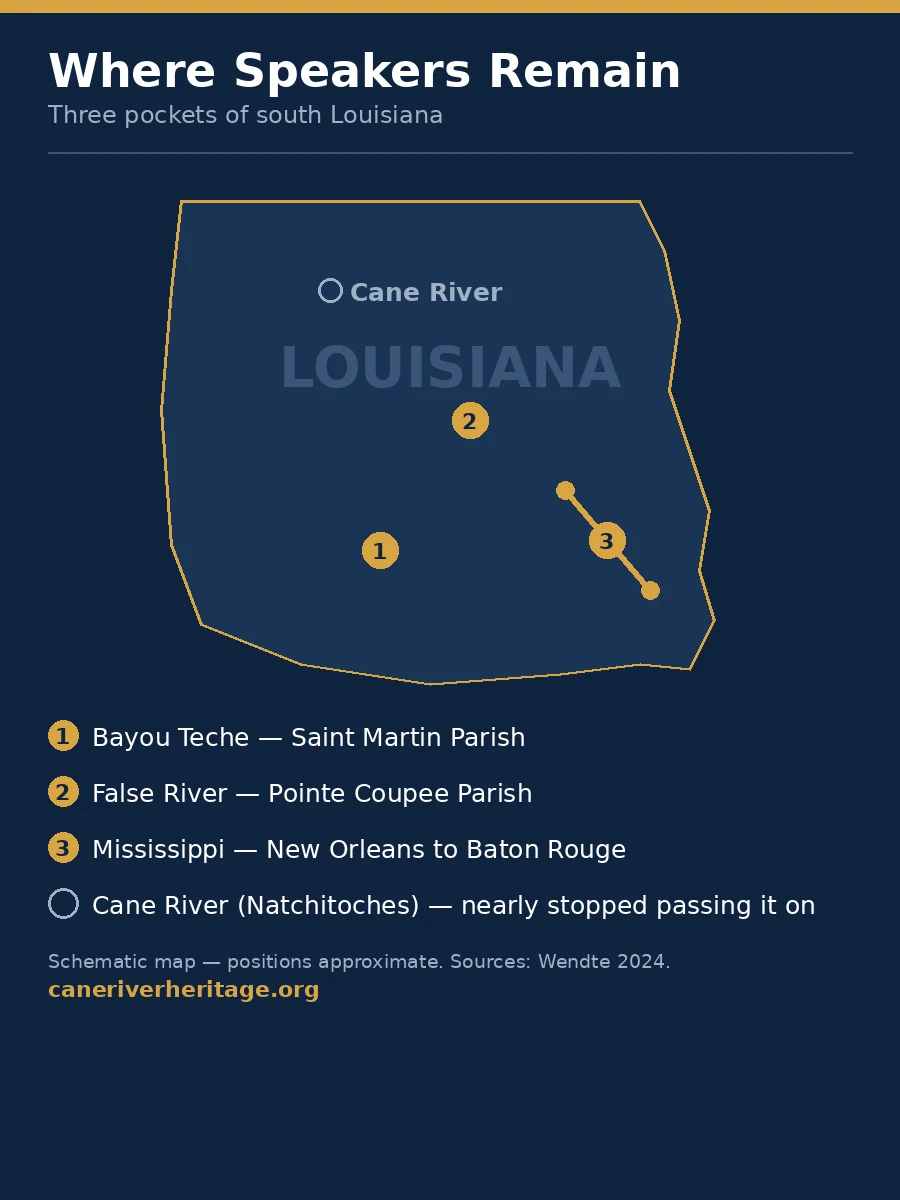
    Three pockets hold most of the remaining speakers, all of them south of Cane River.

    One pocket follows Bayou Teche through Saint Martin Parish, and a second follows False River through Pointe Coupee Parish.

    Down the Mississippi, one more pocket runs from New Orleans toward Baton Rouge (Wendte, 2024).

    Natchitoches once spoke Creole from its founding, but parents there have nearly stopped passing it to their children (Wendte, 2024).

    Cane River keeps the records, the family names, and the songs, while the living speech has moved south.

    Most remaining speakers cluster in three pockets of south Louisiana. Cane River keeps the records, the family names, and the songs, while the living speech has moved south.

    The Revival

    Decline is not the whole story, because a revival movement now pushes the other way.

    Wendte calls that movement established, and its classes have turned out many fluent young voices even as elder speakers age (Wendte, 2024).

    C.R.E.O.L.E., Inc., founded in Lafayette in 1982, preserves Creole heritage, and founder Herbert Wiltz hosted a table where learners practiced Kouri-Vini (BBC Travel, 2023).

    Chinbo, Inc., works to reclaim the language through teaching and community events.

    Music carries it furthest: Cedric Watson sings in Kouri-Vini and hosts “La Nation Créole” on Lafayette radio station KRVS-88.7.

    Linguist Oliver Mayeux, himself the son of a Louisiana Creole, champions the language as a mark of survival.

    A first online guide appeared in 2016, and young Louisianans now learn the tongue their grandparents were punished for speaking.

    Kouri-Vini at Cane River

    The river holds a special place in this story, as the home of the language’s northern memory.

    Northwestern State University built the Creole Heritage Center in 1998 to gather the records of Louisiana Creole families.

    In 2008 the center launched a movement to document Louisiana Creole itself, not Louisiana French (64 Parishes, 2026).

    Its resource library holds more than 5,000 items (Northwestern State University, 2026). More than 9,500 names fill the family database, the university reported in a May 2026 press release.

    Albert Valdman of Indiana University published a Dictionary of Louisiana Creole in 1998, giving the language a printed record.

    Today the center’s work keeps Cane River’s Creole past searchable, even as the spoken language fades from the parish.

    How to Hear It Today

    Start with music, since musicians led the revival.

    Cedric Watson’s albums sing in Kouri-Vini, and his radio show plays Creole music from Louisiana, Haiti, and Guadeloupe.

    Classes run through Chinbo’s community programs and through the Louisiana Historic & Cultural Vistas online courses (BBC Travel, 2023).

    Online guides and dictionaries now let a beginner learn the first words without leaving home.

    The town offers the quieter path: the Creole Heritage Center, the family records, and the church where the language once filled the pews.

    Frequently Asked Questions

    How many people speak Kouri-Vini?

    Fewer than 10,000 native speakers as of 2023, with about 5,000 speaking it as a first language (Wendte, 2024).

    What does “Kouri-Vini” mean?

    It comes from the Creole pronunciation of the French verbs “courir” (to run) and “venir” (to come).

    Is Kouri-Vini the same as Cajun French?

    No, Kouri-Vini is a French-based creole language, while Cajun French is a dialect of French.

    Is Kouri-Vini still spoken on Cane River?

    Yes, from its founding — but parents there have nearly stopped passing it to their children.

    Who is keeping the language alive?

    Classes from Chinbo’s community programs and the Louisiana Historic & Cultural Vistas online courses (BBC Travel, 2023). Cedric Watson keeps it in music, and the Creole Heritage Center keeps its records.

    Methodology

    Every date and figure in this article comes from a named source, and each source appears in the References below.

    Speaker figures rest on Nathan Wendte’s 2024 language snapshot, read in November 2026, with first-language numbers from Mayeux’s 2019 estimate inside it.

    History of the language rests on the Louisiana Creole encyclopedia entry and on 64 Parishes.

    Revival details rest on the BBC Travel profile of Cedric Watson and on 64 Parishes.

    Search volume, keyword difficulty, and cost per click for the target phrase remain unverified, and no figure of that kind appears here.

    Where sources disagree, the article prints the firmer record and names the other account.

    References

    1. Louisiana Creole (Louisiana, USA) — Language Snapshot, Wendte 2024
    2. Louisiana Creole, Wikipedia
    3. Kouri-Vini: The return of the US’ lost language, BBC Travel
    4. Creoles, 64 Parishes
    5. Francophone Louisiana, 64 Parishes
    6. Creole Heritage Center — Northwestern State University of Louisiana
    7. May 26 NGHA talk will focus on resources at NSU’s Creole Heritage Center, Northwestern State University
    8. Cane River Creole Culture and History: The Complete Guide, Cane River Heritage
    9. Cane River Creole in Numbers 2026, Cane River Heritage
    10. Kouri-Vini Counts About 5,000 First-Language Speakers, Wendte Snapshot Finds, Cane River Heritage
  • Creole vs Cajun on Cane River: What Makes Cane River Creole Different

    Creole vs Cajun on Cane River: What Makes Cane River Creole Different

    Order gumbo in Natchitoches, and the cook may correct you before the bowl arrives.

    Call the food Cajun, and the answer comes back fast: no, it is Creole, and Cane River Creole at that.

    Louisiana hands visitors two words that sound interchangeable, then punishes anyone who swaps them.

    Most guides stop at two peoples, Cajun and Creole, and treat the difference as a matter of tomatoes.

    Here a third party joins the comparison, and it changes the whole picture.

    Summary

    • “Cajun” comes from “Acadien”: French settlers expelled from Canada between 1755 and 1763, about 3,000 of whom reached south Louisiana.
    • Anyone born in the Louisiana colony, of any race, first counted as Creole, and only later did the word narrow to New Orleans families.
    • At Isle Brevelle, a farming community of free people of color grew Cane River Creole, not a port city.
    • Natchitoches dates to 1714, four years before New Orleans and four decades before the Acadian expulsion.
    • Food gives the quickest test: Creole gumbo takes tomatoes, Cajun gumbo does not, and Cane River keeps its own table.
    • Language gives the deeper test: Kouri-Vini, Cajun French, and Louisiana French are three different tongues.

    Two Words, One Confusion

    Start with the words themselves, because the confusion lives inside them.

    “Creole” began as a birthplace, not a bloodline.

    In colonial Louisiana, a child born in the colony was Creole, whether the parents were French, Spanish, African, or mixed (64 Parishes, 2026).

    A white planter’s son in New Orleans counted as Creole. So did an enslaved child born on a River Parish plantation.

    Only after 1803 did the label shrink toward the mixed-race, French-speaking Catholic families of New Orleans and the River Parishes.

    From a place name to a people: that is the road “Cajun” took.

    “Acadien” named the French colonists of Acadia, in what is now Nova Scotia, New Brunswick, and Prince Edward Island.

    British officers expelled more than 10,000 of them between 1755 and 1763, in the forced removal called Le Grand Dérangement.

    “Acadien” softened in Louisiana mouths to “Cadien”, then to “Cajun”.

    One word describes where a person was born, and the other describes where a person was driven from.

    The Acadians Arrive Late

    Timing alone separates the two stories by two generations.

    French traders founded Natchitoches in 1714, on the Red River in present-day north Louisiana.

    Four years later, in 1718, French engineers laid out New Orleans at the Mississippi.

    Acadians began arriving only in the 1760s, after years of wandering through the American colonies, England, and France.

    Spanish officials welcomed the exiles in the 1760s, and Governor Luis de Unzaga placed them on riverfronts and swamps the colony needed settled.

    Roughly 3,000 reached south-central Louisiana, where they built homes on stilts and learned the pirogue (64 Parishes, 2026).

    By then, Natchitoches already had a church, a fort, farms, and a Creole community taking shape.

    Acadiana is younger than Creole Louisiana by half a century, and the gap matters.

    New Orleans Creole: A Port City Culture

    New Orleans made Creole culture urban, layered, and tied to trade.

    French officials, Spanish merchants, enslaved Africans, Caribbean immigrants, and later Germans and Italians all came through the same docks.

    Free people of color in the city held property, spoke polished French, and took part in civic life decades before emancipation.

    Spain ruled the city from 1763 to 1803, and the United States bought it in 1803.

    Wealth from sugar and cotton paid for restaurants, townhouses, and a cuisine built on imports.

    Butter, tomatoes, seafood, and wine reached city tables that country kitchens never saw.

    City kitchens made it layered and refined, seasoned with what the port could supply.

    Cane River Creole: A Farming Community

    This river tells a different story, and the difference starts with the land.

    Farm fields, not docks, shaped this culture, and free families of color built its center.

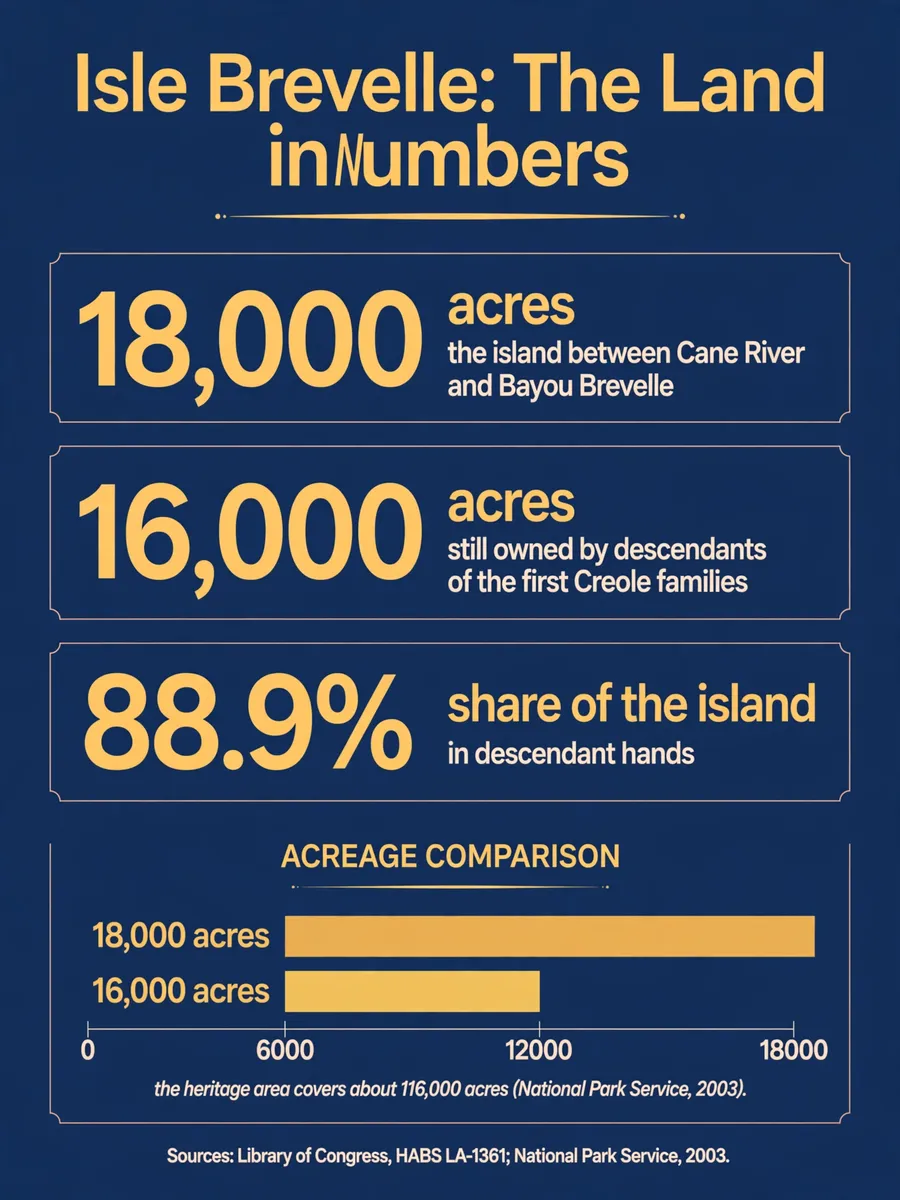
    Isle Brevelle sits about twelve miles south of Natchitoches, between Cane River and Bayou Brevelle.

    About 16,000 of those 18,000 acres remain in the hands of the first families’ descendants (Library of Congress, HABS LA-1361).

    Church kitchens set the table, not restaurants, and family land passed from parent to child for generations.

    Marie Thérèse Coincoin and the Métoyer Family built that community from three land grants, not from trade.

    Natchitoches lies north of the Cajun prairie, and its old French-speaking kitchens cook Creole food (EatBayou, 2026).

    Rural, Black, Catholic, and French-speaking: four words that fit Cane River and fit neither New Orleans nor Acadiana in the same way.

    Three Arrivals, Three Homelands

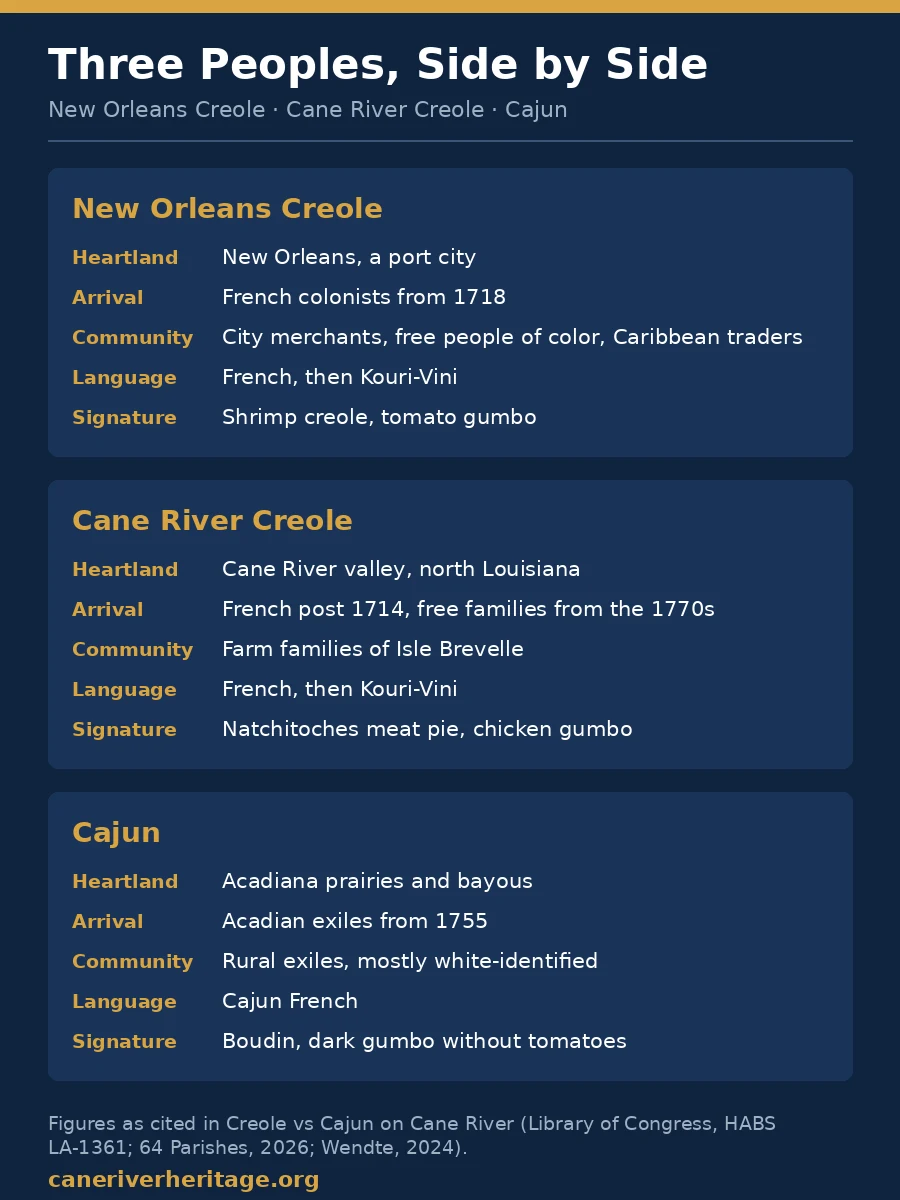
    Put the three peoples side by side, and the pattern turns clear.

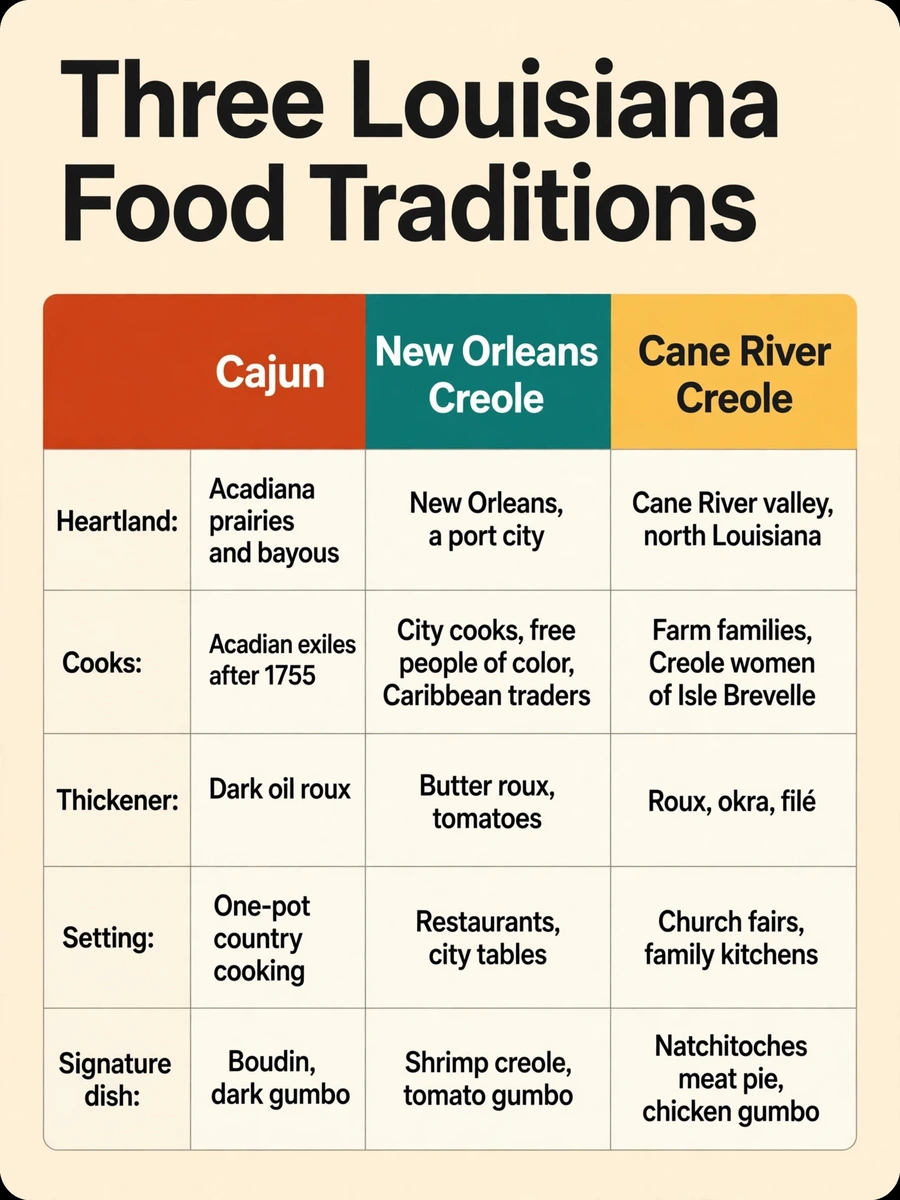
    New Orleans CreoleCane River CreoleCajun
    HeartlandNew Orleans, a port cityCane River valley, north LouisianaAcadiana prairies and bayous
    ArrivalFrench colonists from 1718French post 1714, free families from the 1770sAcadian exiles from 1755
    CommunityCity merchants, free people of color, Caribbean tradersFarm families of Isle BrevelleRural exiles, mostly white-identified
    LanguageFrench, then Kouri-ViniFrench, then Kouri-ViniCajun French
    SignatureShrimp creole, tomato gumboNatchitoches meat pie, chicken gumboBoudin, dark gumbo without tomatoes
    Table 1. Louisiana’s three peoples, side by side.

    Five rows set the three peoples side by side, from heartland to signature dish. Cane River Creole keeps its own column: farm families, Isle Brevelle, and the meat pie.

    One row alone decides nothing, and every row points the same way.

    Geography made the cultures, not the other way around.

    The Language Test

    Food confuses people, but language settles the question faster.

    Kouri-Vini is a French-based creole language, shaped on the plantations of French Louisiana in the 1700s.

    Its words come mostly from French, and its grammar comes mostly from West Africa.

    Native speakers have thinned to under 10,000, and roughly 5,000 of them speak it from birth (Wendte, 2024).

    The French of the exiles is a different tongue: a dialect carried from Acadia, not a creole at all.

    Louisiana French is a third: the French of colonial Louisiana, spoken by white Creoles and Cajuns alike.

    Three peoples, three tongues, and one shared habit of speaking French at home.

    Visitors who hear Kouri-Vini in Natchitoches are hearing Cane River Creole, not Cajun speech.

    The Food Test

    Gumbo gives the fastest answer at the table, and the answer has three parts.

    Tomatoes mark the Creole pot, and Cajun gumbo does without them.

    That rule comes straight from the port: tomatoes reached New Orleans tables, while prairie kitchens cooked without them.

    Gumbo here takes a third road, built on roux, okra, and filé.

    Okra came from West Africa, and filé came from Native sassafras knowledge.

    Outdoor pots of chicken gumbo feed whole congregations here, and church fairs still call for them (EatBayou, 2026).

    Beyond gumbo, the Natchitoches meat pie belongs to Cane River alone, and no Cajun or New Orleans table claims it.

    That story appears in full in Cane River Creole Food, from the 1826 journal entry to the state title of 2003.

    The Faith and Family Test

    Churches and family land give a second test, slower but just as sure.

    St. Augustine Catholic Church stands on Isle Brevelle land, built by the free families who farmed it.

    Its pews once reversed the southern order, seating free people of color where white planters sat elsewhere.

    Acadiana built its own churches too, but its parishes grew from exile settlements, not from freed families buying land.

    New Orleans built cathedrals for a city, while Cane River built a chapel for a farming community.

    Land tells the same story: Isle Brevelle families kept their acres in the same hands for two centuries.

    Exile scattered Acadian families across four parishes, and the port scattered New Orleans families across the Atlantic world.

    Why the Confusion Persists

    If the differences run this deep, why does everyone mix them up?

    Tourism did much of the damage, and it did the damage in the 1970s.

    Music, food, and festivals from Acadiana became Louisiana’s brand, and the brand swallowed the map.

    Guidebooks now stretch “Cajun Country” across 22 parishes, past the old Acadian settlements.

    The word itself became a flavour label, not a people, and restaurant menus use it for anything spicy with tomatoes.

    Cane River sits far north of Acadiana, so visitors assume the whole state shares one French culture.

    Schoolbooks helped too, since Louisiana history often jumps from New Orleans to the Acadians and skips the river in between.

    How to Tell Them Apart in Natchitoches

    Walk downtown Natchitoches with three questions in mind.

    Ask when the community began: 1714 points to Cane River Creole, 1718 to New Orleans, and the 1760s to Cajun.

    Ask who built it: free families of color point to Cane River, city merchants to New Orleans, and Acadian exiles to Acadiana.

    Check what fills the pot. A meat pie points to Cane River, tomatoes point to New Orleans, and a dark roux without tomatoes points to Cajun.

    Listen for the language too, since Kouri-Vini belongs to Creole families and Cajun French belongs to Acadian ones.

    None of the three tests works alone, and all three together rarely miss.

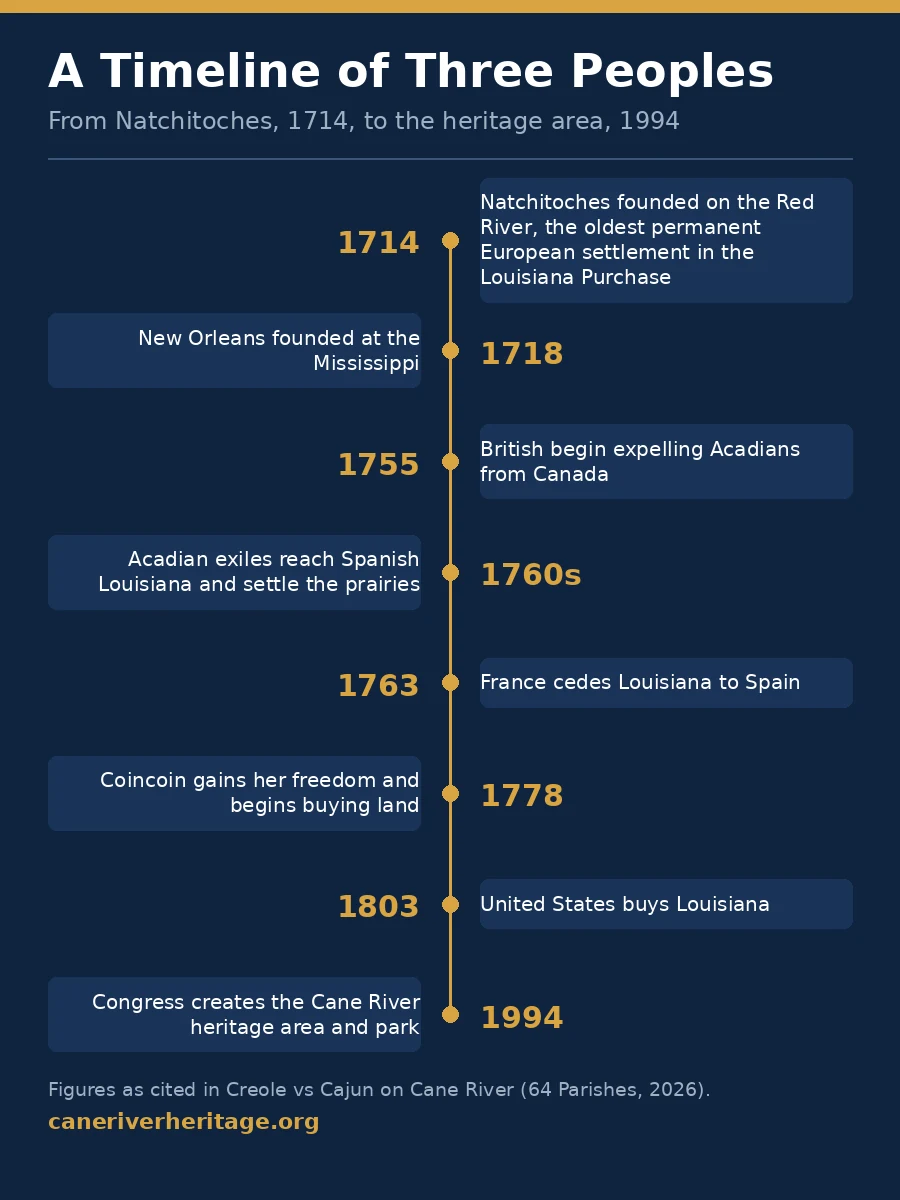
    A Timeline of Three Peoples

    YearEvent
    1714Natchitoches founded on the Red River, the oldest permanent European settlement in the Louisiana Purchase
    1718New Orleans founded at the Mississippi
    1755British begin expelling Acadians from Canada
    1760sAcadian exiles reach Spanish Louisiana and settle the prairies
    1763France cedes Louisiana to Spain
    1778Coincoin gains her freedom and begins buying land
    1803United States buys Louisiana
    1994Congress creates the Cane River heritage area and park
    Table 2. Peoples on one timeline, 1714 to the 1760s.

    Eight dates carry three peoples from the Natchitoches post of 1714 to the heritage area of 1994. The Acadian expulsion of 1755 arrives a full generation after the river towns.

    Frequently Asked Questions

    What is the difference between Cajun and Creole?

    Descendants of Acadians expelled from Canada after 1755 are Cajun, while Creole first meant anyone born in colonial Louisiana.

    Is Cane River Creole the same as New Orleans Creole?

    Free people of color in a rural farming community grew Cane River Creole, while New Orleans Creole grew in a port city.

    Is Cajun food the same as Creole food?

    Creole cooking uses tomatoes and Cajun cooking does not, and Cane River keeps a third table of its own.

    Do Cajuns and Creoles speak the same language?

    Cajuns speak Cajun French, while many Creoles speak Kouri-Vini, a French-based creole language.

    Where can I see Cane River Creole culture?

    Isle Brevelle, St. Augustine Church, and the Cane River heritage sites carry it, and Natchitoches celebrates it each October.

    Methodology

    Every date and figure in this article comes from a named source, and each source appears in the References below.

    Population figures for the Acadian expulsion rest on 64 Parishes and on the histories it draws from.

    Comparisons of the food rest on Explore Louisiana’s Cajun-versus-Creole guide and on EatBayou’s parish survey.

    Language figures rest on Nathan Wendte’s 2024 language snapshot, as cited in the References.

    Search volume, keyword difficulty, and cost per click for the target phrase remain unverified, and no figure of that kind appears here.

    Where sources disagree, the article prints the firmer record and names the other account.

    References

    1. Cajun vs. Creole Food, Explore Louisiana
    2. Creoles, 64 Parishes
    3. Francophone Louisiana, 64 Parishes
    4. Louisiana Creole (Louisiana, USA) — Language Snapshot, Wendte 2024
    5. The Food Traditions of Natchitoches Parish, EatBayou
    6. Cane River National Heritage Area — Historic American Buildings Survey, HABS No. LA-1361 (Library of Congress)
    7. Isle Brevelle: The Free Creole Community That Built Cane River, Cane River Heritage
    8. Marie Thérèse Coincoin and the Métoyer Family, Cane River Heritage
    9. Cane River Creole Food: Meat Pies, Gumbo, Tamales, Cane River Heritage
  • The Caddo People of Cane River: The First Inhabitants Before the French Post

    The Caddo People of Cane River: The First Inhabitants Before the French Post

    Stand on the riverbank at Natchitoches, and the French story starts in 1714.

    Walk the same bank a thousand years earlier, and the story belongs to someone else.

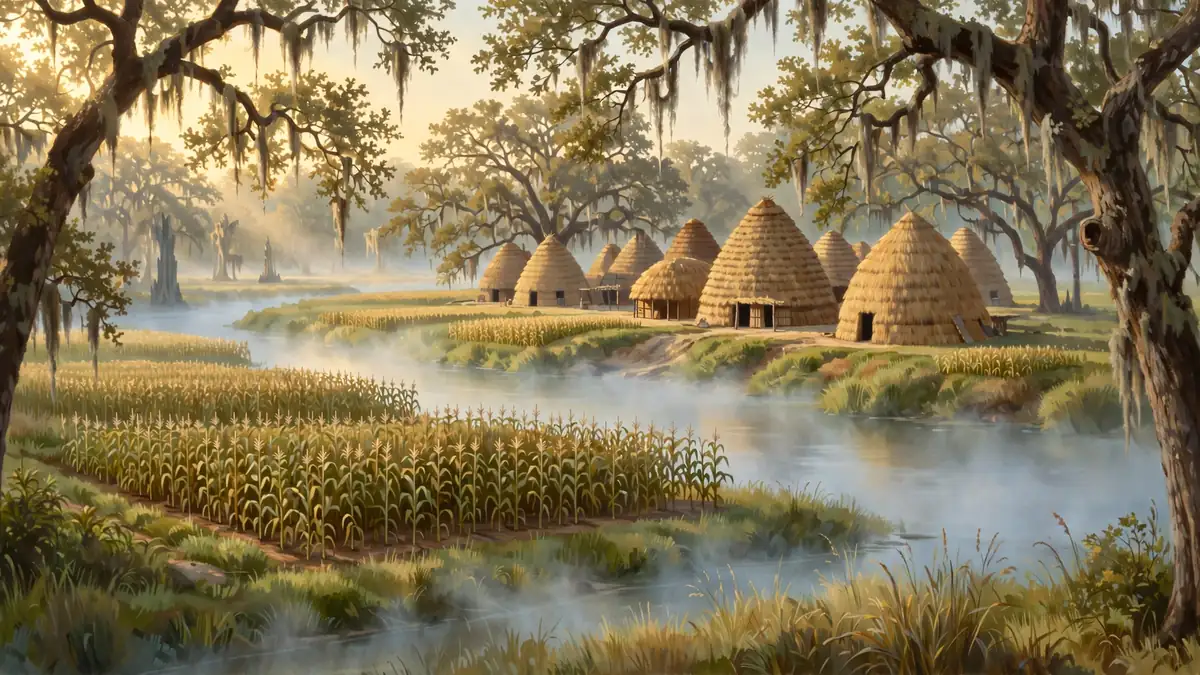
    This river fed farmers long before any European ship reached the Gulf Coast.

    Their towns, trails, and trading paths shaped the land the French later entered.

    Summary

    • On this river, Caddo culture traces back to about A.D. 800–900, and its mound towns peaked around 1300.
    • Three Louisiana groups — Natchitoches, Adai, and Yatasi — lived along Cane River and the Red River.
    • Corn, beans, and squash grew in river-bottom fields, and large grass-thatched houses sheltered the farmers.
    • At their height around 1300, the Caddo may have numbered more than 200,000 people across four states.
    • War and disease had cut that number to as few as 10,000 by the 1680s (National Park Service, 2026).
    • Now the Caddo Nation of Oklahoma, a federally recognized tribe, gathers their descendants at Binger.

    A Thousand Years on the River

    Archaeology gives Cane River a history far older than its French post.

    Pottery forms and decorations trace the Caddo story back to about A.D. 800–900 (Webb & Gregory, 1978).

    Mound centers rose at river crossings, where trails met and communities gathered for ceremony and trade.

    Red River anchored that world, with its tributaries reaching into four states: Louisiana, Arkansas, Texas, and Oklahoma.

    Fertile river bottoms suited the farming life, and Caddo families worked fields that floods renewed each year.

    Centuries passed before any European set foot here, and the river already had towns, trails, and names.

    Three Louisiana Peoples

    “Caddo” names a family of peoples, not a single tribe.

    Louisiana held five Caddoan-speaking groups: the Adai, Doustioni, Natchitoches, Ouachita, and Yatasi (Webb & Gregory, 1978).

    Villages of the Natchitoches lined the Red River near the present-day city, and the Adai lived west toward the Sabine.

    Yatasi towns stood farther north, along the river the French later called the Red.

    Hasinai towns lay across the Sabine in present-day Texas, and their name gave Spanish Texas its first label: Tejas.

    Each group kept its own towns and chiefs, and all of them shared the Caddo language, pottery, and farming life.

    Towns of Grass and Timber

    Those towns looked nothing like the French post that came later.

    Families lived in large, conical houses thatched with grass, big enough for extended kin under one roof.

    Corn stood at the center of the fields, with beans and pumpkins planted beside it.

    Hunters took deer from the woods, and fishers worked the rivers and bayous for catfish and gar.

    Clans ordered the community, and descent followed the female line through ten named clans.

    Nine of those clans took animal names, and no Caddo would kill the animal his clan carried.

    Trade moved along the rivers too, since Caddo salt, pottery, and bows reached peoples far beyond the Red River valley.

    Trails That Became Roads

    Long before Europeans drew maps, Caddo feet wore trails across East Texas and Louisiana.

    Major trails ran east and west, north and south, joining mound centers at river crossings (National Park Service, 2026).

    El Camino Real de los Tejas followed one of those corridors, and Trammel’s Trace followed another.

    Spanish and French travellers walked Caddo trails without knowing whose work they used.

    Modern highways still follow some of those lines, and the old crossings still mark where towns stand.

    First Europeans: De Soto to La Salle

    Europeans reached the Caddo world slowly, and the first meetings cost the Caddo dearly.

    Hernando de Soto’s expedition entered Caddo territory in 1541–1542, bringing disease the Caddo had never met.

    French explorers La Salle and Joutel made friendly contact with the principal tribes in 1687.

    Franciscans opened the first mission among the Tejas in May 1690, on the Trinity River in Texas.

    By then the allied Caddo tribes numbered close to 10,000 souls, a fraction of their old strength (Catholic Encyclopedia, 2026).

    Disease had already done what no army could, emptying towns before the French post existed.

    The French Post and the Adai

    Natchitoches began as a trading post among the Natchitoches Indians, not on empty land.

    Louis Juchereau de St. Denis built the post in 1714, at the present-day city of Natchitoches.

    St. Denis had travelled to the Rio Grande in search of Spanish traders, and his visit alarmed Madrid.

    Spain answered in 1716, sending Captain Domingo Ramón with troops and twelve Franciscan priests to re-establish missions.

    Six missions rose between the Neches and Red rivers, including San Miguel de los Adaes among the Adai.

    French soldiers from Natchitoches attacked that mission in 1719, during the War of the Quadruple Alliance.

    Only 25 soldiers held the nearby French fort, and the fighting stayed small, but the border had been drawn.

    Los Adaes: A Spanish Capital Next Door

    Fifteen miles west of Natchitoches, Spain built an answer to the French post.

    In 1721 the Marqués de Aguayo raised a presidio and mission among the Adai, near present-day Robeline.

    San Miguel de Cuéllar served the Adai people, and Nuestra Señora del Pilar guarded the frontier.

    From 1729 to 1770 the settlement served as the official capital of the Spanish province of Texas (64 Parishes, 2026).

    Its 500 residents lived, traded, and married across the border, and French neighbours kept the town alive.

    Spain closed the mission and presidio in 1773, and the whole population moved to San Antonio.

    Today the site stands as Los Adaes State Historic Site, a National Historic Landmark since 1986.

    Since 2017 the heritage area has managed the property (64 Parishes, 2026).

    Disease, War, and Removal

    Numbers tell the hardest part of this story.

    Around 1300 the Caddo may have numbered more than 200,000 people (National Park Service, 2026).

    Drought struck by 1350, and European diseases followed the first expeditions.

    By the 1680s the population had fallen to as few as 10,000.

    Removal began in the 1830s, when the survivors left East Texas for new lands westward (National Park Service, 2026).

    Louisiana’s Caddo groups scattered with them, and the old towns along the Red River emptied.

    What survived was not the towns but the people, their language, their dances, and their memory of the river.

    The Caddo Nation Today

    Binger, Oklahoma, holds the capital of a nation that refused to vanish.

    Today the Caddo Nation of Oklahoma is a single federally recognized tribe with its capital at Binger (National Park Service, 2026).

    About 6,000 people are enrolled in the nation, with 3,044 living in Oklahoma (Wikipedia, 2026).

    Enrollment requires documented descent of at least one-sixteenth Caddo ancestry.

    An eight-person council governs the nation, and Bobby Gonzalez serves as chairman as of 2025.

    Dance grounds, community centers, and the Caddo Heritage Museum stand south of Binger.

    Citizens of the nation still dance, sing, tell stories, and make the pottery their ancestors shaped a thousand years ago.

    Caddo Blood in the First Creole Families

    Creole history here begins where Caddo history continues.

    Jean Baptiste Brevelle II gave Isle Brevelle its name. He was the son of a French trader and Anne des Cadeaux, an Adai Caddo woman.

    His children married into the free families of color who farmed the river bottoms.

    Filé powder carries the same crossing: sassafras knowledge from Native hands reached Creole kitchens, and the gumbo pot kept it.

    That thread runs from the sassafras harvest to the table in Cane River Creole Food.

    Isle Brevelle tells the fuller story of the community those families built.

    No Cane River history is complete without the people who farmed this river first.

    Where to See Caddo Cane River Today

    Los Adaes State Historic Site opens the Spanish story, on Louisiana Highway 485 near Robeline.

    Cane River National Heritage Area covers the wider landscape, from Natchitoches to Isle Brevelle.

    Natchitoches itself keeps the French post, and the river keeps the Caddo trails beneath the modern roads.

    Farther away, the Caddo Heritage Museum south of Binger, Oklahoma, holds the living culture.

    Visitors who start at Los Adaes and end at Isle Brevelle walk the whole arc, from first inhabitants to free families.

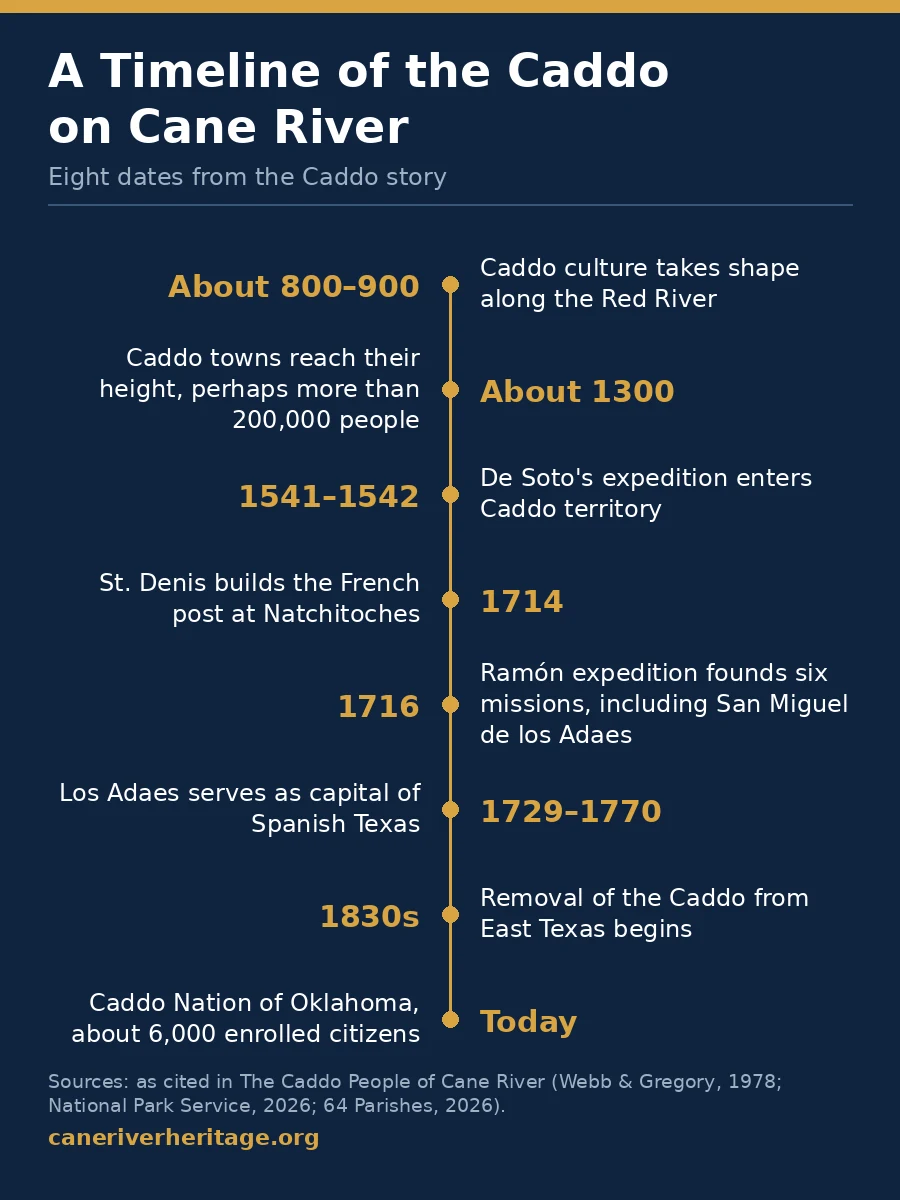
    A Timeline of the Caddo on Cane River

    YearEvent
    About 800–900Caddo culture takes shape along the Red River
    About 1300Caddo towns reach their height, perhaps more than 200,000 people
    1541–1542De Soto’s expedition enters Caddo territory
    1687La Salle and Joutel meet the Caddo in friendship
    1690First mission opens among the Tejas
    1714St. Denis builds the French post at Natchitoches
    1716Ramón expedition founds six missions, including San Miguel de los Adaes
    1721Aguayo builds the Los Adaes presidio
    1729–1770Los Adaes serves as capital of Spanish Texas
    1773Spain closes Los Adaes; its people move to San Antonio
    1830sRemoval of the Caddo from East Texas begins
    TodayCaddo Nation of Oklahoma, about 6,000 enrolled citizens
    Table 1. A timeline of the Caddo on Cane River.

    Eight dates carry the Caddo story from the first mound towns to the nation at Binger today. The French post of 1714 stands near the middle of that long arc.

    Frequently Asked Questions

    Who were the Caddo people of Cane River?

    They were the Natchitoches, Adai, and Yatasi peoples, farming towns along the Red River and Cane River before 1714.

    When did the Caddo live on Cane River?

    People of the Caddo tradition farmed this river from about A.D. 800–900, and held it when the French arrived in 1714.

    What happened to the Caddo of Louisiana?

    Disease cut their numbers first, and removal in the 1830s scattered the survivors westward to Oklahoma.

    Where is the Caddo Nation today?

    The Caddo Nation of Oklahoma, a federally recognized tribe, has its capital at Binger, Oklahoma.

    How are the Caddo connected to Cane River Creole families?

    Jean Baptiste Brevelle II, son of an Adai Caddo woman, gave Isle Brevelle its name, and his children married into the first Creole families.

    Methodology

    Every date and figure in this article comes from a named source, and each source appears in the References below.

    Archaeology and early history rest on Webb and Gregory’s The Caddo Indians of Louisiana (1978), published by the Louisiana Archaeological Survey.

    Population figures rest on the National Park Service and on the Catholic Encyclopedia’s Caddo entry.

    Los Adaes dates rest on 64 Parishes and on the National Park Service site listing.

    The Texas State Historical Association Handbook entry for Domingo Ramón names the expedition commander correctly, while the Catholic Encyclopedia gives Diego Ramón.

    Search volume, keyword difficulty, and cost per click for the target phrase remain unverified, and no figure of that kind appears here.

    Where sources disagree, the article prints the firmer record and names the other account.

    References

    1. The Caddo Indians of Louisiana, Webb & Gregory 1978 (PDF)
    2. Caddo Nation — The Sacred Landscape, National Park Service
    3. Los Adaes State Historic Site, National Park Service
    4. Los Adaes, 64 Parishes
    5. Caddo Indians, Catholic Encyclopedia
    6. Caddo, Wikipedia
    7. Ramón, Domingo, Texas State Historical Association
    8. Isle Brevelle: The Free Creole Community That Built Cane River, Cane River Heritage
    9. Cane River Creole Food: Meat Pies, Gumbo, Tamales, Cane River Heritage
  • Cane River Creole Food: Meat Pies, Gumbo, Tamales

    Cane River Creole Food: Meat Pies, Gumbo, Tamales

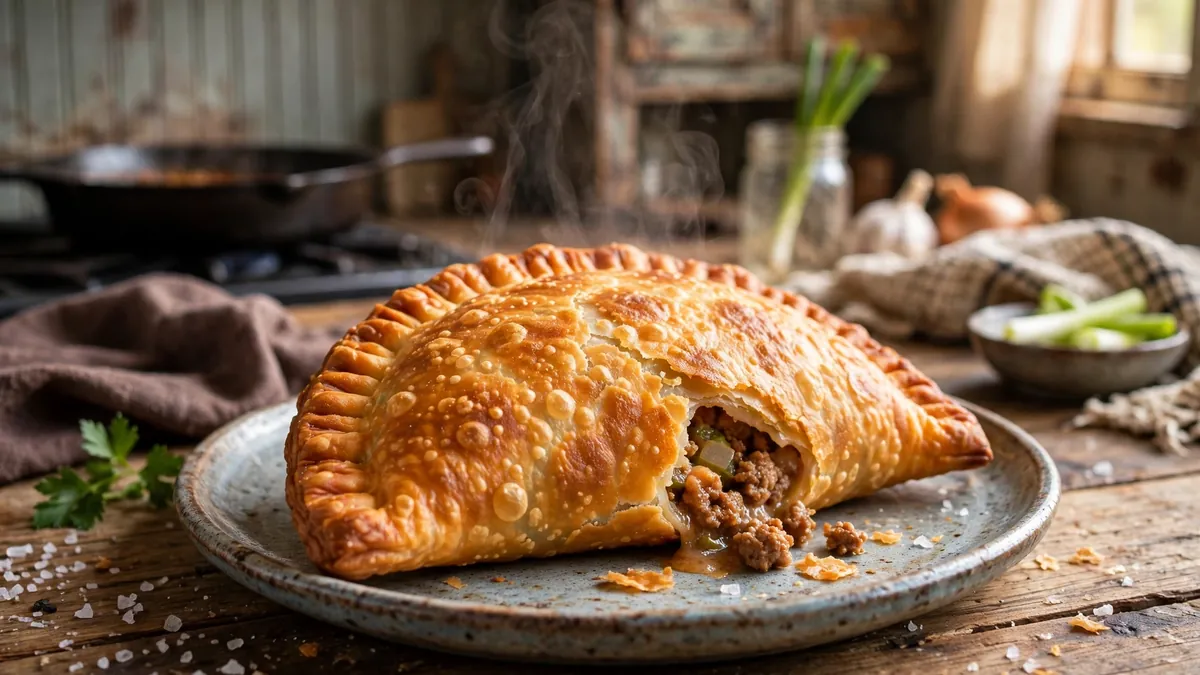
    Main image: AI illustration.

    Say the words Natchitoches meat pie in Louisiana, and most people picture a golden half-moon, hot from the fryer.

    Crisp pastry gives way to seasoned ground beef and pork, with onion, bell pepper, and garlic folded in.

    That hand pie is the signature dish of Cane River Creole culture, a farming community along Cane River in north Louisiana.

    Behind one snack stands a whole cuisine, built by French, Spanish, African, and Native cooks over three centuries.

    Summary

    • A Natchitoches meat pie is a half-moon hand pie of ground beef and pork in a flaky crust, traditionally deep-fried.
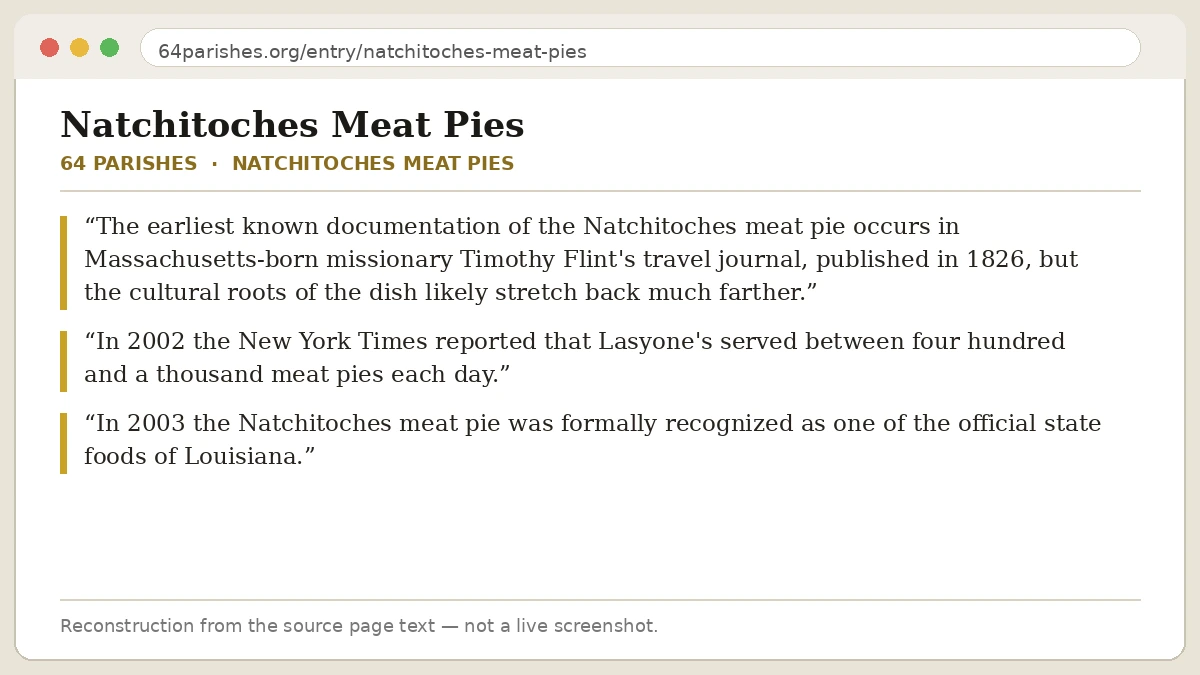
    • Earliest written record of the pie sits in a missionary’s journal from 1826.
    • Isle Brevelle’s Creole women of color made the pie famous decades before restaurants sold it.
    • In 1967 a Natchitoches butcher named James Lasyone opened a pie kitchen, and the dish went national from there.
    • Summer 2003 brought a unanimous vote, and Louisiana gave the pie a state title.
    • Beyond the pie, Cane River Creole cooking stands on gumbo, filé, tamales, sausage, gravy, and gardens.
    Penjelajah Data
    Cane River Creole Food in Numbers
    Meat pies, gumbo, and tamales — the counted facts behind Cane River Creole food.
    1826First written record of Cane River meat pies, in Timothy Flint’s journal
    1967Lasyone’s Meat Pie Kitchen opens
    400–1,000Meat pies served per day at Lasyone’s in 2002
    2003Meat pie named the official state meat pie of Louisiana
    18–19 Sep 202625th Meat Pie Festival

    What a Natchitoches Meat Pie Is

    Pronounced NACK-uh-tish, the pie is a savory turnover, shaped like a half-moon and sized to fit one hand.

    Inside the crust sits a filling of ground beef and pork, cooked with onion, bell pepper, garlic, and seasonings.

    Flour binds the browned meat and vegetables into a savory mixture, and the filling rests a day before frying.

    Tradition calls for deep-frying until the crust turns golden and crisp, though some kitchens bake the pie instead.

    Lasyone’s still uses a four-to-one ratio of ground beef to ground pork, the mix James Lasyone settled on (JSTOR Daily, undated).

    Crawfish pies came later, and they now sit beside the classic beef-and-pork pie on Natchitoches menus.

    Spanish empanadas offer the closest comparison, since both wrap seasoned meat in pastry for eating by hand.

    Unlike an empanada, though, this pie carries the holy trinity of Louisiana cooking in every bite.

    Where the Pie Came From

    No single inventor stands behind the pie, and its roots likely stretch back to the 1700s.

    Soldiers at Los Adaes, the Spanish outpost just west of Natchitoches, may have carried the empanada into the region (64 Parishes, 2023).

    Louis Juchereau de St. Denis, the French-Canadian founder of Natchitoches, may have brought a taste for tourtière (64 Parishes, 2023).

    Native cooks shaped the dish too, according to the city’s own 2026 proclamation, which traces the pie’s concept to the mid-1700s (City of Natchitoches, 2026).

    Crossroads explain the mixture better than any single ancestor, since French, Spanish, African, and Native cooks traded food here for generations.

    A missionary named Timothy Flint wrote about meat pies near Natchitoches, and his journal reached print in 1826 (64 Parishes, 2023).

    By then the pie was already a local habit, not a new invention.

    The Women Who Kept the Pie Alive

    Restaurants did not invent this pie, and they were not its first sellers either.

    Home kitchens came first, and street vendors carried pies through town in the early twentieth century (Wikipedia, 2026).

    Isle Brevelle, about twelve miles south of Natchitoches on Cane River, supplied the most famous pie makers (64 Parishes, 2023).

    When Ascher Rouqier died in 1913, the Natchitoches Enterprise ran a column lamenting her death (64 Parishes, 2023).

    Visitors in the 1950s and 1960s ordered pies from Louise Sarpy after spotting her classified advertisements (64 Parishes, 2023).

    That work matters because famous foods usually live in home kitchens long before restaurants adopt them.

    These women cooked in the community that Coincoin’s descendants built, a story told in Marie Thérèse Coincoin and the Métoyer Family.

    Without their hands, the pie might have stayed a farmhouse habit instead of becoming a town’s signature.

    Lasyone’s: From Butcher Shop to Landmark

    James Lasyone sold ground meat to women who made pies at home, and he watched the demand grow (JSTOR Daily, undated).

    He opened Lasyone’s Meat Pie Kitchen and Restaurant at 622 Second Street in 1967, and cooked-to-order pies became a daily fact (64 Parishes, 2023).

    More dining rooms followed, seating up to one hundred guests, as travellers learned the address (64 Parishes, 2023).

    House Beautiful praised Natchitoches and its meat pies in February 1974, and national writers followed (64 Parishes, 2023).

    Craig Claiborne wrote about the pie for the New York Times, and Calvin Trillin wrote about it for the New Yorker (64 Parishes, 2023).

    Good Morning America, Glamour, and Southern Living carried the story onward through the 1970s and 1980s (64 Parishes, 2023).

    In 2002 the kitchen was serving between four hundred and one thousand meat pies each day (64 Parishes, 2023).

    64 Parishes on the meat pie: Flint’s 1826 journal, Lasyone’s 400–1,000 pies a day in 2002, and the 2003 state title. Reconstruction from the source page text.

    James Lasyone died in 2015 at eighty-four, and his daughters Angela and Tina still run the restaurant on his recipe (64 Parishes, 2023).

    Today the restaurant keeps daytime hours, opening at seven in the morning and closing in the early afternoon (Travelmag, 2026).

    Its menu still centres on the pie, with crawfish étouffée, chicken and sausage gumbo, and red beans and rice (Only In Your State, undated).

    An Official State Food

    The legislature voted without dissent in the summer of 2003, and the pie became a state symbol by law (JSTOR Daily, undated).

    State representative Taylor Townsend, a Natchitoches native, carried the bill that made the pie official (JSTOR Daily, undated).

    Twelve years later, the legislature named a mini Natchitoches meat pie the appetizer of North Louisiana’s official meal (Louisiana State Legislature, 2015).

    Natchitoches now calls itself the Meat Pie Capital of Louisiana, and the title fits the town’s history (Tour Louisiana, undated).

    Few Louisiana foods carry a state title, and fewer still belong so clearly to one small city.

    Louisiana law RS 49:170.9 names the Natchitoches Meat Pie the official state meat pie. Reconstruction from the source page text.

    Gumbo: The Pot That Feeds a Crowd

    Gumbo feeds crowds here, and church fairs, Mardi Gras gatherings, and family events all call for a large outdoor pot (EatBayou, 2026).

    Chicken gumbo leads the tradition, cooked outdoors in pots big enough for a whole congregation (EatBayou, 2026).

    Sausage or other meats join according to occasion and availability, and every cook guards a family version (EatBayou, 2026).

    Roux gives the pot its body, okra gives it a West African root, and filé gives it a Native one (Historic New Orleans Collection, undated).

    Each cook seasons by habit rather than by book, so no two church-fair gumbos taste quite alike.

    Arguing over the pot is part of the meal, and the argument itself proves how much the dish matters.

    Filé: The Native Ingredient in the Pot

    Filé powder is dried sassafras leaf, ground fine, and it carries Native knowledge into the gumbo pot (EatBayou, 2026).

    Cane River families once gathered sassafras in the uplands, and Native sellers brought filé and herbs to Creole kitchens (EatBayou, 2026).

    John Oswald Colson, a Cane River Creole recognised as a Louisiana Tradition Bearer, still harvests sassafras in Kisatchie National Forest (Atlas Obscura, undated).

    Dustin Fuqua, who manages resources at Cane River Creole National Historical Park, learned the craft as Colson’s apprentice for over ten years (Atlas Obscura, undated).

    Choctaw practice shapes the method, and the harvest follows lessons Colson learned from his parents (Atlas Obscura, undated).

    Add filé at the end of cooking, never while the pot boils, or the gumbo turns stringy (Historic New Orleans Collection, undated).

    Sassafras grows wild across this parish, which is why one expert calls Cane River country the hotbed of gumbo filé (Historic New Orleans Collection, undated).

    Historic New Orleans Collection on filé: ground sassafras leaves, necessary in Cane River gumbo, the hotbed of gumbo filé. Reconstruction from the source page text.

    Okra came another way, from West Africa, where the word ki ngombo likely gave gumbo its name (Atlas Obscura, undated).

    Tamales, Sausage, and Gravy

    Tamales surprise first-time visitors, yet they belong at St Augustine Catholic Church gatherings beside gumbo and meat pies (EatBayou, 2026).

    Old crossroads explain the tamale, since French, Spanish, Indigenous, and African foodways met in this parish.

    Pork fed the community through the year, and a single hog could supply chops, ribs, ham, sausage, and smoked meat (EatBayou, 2026).

    Several sausage types were known along Cane River, and cooks preserved pork by smoking it or storing it in rendered fat (EatBayou, 2026).

    Tasso, the smoked and dried meat now linked with Cajun cooking farther south, also has a Cane River history (EatBayou, 2026).

    Gravy tied the table together, since smothered meats turned modest cuts into dishes worth serving with bread or rice (EatBayou, 2026).

    Rice and gravy remains the everyday plate of central and north Louisiana, and Cane River cooks claim it as their own (EatBayou, 2026).

    The Rest of the Cane River Table

    Caddo farmers came first, growing corn, beans, squash, and sunflowers while hunting deer and catching fish (EatBayou, 2026).

    Their knowledge of land, water, crops, and trade routes shaped the region Europeans later entered (EatBayou, 2026).

    Enslaved families kept garden plots beside the cotton fields, raising sweet potatoes, watermelons, turnips, and other vegetables (EatBayou, 2026).

    After emancipation, Black cooks, gardeners, farmers, and labourers carried those foodways into tenant farms, church kitchens, and family tables (EatBayou, 2026).

    Fried chicken, greens, beans, cornbread, freshwater fish, and sweet potatoes all belong to that history (EatBayou, 2026).

    Gardens still feed the parish, with greens, beans, peas, tomatoes, corn, squash, peppers, and sweet potatoes in season (EatBayou, 2026).

    Pecan trees ringed Creole homes long before commercial orchards, and families gathered the nuts for pies, cakes, and pralines (EatBayou, 2026).

    Catfish, crappie, bream, and bass fill the parish waters, and gar becomes a boulette, ground and smothered in gravy over rice (EatBayou, 2026).

    Barbecue belongs to the wider parish table too, and Grayson’s Barbeque in Clarence has smoked meat for more than half a century (EatBayou, 2026).

    Not Cajun, Not New Orleans Creole

    Two labels follow Louisiana food everywhere, and both fit Cane River badly.

    Cajun cooking grew from Acadian exiles who settled the prairies and bayous of south Louisiana after 1755 (Explore Louisiana, undated).

    New Orleans Creole cooking grew in a port city, with tomatoes, butter roux, and Caribbean and European imports at hand (Explore Louisiana, undated).

    Cane River Creole cooking grew in a farming community, where families and church kitchens set the table.

    Natchitoches sits outside the traditional Cajun prairie, and its historic French-speaking food tradition is Creole (EatBayou, 2026).

    The 1901 Picayune Creole Cook Book, with over a thousand New Orleans recipes, contains no Natchitoches meat pie at all (Wikipedia, 2026).

    CajunNew Orleans CreoleCane River Creole
    HeartlandAcadiana prairies and bayousNew Orleans, a port cityCane River valley, north Louisiana
    CooksAcadian exiles after 1755City cooks, free people of color, Caribbean tradersFarm families, Creole women of Isle Brevelle
    ThickenerDark oil rouxButter roux, tomatoesRoux, okra, filé
    SettingOne-pot country cookingRestaurants, city tablesChurch fairs, family kitchens
    Signature dishBoudin, dark gumboShrimp creole, tomato gumboNatchitoches meat pie, chicken gumbo
    Table 1. Three Louisiana food traditions, side by side.

    Three Louisiana food traditions side by side: Cajun, New Orleans Creole, and Cane River Creole — heartland, cooks, thickener, setting, and signature dish.

    A Timeline of the Cane River Table

    YearEvent
    1714Natchitoches founded, the oldest permanent European settlement in the Louisiana Purchase
    1826Timothy Flint describes meat pies near Natchitoches
    1913Ascher Rouqier dies, and the local paper mourns her pies
    1950s–1960sLouise Sarpy sells pies through classified advertisements
    1967James Lasyone opens Lasyone’s Meat Pie Kitchen
    1974House Beautiful praises Natchitoches meat pies
    2002Natchitoches Meat Pie Festival formed
    2003Louisiana names the pie its official state meat pie
    2015North Louisiana’s official meal names a mini meat pie its appetizer
    2026The festival marks its 25th year, 18–19 September
    Table 2. A timeline of the Cane River table.

    Meat pie timeline, 1714–2026: Natchitoches founded, Flint’s 1826 journal, Lasyone’s 1967 opening, the 2003 state title, and the 25th festival in 2026.

    Where to Taste It Today

    Start downtown, where Lasyone’s still serves the pie at 622 Second Street, Monday through Saturday (Travelmag, 2026).

    Maglieaux’s offers mini meat pies on a patio above Cane River Lake, at 805 Washington Street (This Is My South, undated).

    Merci Beaucoup, at 127 Church Street, serves mini meat pies and sells chicken and sausage gumbo by the gallon (TravelAwaits, undated).

    French Market Express, off Interstate 49, sells regular, spicy, and crawfish pies around the clock (This Is My South, undated).

    Front Street Marketplace gives the same downtown another quick stop for a pie on foot (This Is My South, undated).

    South of town, the St Augustine church fair still gathers descendants each autumn, with gumbo, meat pies, and tamales on the tables (EatBayou, 2026).

    September brings the Meat Pie Festival to the downtown riverbank, free to enter, with cooking and eating contests (City of Natchitoches, 2026).

    Resolution No. 061 of 2026 proclaims 18–19 September 2026 as Natchitoches Meat Pie Festival Days. Reconstruction from the source PDF text.

    December brings the Christmas Festival of Lights, when meat pies join holiday meals along the river (EatBayou, 2026).

    Pies also travel, since Lasyone’s ships them and frozen pies reach grocers across north Louisiana (This Is My South, undated; Wikipedia, 2026).

    One pie, three centuries, four cultures: 1826, 1967, 2003, and the 25th festival in 2026.

    Frequently Asked Questions

    What is a Natchitoches meat pie?

    It is a half-moon hand pie of seasoned ground beef and pork in a flaky crust, deep-fried until golden.

    Where can I eat a Natchitoches meat pie?

    Lasyone’s in downtown Natchitoches is the classic stop, and Maglieaux’s, Merci Beaucoup, and French Market Express also serve them.

    Why is Cane River Creole food not Cajun food?

    Cajun cooking comes from Acadian exiles on the south Louisiana prairies, while Cane River cooking comes from a Creole farming community.

    What makes filé different from okra in gumbo?

    Filé is ground sassafras leaf from Native tradition, added at the end, while okra is a West African vegetable cooked in the pot.

    When is the Natchitoches Meat Pie Festival?

    Each September, on the downtown riverbank, with free entry and a meat pie cooking contest.

    Methodology

    Every date and figure in this article comes from a named source, and each source appears in the References below.

    Histories of the pie rest on 64 Parishes, the Louisiana Endowment for the Humanities encyclopedia, and the city’s own 2026 festival proclamation.

    Foodways beyond the pie rest on EatBayou’s parish survey, which draws on National Park Service research, and on the Historic New Orleans Collection.

    Search volume, keyword difficulty, and cost per click for the target phrase remain unverified, and no figure of that kind appears here.

    Where sources disagree, the article prints the firmer record and names the other account.

    Hours and menus change, so readers should check the latest details before travelling.

    References

  • Marie Thérèse Coincoin and the Métoyer Family: The Family That Founded Isle Brevelle

    Marie Thérèse Coincoin and the Métoyer Family: The Family That Founded Isle Brevelle

    Main image: AI illustration.

    Marie Thérèse Coincoin was born enslaved in August 1742, and she died a landowner in 1816 (Mills, 2008).

    Cane River at Natchitoches, in the Cane River National Heritage Area.
    Cane River at Natchitoches, in the Cane River National Heritage Area.

    Claude Thomas Pierre Métoyer bought her freedom in 1778, after a parish priest threatened her sale to New Orleans (Mills, 2008).

    Ten children followed, and that family founded Isle Brevelle, raised its church, and built Melrose Plantation.

    Legend credits Coincoin herself with Melrose and with thousands of acres.

    Records say otherwise, and the parish register wins wherever the two disagree.

    Summary

    • One documented life: enslaved in 1742, free in 1778, landowner by 1794 (Mills, 2008).
    • Ten children with Claude Thomas Pierre Métoyer became landowners, church builders, and planters (Mills, 2008).
    • Melrose belonged to her son Louis, not to Coincoin herself.
    • The family also held enslaved people, and the census counts them plainly.

    The Legend and the Record

    Family lore once made Coincoin a heroine of romance.

    A sick mistress, a grateful gift of land, and a plantation empire filled the tale (Mills, 2012).

    Gary B. Mills tested that tale against parish registers, tax rolls, and land records (Mills, 1977).

    His verdict still stands: the records tell a harder and more impressive story.

    Coincoin owned just over 1,000 acres, not the 12,000 of legend (Mills, 2012).

    Frugality marked her free life: she spent her income freeing her own children (Mills, 2008).

    That correction does not shrink her.

    It makes her achievement measurable, and therefore believable.

    Born Enslaved at Natchitoches

    Coincoin first appears in the written record in 1756 (Mills, 2008).

    She was listed as a slave in the estate papers of Louis Juchereau de St Denis, founder of Natchitoches.

    Her parents were François and Marie Françoise, both Africans enslaved at the post (Mills, 2008).

    Eleven children filled that household, and Coincoin was the fourth (Mills, 2008).

    Medicine came early: she made medicine, a skill that later earned her a living as a free woman (Mills, 2008).

    No document names the African birthplace of either parent (Mills, 2008).

    Her name may be an Ewe word for a second-born daughter, though scholars still debate the link (Mills, 2008).

    Five children came before Métoyer entered her life.

    Their father was an enslaved Native man, according to tradition no record proves (Mills, 2008).

    Freedom in 1778

    About 1767, her owner rented Coincoin to Métoyer, a young French merchant (Mills, 2008).

    Twenty years together produced ten children.

    Spanish law opened the door Coincoin walked through (Mills, 1977).

    Under Spain, enslaved people could buy freedom, and free people of color could hold land (Mills, 1977).

    Métoyer kept the children born before 1778 as his property for years (Mills, 2008).

    He freed the eldest five as they matured and married (Mills, 2008).

    A parish priest charged Coincoin as a public concubine in 1778 (Mills, 2008).

    Métoyer bought her freedom rather than see her sold to New Orleans.

    Freedom changed little at first.

    In 1788 Métoyer married a white widow, and the liaison ended (Mills, 2008).

    He gave Coincoin land off his plantation as they parted (Mills, 2008).

    She also received a yearly allowance, later traded for the freedom of several children (Mills, 1977).

    Land: Three Tracts, Not an Empire

    Spanish land policy rewarded free people of color who farmed (Mills, 1977).

    The policy paid off in her hands.

    One farm measured 80 arpents, about 67 acres (Mills, 2012).

    The Coincoin-Prudhomme House seen from across Cane River; Coincoin's farm stood on this land.
    The Coincoin-Prudhomme House seen from across Cane River; Coincoin’s farm stood on this land.

    The Crown patented it in May 1794 (Mills, 2012).

    Next came 800 arpents of piney woods on Old River (Mills, 2012).

    Cattle grazed there under a Spaniard she hired to work the range.

    In 1807 she bought a third tract beside her homestead (Mills, 2012).

    It was meant for a younger son who came of age too late for Spanish grants.

    Surviving records document just over 1,000 acres in her name (Mills, 2012).

    Legends of 12,000 acres and 100 slaves have no record behind them (Mills, 2012).

    Tobacco paid for the land, and medicine and trapping paid for more (Mills, 2008).

    Bear grease, pelts, and cured tobacco went downriver to New Orleans.

    Every spare coin went to one purpose.

    Freedom for three children and several grandchildren from her first union came from those coins (Mills, 2008).

    Ten Children Who Became a Dynasty

    Manumission came slowly for the children, as each matured and married (Mills, 2008).

    Some waited until their twenties, thirties, and forties (Mills, 2008).

    Augustin, the eldest, was born in 1768 (Dictionary of Louisiana Biography, 1988).

    Augustin Métoyer, Coincoin's eldest son, painted about 1835–1841.
    Augustin Métoyer, Coincoin’s eldest son, painted about 1835–1841.

    Augustin gave the land for St Augustine Church, and tradition credits his brother Louis with building it (Mills, 1977).

    Louis, born about 1770, waited longest for legal freedom (Dictionary of Louisiana Biography, 1988).

    His father bought him as a child, yet formal manumission came only in 1802 (Dictionary of Louisiana Biography, 1988).

    Pierre Victorin, born in 1789, and François Benjamin, born in 1793, farmed beside their brothers (Dictionary of Louisiana Biography, 1988).

    By 1830 the siblings stood among the wealthiest free families of color in the nation (Mills, 2008).

    Their wealth came from land, cotton, and the labor of enslaved people.

    Louis Métoyer and Melrose

    Louis received his own land while still enslaved in law.

    Royal favor reached him early: a grant of 1,372 arpents came in 1795 (Dictionary of Louisiana Biography, 1988).

    Melrose itself grew from a 912-acre grant to Louis in 1796 (National Register of Historic Places, 2014).

    The Big House at Melrose Plantation, built under Louis Métoyer and finished by his son in 1833.
    The Big House at Melrose Plantation, built under Louis Métoyer and finished by his son in 1833.

    Most of the surviving plantation buildings rose under his direction before his death (Mills, 2012).

    Work on the Big House began about 1832, and his son Jean Baptiste Louis finished it in 1833 (Melrose on the Cane, 2026).

    Death came on 11 March 1832, when he was 62 (Dictionary of Louisiana Biography, 1988).

    At his death his estate passed 100,000 dollars in value (Dictionary of Louisiana Biography, 1988).

    Melrose left Métoyer hands in 1847 (Mills, 2012).

    Its buyers were Henry and Hypolite Hertzog, and the price was 8,340 dollars (Melrose on the Cane, 2026).

    The Yucca House at Melrose, one of the plantation's oldest surviving buildings.
    The Yucca House at Melrose, one of the plantation’s oldest surviving buildings.
    The African House, one of Melrose's surviving outbuildings.
    The African House, one of Melrose’s surviving outbuildings.

    Augustin Métoyer and St Augustine

    Land for the chapel came from Augustin, and tradition credits Louis with designing and raising it (Mills, 1977).

    St. Augustine Catholic Church on Isle Brevelle; the present church dates to 1917.
    St. Augustine Catholic Church on Isle Brevelle; the present church dates to 1917.

    Tradition dates the church to 1803 (Mills, 1977).

    Parish records say Father Jean Baptiste Blanc consecrated the chapel on 19 July 1829 (Mills, 1977).

    Both dates stand in the record, and neither is settled here.

    Pew records put the Métoyer family in front and white planters behind them (Mills, 1977).

    Visitors still notice the reversal today.

    Union troops are said to have burned the first chapel in May 1864 (Mills, 1977).

    Today the present church dates to 1917 (National Register of Historic Places, 2014).

    St Augustine became a parish in its own right in 1856 (Mills, 1977).

    Worship continues there today, in an active parish on Isle Brevelle.

    For the church itself, a companion article tells the full story St. Augustine Catholic Church.

    The Hardest Fact: The Family Held Enslaved People

    Liberty did not make the Métoyers opponents of slavery.

    They held enslaved people themselves, and the census counts them (Mills, 1977).

    By 1830 Louis owned 54 enslaved people, and Augustin owned 54 (United States Census, 1830).

    Thirteen members of the family together owned 215 (United States Census, 1830).

    Together the two brothers ranked among the fifteen largest slaveholders in the parish in 1830 (United States Census, 1830).

    Enslaved workers and later tenants worked the Métoyer plantations alongside the family (Mills, 1977).

    Near the top of that small owning class stood the Métoyers.

    Even Coincoin bought enslaved people to protect kin from other buyers (Mills, 2008).

    Work beside them filled her days until her health failed (Mills, 2008).

    None of this erases what the family built.

    Remembering it stops the story from becoming a simple tale of triumph.

    The House That May Not Be Hers

    Near Bermuda, a small raised cottage still carries her name.

    The Coincoin-Prudhomme House (Maison de Marie Therese) near Bermuda; its date is disputed.
    The Coincoin-Prudhomme House (Maison de Marie Therese) near Bermuda; its date is disputed.

    National Register listing came on 6 December 1979 (National Register of Historic Places, 1979).

    Its nomination dates the cottage to about 1786 (National Register of Historic Places, 1979).

    Federal surveyors date the standing walls to 1828–1847, decades after her death (Mills, 2012).

    Scholars still disagree, and visitors should know that (Mills, 2012).

    What no one disputes is the ground: her farm stood on that land.

    Private owners hold the house today.

    Check before visiting, and respect the owners.

    Why the Legend Stuck

    Younger than the plantation itself, the Melrose legend dates to the twentieth century (Mills, 2012).

    Elizabeth Shown Mills traces its birth to François Mignon, a writer who also invented his own identity (Mills, 2012).

    Mignon romanticized Melrose for visitors in the mid-twentieth century (Mills, 2012).

    Later writers repeated him without checking the land records.

    Tourism rewarded the romance, and the records sat unread.

    Correcting it took parish registers, land claims, and three decades of Mills research (Mills, 2008).

    Mills found no telling of the Melrose tradition before 1927 (Mills, 2012).

    That makes the legend younger than the plantation by more than a century.

    Fiction kept the legend alive as well.

    Elizabeth Shown Mills told the same family story as a novel, Isle of Canes, in 2004 (Mills, 2008).

    Novel and history share the same archives, and only the novel invents dialogue.

    Tracing the Family Today

    Descendants still live on Isle Brevelle, and the paper trail survives (Northwestern State University, 2026).

    Start at the Creole Heritage Center at Northwestern State University.

    More than 5,000 items on Louisiana Creole life fill its library (Northwestern State University, 2026).

    Staff there point researchers to church registers and family histories.

    An online National Creole Family database holds more than 9,500 names with basic genealogical information, the university reported in a May 2026 press release.

    Church records, cemetery records, and family history books fill the shelves behind it (Northwestern State University, 2026).

    Access to Ancestry and Newspapers helps researchers check names against wider records (Northwestern State University, 2026).

    Collecting for almost 30 years, the Center holds material reaching back to the 18th century (Northwestern State University, 2026).

    Staff can also arrange research help for visitors who write ahead.

    Louisiana State University holds Metoyer family papers from 1895 to 1944, in 219 items (Louisiana State University Libraries, 2026).

    Those papers record cotton sales, store accounts, and family births and deaths.

    Archive research suits readers tracing a named ancestor with a parish and a decade in hand.

    Readers seeking a single online family tree will not find one, because the records sit in several archives, not one website.

    For the wider story, see the guide Cane River Creole Culture and History: The Complete Guide.

    Harder than the legend, the true story serves Coincoin better.

    From slavery she rose to land, and her children built a church and a plantation on that land.

    Keep the whole record in view, and the family stays remarkable without needing a myth.

    Frequently Asked Questions

    Did Marie Thérèse Coincoin found Melrose Plantation?

    No. Records grant the Melrose core tract to her son Louis in 1796 (Mills, 2012).

    Nearby lay her own farms, and Louis built the plantation buildings.

    How did Coincoin gain her freedom?

    Claude Thomas Pierre Métoyer bought her freedom in 1778 (Mills, 2008).

    Priest charges of public concubinage had threatened her sale to New Orleans.

    How much land did Coincoin own?

    Just over 1,000 acres stand documented in her name (Mills, 2012).

    First came an 80-arpent farm, about 67 acres, patented in 1794 (Mills, 2012).

    Was St Augustine Church built in 1803?

    Tradition says 1803, and parish records say the chapel was consecrated on 19 July 1829 (Mills, 1977).

    Both dates stand in the record, and neither is settled here.

    Where can descendants research the Métoyer family?

    Start with the Creole Heritage Center at Northwestern State University (Northwestern State University, 2026).
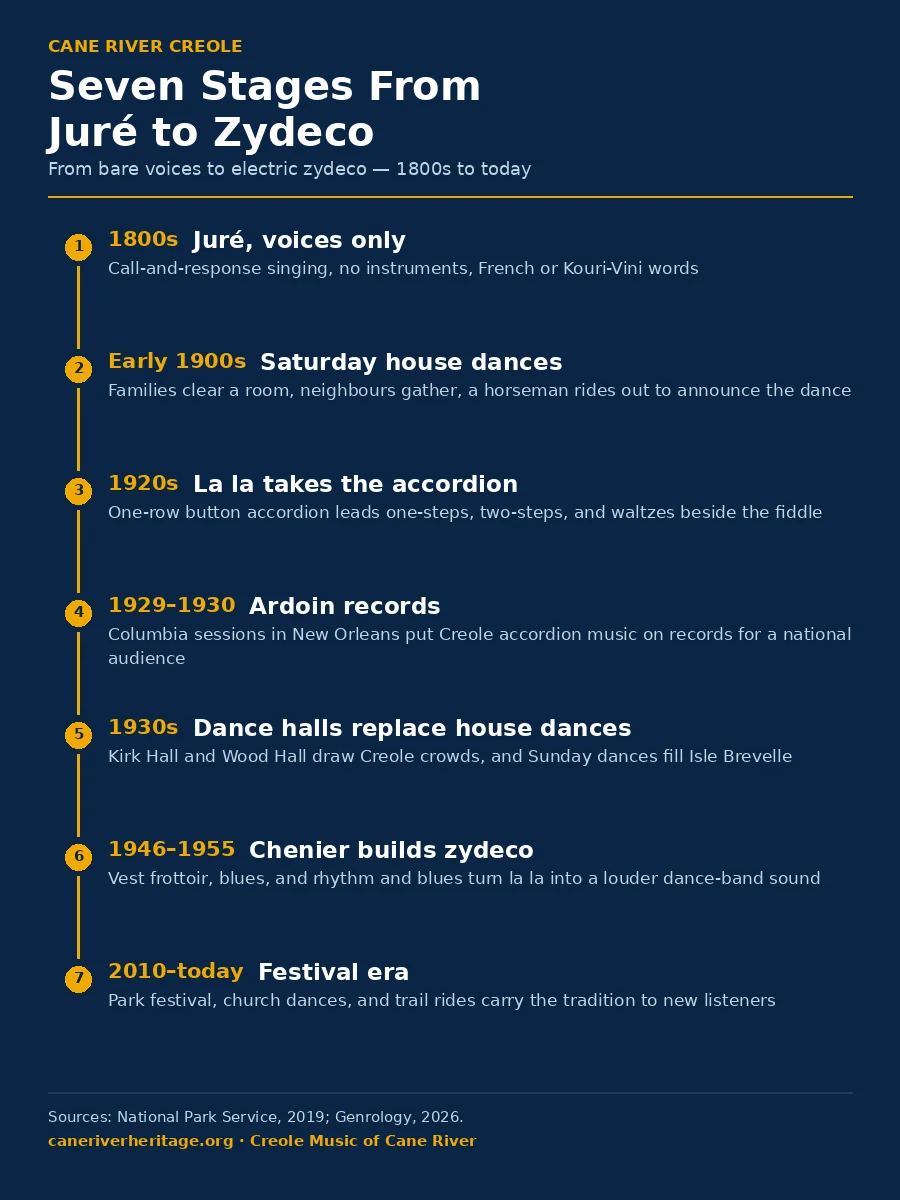
    More than 5,000 items fill the library, and Louisiana State University holds the Metoyer family papers.

    Methodology

    This article was written in November 2026 from Gary B. Mills, The Forgotten People (LSU Press, 1977).

    Later corrections came from Elizabeth Shown Mills, in the National Genealogical Society Quarterly (2008) and Louisiana History (2012).

    National Register nominations, the Historic American Buildings Survey, and the 1830 census supplied the property and population figures.

    Each figure was checked against one of those sources on 23 November 2026.

    Figures found in only one secondary source were left out.

    Where sources disagree, both sides appear instead of one, and hours, prices, and addresses are left out because those change.

    References

  • St. Augustine Catholic Church: The First Church Built by Free People of Color

    St. Augustine Catholic Church: The First Church Built by Free People of Color

    Main image: AI illustration.

    Two centuries of Cane River Creole life run through one white church on Isle Brevelle. Isle Brevelle’s white church is the spiritual center of a farming community, and its story belongs to the free people of color who raised it.

    Nicolas Augustin Métoyer gave the land for the chapel. Brother Louis is credited with designing and raising the building, and the family filled the front pews while white planters sat behind them.

    That reversal is the point of this church. Builders raised it with their own hands, on ground they owned.

    Almost no Black congregation in America could say the same at the time.

    Summary

    • Two dates compete for the beginning: family tradition says 1803, while parish records show a consecration on 19 July 1829 — both are reported and neither is settled.
    • Nicolas Augustin Métoyer gave the land, and his brother Louis is credited as designer and builder — though the National Register nomination itself warns that no primary source proves the design claim.
    • Pew records put the Métoyer family in front and white planters behind them, the opposite of the usual Southern arrangement.
    • Fire is said to have taken the first chapel in 1864 and a second church in the early 1900s; the present building rose from a 1916 campaign and was dedicated on 15 February 1917.

    Two Dates for One Beginning

    Ask when St Augustine began and you get two answers. Family tradition says 1803, and the community celebrated the 200th anniversary of that traditional date on 1 November 2003 (Northwestern State University, 2003).

    St. Augustine Catholic Church on Isle Brevelle; the present church dates to 1917.

    Parish records tell a different story. Registers show the chapel consecrated for worship on 19 July 1829.

    Jean Baptiste Blanc blessed it as a mission of St Francis of Natchitoches (St. Augustine Catholic Church and Cemetery, 2026). Blanc recorded that Augustin Métoyer raised the chapel on his own plantation, with help from his brother Louis.

    Four days after the blessing, four couples married in the chapel, and a fifth wedding followed two days later (National Register nomination, 2014). Historian Elizabeth Shown Mills spent forty years searching for proof of an 1803 chapel.

    She found no record of a church or chapel built on the Isle in that year, that decade, or that quarter-century (National Register nomination, 2014). Earlier registers explain the gap.

    Priests from Natchitoches travelled to Isle Brevelle for baptisms and marriages after 1803. They held services in private homes, naming each house where they stopped (National Register nomination, 2014).

    None of those entries names a chapel before 1829.

    A Natchitoches priest had already hoped for one on the Isle as early as 1799 (National Register nomination, 2014). Yet the registers show the building came later.

    Tradition carries what the community has always believed about itself, while the registers carry what the paper proves. Choosing one side would hide the other half of the story.

    Both dates stay in view, and the reader can see why each one matters.

    The Métoyer Brothers Raised It on Family Land

    Augustin Métoyer was the eldest son of Marie Thérèse Coincoin and Claude Thomas Pierre Métoyer. Born in January 1768 as one of twins, he was freed by his father in 1792.

    Augustin Métoyer, Coincoin’s eldest son, painted about 1835–1841.

    He bought his first Isle Brevelle land soon after (National Register nomination, 2014). Younger brother Louis followed with a neighbouring grant of 912 acres in early 1796.

    Together the brothers turned family ground into the center of a community that soon held about 18,000 acres (National Register nomination, 2014). Augustin gave the chapel its ground from his own plantation.

    Louis is traditionally credited with designing and building it, a role repeated in almost every account of the church (National Register nomination, 2014). Here the nomination adds a warning that most retellings skip.

    Footnotes in the nomination say no primary source for Louis as architect or builder is known. Mignon may have supplied the idea: a Melrose resident from the 1930s, he invented several Cane River stories (National Register nomination, 2014).

    That caution does not erase the brothers from the story: he paid for the chapel, gave the land, and stood behind it until his death.

    Louis built the great house at Melrose nearby (National Register nomination, 2014). What the record proves is a family project, funded and directed by free men of color.

    The Big House at Melrose Plantation, built under Louis Métoyer and finished by his son in 1833.

    What it does not prove is which brother held the drawing pen, and honest history says so.

    The Pews Reversed the Southern Order

    Inside the chapel, seating told the community who mattered. Surviving pew records show the Créole de couleur Métoyer family in the front seats.

    Builders of the chapel sat where builders rarely sat (National Register nomination, 2014). Behind them sat the families of prominent white planters and other Creoles.

    Surnames in those rear pews included Blanchard, Brevelle, Garcia, Landry, and Lemoine (St. Augustine Catholic Church and Cemetery, 2026). Southern churches of the time usually ordered seating the other way.

    White families took the front, and Black worshippers sat behind them or in a gallery, if they were admitted at all. Isle Brevelle turned that order around because its builders owned the building.

    Money and land, not custom, decided who sat nearest the altar. An 1839 will carried the same principle.

    In it he said the church was built by him and his family, principally for their use. Yet outsiders of the Catholic faith could worship there with the same rights his family enjoyed (National Register nomination, 2014).

    Early marriages in the chapel joined couples of French, Spanish, Native American, and mixed heritage.

    White neighbours worshipped there alongside its Creole founders (National Register nomination, 2014).

    The Pews Reversed the Southern Order

    From Mission to Parish in 1856

    For its first decades St Augustine was a mission, served by travelling priests from Natchitoches. Resident pastor was lacking, and its people waited for the priest to come to them (National Register nomination, 2014).

    Bishop Auguste Martin changed that on 11 March 1856. Martin decreed St Augustine a parish in its own right.

    Father François Martin, the bishop’s brother, became its first resident pastor (National Register nomination, 2014). Founder lived just long enough to see it happen.

    Death came on 19 December 1856, nine months after the decree. Burial placed him in the tomb behind the church beside his wife Marie Agnes, who had died in 1839 (National Register nomination, 2014).

    Parish status made St Augustine the mother church of the river settlements. Four other churches soon fell under its care (St. Augustine Catholic Church and Cemetery, 2026).

    Among them were St Charles Chapel at Bermuda and St Anne Church at Spanish Lake, which served the Adai Caddo people. Bayou Derbonne and Old River held the other two: St Joseph Mission and St Anne Chapel.

    Daughters of the Cross opened a girls school in 1857.

    Girls learned there in the building now called the Badin-Roque House, about a mile up the road (National Register nomination, 2014). Larger convent and school rose beside the church around 1860.

    The Badin-Roque House on Highway 484, where the Daughters of the Cross opened a girls school in 1857.

    Fire, Rebuilding, and the Church You See Today

    War reached Isle Brevelle in May 1864. Union troops are said to have torched the first chapel during the Red River campaign.

    No trace of the original building survives (National Register nomination, 2014).

    A second church burned in the early 1900s. Its replacement is the white church visitors see today, and its date is where the sources split by a single year (National Register nomination, 2014).

    Northwestern State University and the WAFB television history both date the present structure to 1916. Nomination text calls the present church part of a 1916 building campaign that replaced the older buildings (Northwestern State University, 2026; WAFB, 2026).
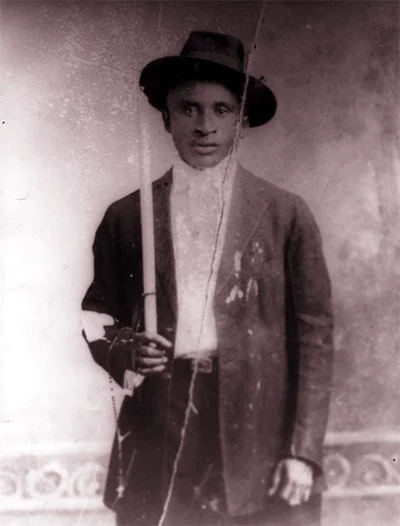
    Other accounts give 1917, and the two years fit together rather than fight. Bishop Van de Van dedicated the finished church at a solemn high Mass on 15 February 1917.

    So the campaign began in 1916 and the doors opened in 1917 (National Register nomination, 2014).

    Romanesque Revival arches shape the building inside and out. Bell tower rises through the center of the front gable, topped by a broach spire.

    Walls wear white asbestos shingles, and a red standing-seam metal roof covers the nave.

    Renovation in 2001 stripped 1970s panelling to expose the original beaded board again. Sam Jacobs, the bishop, rededicated the renovated church on 24 February 2001 (Diocese of Alexandria, 2025).

    Last windows went in during 2017, blessed that year, so the building still gains new work in living memory (Diocese of Alexandria, 2025).

    An oil portrait keeps the founder in the room.

    Descendants bought it back at auction, and it has hung in the church annex since the 1970s (St. Augustine Catholic Church and Cemetery, 2026).

    St Augustine: Two Dates, One Church

    The Cemetery Behind the Church

    Behind the church and rectory lies the cemetery, one contributing site in a property of about 57 acres (National Register nomination, 2014).

    Iron cross grave markers and a mausoleum in the cemetery behind St. Augustine Catholic Church (HABS LA-1316-10, Historic American Buildings Survey, public domain).

    Late twentieth-century mausoleums, four of them, flank the sides (National Register nomination, 2014).

    Marie Agnes shares the most prominent tomb with Augustin, directly behind the church. He died in 1856 and she in 1839, and their brick tomb carries a marble tablet over the crypt (National Register nomination, 2014).

    Burials began here by the end of 1839. Marie Agnes, who died on 7 July 1839, was likely among the first laid to rest on this ground (National Register nomination, 2014).

    Surnames like Metoyer, Balthazar, Dubreuil, and Rachal repeat across generations, and the cemetery reads as a family record in stone (National Register nomination, 2014).

    All Saints Day and All Souls Day, on 1 and 2 November, center on this ground. Families clean and decorate the graves, and the evening closes with a candlelit gathering to remember the dead (National Register nomination, 2014).

    After Mass the congregation moves outside for games and coffee brewed over fires at the cemetery edge.

    Children hunt eggs around the tombs (National Register nomination, 2014).

    A School, a Hall, and a Community That Gathers

    Classrooms gave the community its second calling. Sisters of Divine Providence reopened it in 1890 after a closure of about fifteen years.

    Three pupils walked in on the first day (National Register nomination, 2014).

    Seventy-five children were enrolled by the end of that first year. At its peak the school taught 250 boys and girls through the eighth grade.

    Plays, wedding receptions, and every kind of gathering filled its hall (National Register nomination, 2014).

    New school and convent buildings rose in 1917, beside the new church.

    Enrolment faded as Louisiana schooling changed and families moved away. The school closed in the late 1960s, and its building was demolished in the early 1970s (National Register nomination, 2014).

    Hall rose in its place around 1973.

    Societies kept the parish busy between Sundays. Members joined the Confraternity of Christian Mothers and the Holy Name Society.

    Others joined the Knights and Ladies Auxiliary of St Peter Claver and the Cane River Social Club (National Register nomination, 2014).

    Gumbo, meat pies, and tamales appear at parish events, and quilts go up for raffle at the annual fair (National Register nomination, 2014).

    The School and the Trail

    Why the “Oldest” Claim Needs Care

    Superlatives cling to St Augustine, and they deserve a hard look. Many accounts call it the oldest surviving Black Catholic church in the United States, and the parish celebrates that title (National Register nomination, 2014).

    Official nomination language is more careful than its admirers. Firsts are always difficult to prove with certainty, the nomination says, and they can hide the nuances that matter (National Register nomination, 2014).

    Father J J Callahan, pastor in 1954, once claimed the parish was the oldest for people of color in the United States. Nomination text corrects him.

    New Orleans had a St Augustine parish from 1841, fifteen years before Isle Brevelle gained parish status in 1856 (National Register nomination, 2014).

    Record support is narrower and stronger (National Register nomination, 2014). St Augustine was the first Catholic chapel established by, funded by, and built on the land of persons of part African descent.

    The university states the same point in plainer words. University text calls St Augustine the first Catholic church in America founded, independently financed, and built by free people of color (Northwestern State University, 2026).

    Judge the church by that proven claim, not by the looser superlative. No exaggeration is needed for a community that paid for its own church, kept it through war and fire, and still worships in it.

    National Register, Heritage Trail, and a Living Parish

    Federal recognition came late, in two steps. Church and cemetery entered the National Register of Historic Places on 24 September 2014, under reference number 14000679 (National Register nomination, 2014).

    In 2016 the church was nationally registered as a traditional cultural center, the first such listing in Louisiana (Diocese of Alexandria, 2025).

    State recognition came earlier. Louisiana created its African American Heritage Trail in 2008 with 26 sites.

    St Augustine Church at Natchez was among them (Louisiana African American Heritage Trail, 2022).

    Trail grew to 38 sites by 2022, running from New Orleans along the Mississippi to Baton Rouge and north to Shreveport.

    Today the parish keeps a large choir, an active youth group, vacation Bible school, and scriptural studies.

    Every October the church fair draws descendants home from across the country. Creole Festival falls on the second weekend of October.

    Fish fry, live music, games, and Creole cooking fill the church grounds (Explore Louisiana, 2022).

    Descendants travel from California, Chicago, and farther for that weekend.

    Penjelajah Data
    St Augustine in Numbers
    Two dates, two brothers, and a parish that still gathers — the counted facts behind St Augustine Church.
    1803Traditional date of the first chapel, kept by the community
    19 July 1829Chapel consecrated, per parish records (National Register nomination, 2014)
    15 Feb 1917Present church dedicated by Bishop Van de Van (National Register nomination, 2014)
    Years between milestones (scale 0–100 years)
    1803 to 182926 years
    1829 to 185627 years
    1856 to 191761 years
    1917 to 201497 years
    Parish in its own right on 11 March 1856; first chapel said to have been torched in May 1864; church and cemetery listed on the National Register on 24 September 2014, about 57 acres (National Register of Historic Places, 2014).
    Jan 1768Augustin Métoyer born, one of twins
    1792Freed by his father
    912 acresLouis’s neighbouring grant, early 1796 (National Register nomination, 2014)
    1856Augustin dies 19 December, nine months after the parish decree
    Augustin’s life in years (scale 0–40 years)
    Born to freedom, 1768–179224 years
    Freedom to consecration, 1792–182937 years
    Consecration to parish, 1829–185627 years
    Louis is traditionally credited as designer and builder, but the nomination warns no primary source proves the role (National Register nomination, 2014). Together the brothers’ family held about 18,000 acres.
    3 pupilsFirst day, school reopened 1890
    75 pupilsEnrolled by the end of that first year
    250 pupilsPeak enrolment, through the eighth grade
    38 sitesHeritage Trail by 2022, up from 26 in 2008
    The school’s first year (scale 0–250 pupils)
    First day, 18903 pupils
    End of first year75 pupils
    Peak enrolment250 pupils
    The school closed in the late 1960s and its building was demolished in the early 1970s; a hall rose in its place around 1973. The trail began with 26 sites in 2008 and grew to 38 by 2022.

    Who Should Come, and What to Expect

    Visits suit readers tracing Creole roots, and they suit Catholics who want to worship where the community has worshipped since 1829.

    Sightseers expecting a museum with set visiting hours will be disappointed. Worship comes first: doors open for Mass and parish events rather than for sightseeing on a schedule.

    Check the Diocese of Alexandria page before travelling, since Mass times and parish events change.

    Come for the October fair if you want the fullest picture. October fair weekend shows the parish as its founders meant it: church, cemetery, hall, and cousins eating together on family ground.

    This church is one stop in a larger story. Our guide tells the story of the community around it Cane River Creole Culture and History: The Complete Guide.

    Start there for the families, the food, and the language, then come back here for the building where they all met.

    Timeline

    YearWhat happened
    1803Traditional founding date kept by the community
    1829Chapel consecrated on 19 July by Father Jean Baptiste Blanc
    1856St Augustine becomes a parish on 11 March
    1864First chapel said to be torched in May during the Red River campaign
    1916Building campaign begins for the present church
    1917Present church dedicated on 15 February
    2001Church renovated and rededicated on 24 February
    2014Church and cemetery enter the National Register on 24 September

    Frequently Asked Questions

    When was St Augustine Church built?

    Family tradition says the first chapel rose in 1803. Records show it consecrated on 19 July 1829, and the present building was dedicated on 15 February 1917.

    Who built St Augustine Church?

    Nicolas Augustin Métoyer gave the land and paid for the chapel on his plantation. Brother Louis is traditionally credited as designer and builder, though the National Register nomination notes that no primary source proves that role.

    Why do the pews matter?

    Pew records put the Métoyer family in the front seats and white planters behind them. Ownership reversed the usual Southern seating, because the builders owned the church.

    Is St Augustine the oldest Black Catholic church in the United States?

    Many accounts describe it that way. University researchers call it the first Catholic church in America founded, financed, and built by free people of color.

    National Register nomination warns that firsts are hard to prove, and it rests the claim on the funding and land instead.

    Can I visit St Augustine Church?

    Yes, as a worshipper or for a parish event such as the October fair. Check the Diocese of Alexandria page before travelling, since Mass times and events change.

    Methodology

    Primary sources supplied the facts, read in November 2026. Northwestern State University pages, the National Register nomination, and the Diocese of Alexandria parish history supplied them.
    Every date and figure was checked against at least one source in References on 23 November 2026. Where sources disagreed, this article reports both sides instead of choosing one.

    Where a claim rests on tradition rather than a document, it says so. Hours, prices, and addresses are left out because those change.

    References

  • Isle Brevelle: The Free Creole Community That Built Cane River
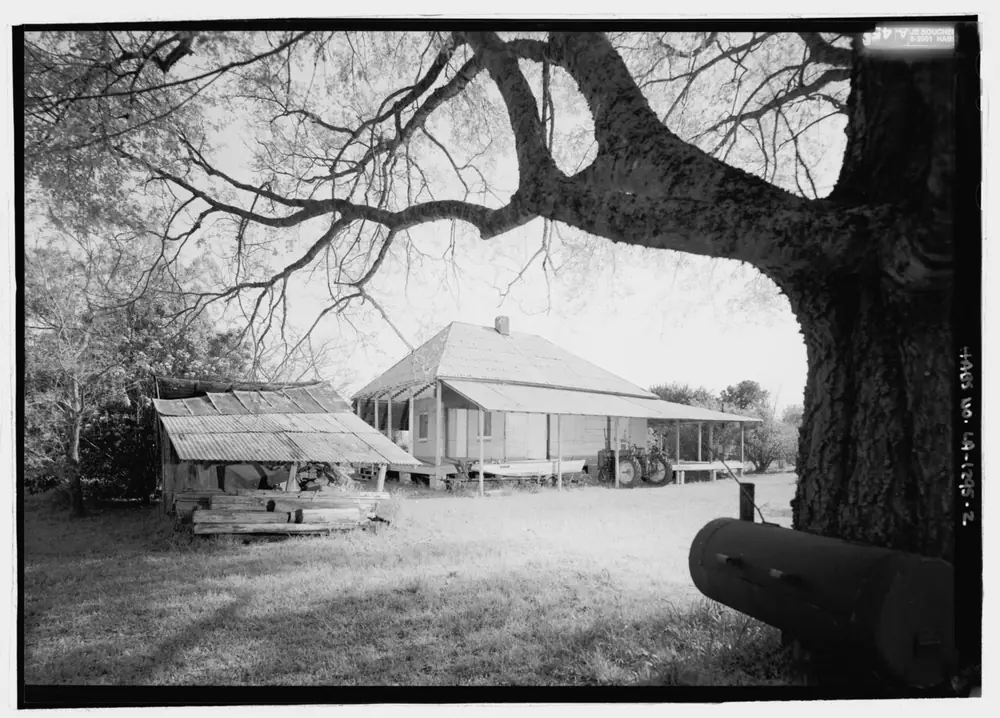
    Isle Brevelle: The Free Creole Community That Built Cane River
    Main image: AI illustration.

    Between Cane River and Bayou Brevelle lies a strip of farmland that free people of color owned outright. That strip is Isle Brevelle, and its families built the Creole culture of Cane River from the ground up.

    No port city made this culture, and no restaurant row made it either. Farmers, church builders, and landowners made it, on ground their ancestors bought field by field.
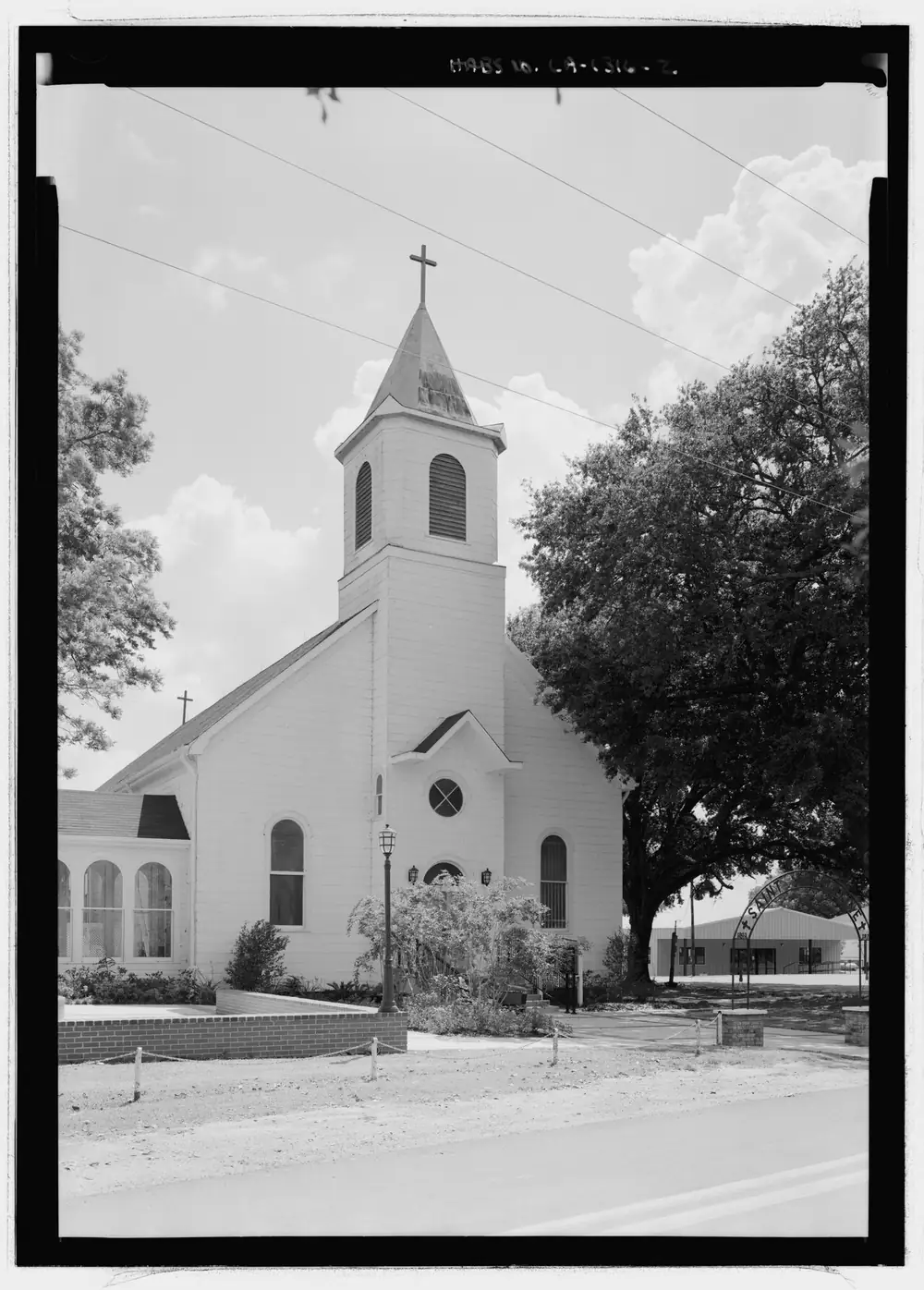
    Those families still own most of it today. Descendants hold the land, gather at the church fair each autumn, and keep the community a living neighbourhood rather than a ruin.

    Summary

    • Isle Brevelle is about 18,000 acres between Cane River and Bayou Brevelle, and descendants of the first Creole families still own about 16,000 of them.
    • Free people of color built the settlement in the late 1700s, under Spanish land law. Marie Thérèse Coincoin bought her freedom and received a land grant.
    • St Augustine Church stands at its centre, and the heritage area marks the island with its own trail as the birthplace of Creole culture.
    • Ownership explains the survival: the people never lost the ground, so the culture never lost its home.

    The Land Between Two Waters

    No sea surrounds this island. Rich bottomland forms a long, narrow strip, walled on two sides by water.

    Cane River at Natchitoches, in the Cane River National Heritage Area.

    Cane River runs along its eastern edge, and Bayou Brevelle runs along its western edge. Between them lies farmland that floods gently, drains slowly, and grows cotton, corn, and pecans.

    For many years the strip was called Côte Joyeuse, French for Joyous Coast. Joyous Coast fits the ground: flat, fertile, and thick with hardwood before the fields were cleared.

    Two highways cross the island today, Highway 119 and Highway 484. Both follow old roads that once linked small plantations in a chain down the river.

    About 18,000 acres make up the strip, and descendants of the first Creole families still own about 16,000 of them (Library of Congress, HABS LA-1361). That single fact separates Isle Brevelle from nearly every other historic Black community in the South.

    Isle Brevelle: The Land in Numbers

    Most such communities lost their land within a generation or two. Here the land stayed, because the titles were real, the families were many, and heirs divided ground among themselves.

    Congress created the heritage area in 1994, and it now covers about 116,000 acres around the river (National Park Service, 2003). Inside that boundary, at its heart, sits Isle Brevelle.

    A Name from a Trader and His Caddo Wife

    Isle Brevelle takes its name from Jean Baptiste Brevelle II. A French trader from Paris fathered him, with his Adai Caddo wife, Anne des Cadeaux.

    Brevelle the younger worked as a translator, explorer, and soldier for the French and Spanish crowns. He knew Caddo languages and customs as his first tongue, not as a learned skill.

    For that service, the French subdelegate at Natchitoches granted him the island. Later, Spanish officials changed the family spelling from Brevel to Brevelle, and the new spelling stuck to the land.

    Brevelle’s story matters because it sets the pattern for everything that followed. From the start, Isle Brevelle mixed French, Spanish, African, and Native peoples in the same families.

    Caddo peoples lived along this river for centuries before any European arrived. Natchitoches, Adai, and Hasinai peoples hunted, farmed, and traded here, and their descendants still belong to the community.

    French soldiers founded a post at Natchitoches in 1714. Traders, soldiers, and settlers came upriver to that post, and their children with Caddo and African women became the first Creoles of the place.

    Therefore the island began as a Native and Creole settlement, older than the plantations around it. Plantation big houses came later; the mixed community came first.

    How Enslaved People Became Landowners

    Spanish rule changed what was possible on Cane River. Spain took Louisiana in the 1760s, and Spanish law let enslaved people buy their freedom.

    Free people of color could then hold land in their own names. One legal difference built Isle Brevelle.

    Marie Thérèse Coincoin walked through the door Spanish law opened. Born enslaved in 1742, she gained her freedom in 1778 and received an 80-arpent land grant in 1787, patented in 1794 (Mills, 1977).

    Her ten children with Claude Thomas Pierre Métoyer became landowners in their turn. Coincoin’s children bought more ground, freed relatives, and raised the church and plantations that held the settlement together.

    The Coincoin-Prudhomme House (Maison de Marie Therese) near Bermuda; Coincoin’s farm stood on this land.

    Nicolas Augustin Métoyer, her son, became the community’s patriarch. Born into slavery himself, he gained his freedom in 1792 at the age of 24 and built the church that still anchors the island.

    Louis Métoyer, another son, founded Melrose Plantation in 1796 (Natchitoches Convention and Visitors Bureau, 2024). Coincoin herself did not found Melrose, whatever legend says; the grant fell to Louis.

    Under the French arpent system, Spanish grants divided the land in long, narrow strips. Each strip ran from the riverbank back to the swamp, giving every family river frontage, high ground for a house, and low ground for fields.

    Houses went up on the high ground at the river’s edge. Fields stretched behind them, and the pattern still shows in the pecan groves and hedgerows that mark old property lines today.

    What a Traveller Saw in 1806

    American explorer Thomas Freeman travelled the river in 1806 and described the settlement as he found it (Freeman, 1806). His account is the earliest eyewitness picture of Isle Brevelle, and it reads like a census taken from a boat.

    Small plantations lined both banks, each with one field in front and land running back to the cypress swamps. Small cottages on the banks and near the river housed those families.

    Freeman counted the mixture plainly: French, Spanish, Indian, and African blood in the same households. Tobacco, indigo, and cotton were the crops he named, all grown on the same ground.

    By the 1780s the community already stood as a true Creole way of life, according to historian H F Gregory at Northwestern State University. Mixed roots built homes, a church, and families of their own.

    Gregory’s account adds the building detail Freeman skipped. Planters raised big houses in the West Indian raised-cottage style, beside humbler cabins of posts in the ground and bousillage.

    Enslaved people’s cabins, often built of hewn logs and bousillage, gradually became tenant houses after emancipation. Shotgun houses replaced many of them in later generations, and a few of the oldest forms still stand.

    Freeman’s picture corrects a lazy assumption about the frontier. Far from a wilderness waiting for plantations, the island was already farmed, settled, and mixed before the plantation economy peaked.

    St Augustine Held the Community Together

    St Augustine Catholic Church stands at the centre of Isle Brevelle, and it has held the community together for two centuries. Nicolas Augustin Métoyer gave the land, and his brother Louis is traditionally credited with designing and raising the chapel.

    St. Augustine Catholic Church on Isle Brevelle; the present church dates to 1917.

    Two dates compete for the church’s beginning, and both deserve a hearing. Tradition says 1803; parish records say the chapel was consecrated on 19 July 1829 (Mills, 1977).

    Pew records tell the same story of reversal as the community. Métoyer family members sat in the front seats, and white planters sat behind them — the opposite of the usual Southern arrangement.

    St Augustine became a parish in its own right in 1856 (National Register of Historic Places, 2014). From that base it founded mission chapels across the surrounding country, carrying the community’s faith outward.

    Union troops are said to have torched the first church during the Red River campaign in May 1864 (Mills, 1977). Rebuilding followed, and the present church was completed in 1917 (National Register of Historic Places, 2014).

    Church and cemetery together entered the National Register of Historic Places in 2014 (National Register of Historic Places, 2014). Roughly 57 acres fall under the listing, including the church, rectory, hall, convent, and burial ground.

    Historians celebrate St Augustine as the first church in Louisiana built by and for free people of color. Scholars also call it the oldest surviving Black Catholic church in the United States.

    Later, the Daughters of the Cross opened a school a mile up the road from the church. Nuns taught the children of Creole families and their workers together, and the school drew pupils from across the island.

    Every autumn the church fair still draws descendants home from across the country. Families return just after the cotton harvest, as their grandparents did, and the fair remains the community’s yearly reunion.

    Isle Brevelle: A Timeline

    The Plantations on the Same Ground

    Melrose Plantation is the most famous address on Isle Brevelle, and its fame needs a straight telling. Louis Métoyer built it as a Creole family’s plantation, and later owners turned it into an artists’ colony.

    The Big House at Melrose Plantation, built under Louis Métoyer and finished by his son in 1833.

    Clementine Hunter worked there as a cook and house worker before she painted the community she knew. Her murals still fill the African House, a building raised by enslaved people in the 1820s.

    Oakland and Magnolia, the two plantations the national park preserves, stand along the same river. Enslaved people and later tenant farmers worked both places, and the park tells their stories alongside the owners’.

    Pairing owners with workers is the honest frame for every plantation on Isle Brevelle. Owners and workers lived on the same ground, and the ground’s history belongs to both.

    Badin-Roque House shows the oldest building tradition on the island. Its walls mix mud, Spanish moss, and deer hair in the poteaux-en-terre method, posts set straight into the ground.

    Scholars date the cottage anywhere from the 1770s to the early 1800s. Agreement eludes every source on the date (National Park Service; National Register of Historic Places, 1980).

    Augustin Métoyer bought the land in 1827. Either way, that purchase ties the house to the free Creole community.

    The Badin-Roque House on Highway 484, a poteaux-en-terre cottage with bousillage walls; Augustin Métoyer bought its land in 1827.

    Linked to Coincoin herself, the Maison de Marie Thérèse is listed on the National Register of Historic Places. Modest beside the plantation big houses, it stands as the family’s own monument.

    Also on the Louisiana African American Heritage Trail, the island stands as a featured destination. Among the state’s sites of Black history, the trail marks the island, beside the church, Melrose, and the Badin-Roque House.

    The Part the Postcards Leave Out

    Free Creoles of Isle Brevelle held enslaved people themselves, and any honest account says so. Heritage-area pages record it plainly: Coincoin and her children built a successful agricultural venture, owned enslaved workers, and gradually acquired more land.

    By 1810 her seven sons held 58 enslaved people, while only 166 of 259 households in their census area owned any (Mills, 1977). Wealth and unfreedom lived in the same families here, as they did across the slave South.

    Such a fact does not cancel the community’s achievement. Completing the picture, it also explains why Mills called his book The Forgotten People: the community fit no stereotype, then or now.

    Prosperity withered during Reconstruction, when Creoles of colour faced the same exclusion that Black Americans suffered. Roads reached the island late, and isolation that once protected the community began to strangle it.

    Isolation held the community until World War II. After the war many members moved away for work, and the island’s population thinned (Explore Natchitoches).

    Yet the departures never broke the tie. Most families return each year for the church fair, and the community remains tight-knit across the distance.

    Romance is the wrong lens for Isle Brevelle. Holding two truths at once rewards the reader here: a free community built something rare, and it built that thing inside slavery.

    Why the Land Stayed in the Same Hands

    Land explains Isle Brevelle more than any single person does. Every family gained river frontage and a defensible title from the arpent strips, and Spanish grants made those titles hard to challenge.

    Inheritance then did the quiet work. Grants divided among numerous heirs became family plantations, and each generation split the ground further without selling it outside the family.

    About 16,000 of the island’s 18,000 acres remain in descendant hands today (Library of Congress, HABS LA-1361). Library of Congress survey records confirm the same pair of figures, which is why this guide trusts them.

    Compare that record with the plantation belt around it, where outside buyers took most of the old ground long ago. Owners lived on it, farmed it, and passed it down in small pieces — which is how the island kept its land.

    Continuity shows in the landscape itself: pecan groves follow old field lines, and hedgerows mark old boundaries. Mailboxes and cemetery stones still carry the same surnames — Métoyer, Brevelle, Roque, Prud’homme.

    Genealogy is therefore the island’s living industry, not a hobby. Paper trails live at the Creole Heritage Center at Northwestern State University: church registers, family histories, and a database of thousands of names.

    Anyone tracing a Cane River family starts with those records. Centre staff can point a researcher to registers and burial records that exist nowhere else.

    Penjelajah Data
    Isle Brevelle in Numbers
    The land, the church, and the people — the counted facts behind Isle Brevelle.
    18,000 acresIsle Brevelle, between Cane River and Bayou Brevelle (Library of Congress, HABS LA-1361)
    16,000 acresStill owned by descendants of the first Creole families (Library of Congress, HABS LA-1361)
    88.9%Share of the island in descendant hands, calculated from the two figures above
    The island inside the heritage area (scale 0–120,000 acres)
    Cane River National Heritage Area116,000 acres
    Isle Brevelle18,000 acres
    The heritage area covers about 116,000 acres around the river (National Park Service, 2003). Isle Brevelle sits at its heart.
    1803Traditional date of the first St Augustine Chapel
    19 July 1829Chapel consecrated, per parish records (Mills, 1977)
    1917Present church completed (National Register of Historic Places, 2014)
    Years between milestones (scale 0–100 years)
    1803 to 182926 years
    1829 to 185627 years
    1856 to 191761 years
    1917 to 201497 years
    Parish in its own right in 1856; first church said to have burned in May 1864; church and cemetery listed on the National Register in 2014, about 57 acres (National Register of Historic Places, 2014).
    1742Marie Thérèse Coincoin born enslaved
    1778Her freedom bought
    1792Augustin free at 24
    1796Louis founds Melrose
    Coincoin’s path to land (scale 0–40 years)
    Enslaved before freedom, 1742–177836 years
    Freedom to land grant, 1778–17879 years
    Grant to patent, 1787–17947 years
    Coincoin’s 80-arpent grant came in 1787 and was patented in 1794 (Mills, 1977). Freeman described the settlement from the river in 1806.

    Isle Brevelle Today

    Isle Brevelle today is a neighbourhood, not a museum, and people live and work here. Its own guide says so plainly: the island is a real place, not a staged one.

    A cultural trail of the heritage area’s own marks the island: the Isle Brevelle Trail, highlighting the birthplace of Creole culture. Trail stops include the church, Melrose, and the Badin-Roque House.

    Respect is the price of admission, and it costs nothing. Drive slowly, stay on public roads, and treat front yards and cemeteries as private ground.

    Food still gathers the community the way the church does. Creole recipes pass down through generations of island families, from garden to kitchen to church supper.

    Music, dancing, and storytelling fill almost every gathering, according to the heritage area’s own account of the community. Trail rides, candlelight vigils, and plays join the church fair on the calendar.

    Film crews have noticed the island too. Shelby’s wedding in Steel Magnolias was filmed at St Augustine, and the 1982 film Cane River took its name and its church from the place.

    Readers will find the full story of this culture in Cane River Creole Culture and History: The Complete Guide. Here is where that story starts, and where it still lives.

    Read the Place on Its Own Terms

    One kind of visitor finds reward here, another finds disappointment, and the difference is worth stating plainly. It suits a reader tracing Creole roots, studying free people of colour, or learning how a community held its land for two centuries.

    It does not suit a visitor hunting a pretty plantation backdrop. Big houses here share their ground with tenant cabins, cemeteries, and working farms, and the beauty is inseparable from that history.

    Come for the community, not the scenery. Church fair, family names on the stones, and fields still farmed by descendants say more than any single building.

    Decide it plainly, as this guide does: Isle Brevelle matters because its people kept their ground, not because its houses photograph well. Land held by the same families for two centuries is the rarest historic site in the American South.

    Frequently Asked Questions

    Where is Isle Brevelle?

    South of the town of Natchitoches, in Natchitoches Parish, Louisiana, lies Isle Brevelle. Cane River bounds it on the east, Bayou Brevelle bounds it on the west, and Highway 119 and Highway 484 cross it.

    Who founded Isle Brevelle?

    Jean Baptiste Brevelle II gave the island its name, after receiving the land for his service as a translator and explorer. Marie Thérèse Coincoin and her Métoyer children then built the free Creole community that made the island famous.

    Why is Isle Brevelle called the birthplace of Creole culture?

    Heritage-area language supplies that phrase, for its Isle Brevelle Trail. French, Spanish, African, and Native peoples mixed into one community on the island, and its church, families, art, and literature grew from that mixture.

    Can I visit Isle Brevelle?

    Yes, by car along the public highways, and the heritage area’s Isle Brevelle Trail marks the historic stops. Remember that people live here: stay on public roads, respect private land and cemeteries, and check the park’s own pages before a visit.

    How much of Isle Brevelle is still owned by descendants?

    Descendants of the original Creole families still hold about 16,000 of the island’s 18,000 acres (Library of Congress, HABS LA-1361). Unbroken ownership is the main reason the culture survived.

    Methodology

    This guide was written in November 2026 from primary sources. Included are the heritage area management plan, Library of Congress survey records, and National Register nominations.

    Northwestern State University’s Creole Heritage Center and Regional Folklife Program supplied the local record. Gary B Mills’ The Forgotten People (LSU Press, 1977) supplied the family history.

    All dates and figures were checked against at least one of those sources on 23 November 2026. Where sources disagree, this guide reports both sides instead of choosing one.

    Some details come from secondary pages, not primary sources. The secondary details are the island’s former French name and its film appearances.

    Hours, prices, and addresses are left out, because those change. Check the official pages before a visit.

    This guide is independent and unaffiliated with the heritage area, the park, or the university. Cultural guide, not official site: that is what this is.

    References