On Cane River, Creole music started with nothing but voices. No instrument joined them, only hands clapping and feet stamping time.
That bare sound has a name: juré singing. It comes from the French jurer, meaning to testify, and it still shapes every Creole dance tune on the river.
This guide follows the sound from its first shouted verses to the zydeco bands of today. Along the way it names the singers, the instruments, and the dance floors that carried it.
Behind this music stand the people and places of Cane River Creole Culture and History. Figures in this article point to Cane River Creole in Numbers 2026 wherever a count appears.
Summary
- Juré singing is unaccompanied call-and-response, sung in French or Louisiana Creole to handclaps and foot stomps.
- House dances carried juré into la la, an accordion dance music of one-steps, two-steps, and waltzes.
- Born near Basile in 1898, Ardoin put that sound on Columbia records in 1929.
- Clifton Chenier built zydeco from la la and juré in the early 1950s, adding the vest frottoir and electric instruments to the old dance sound.
- Cane River still hears the tradition at its park music festival, begun in 2010, and at church dances and trail rides.
What Juré Singing Is
Juré singing means voices and nothing else (National Park Service, 2019). One lead singer calls a line, the group answers, and hands and feet keep the beat.
French gives the form its name. Jurer means to testify, and the songs testify in French or Louisiana Creole.
Rhythms behind the voices came from Afro-Caribbean traditions (National Park Service, 2019). Themes ran both ways, sacred and worldly, sometimes inside one song.
Lent gave juré its season (Genrology, 2026). Instruments and dance halls were frowned upon then, so singing carried the community through the fast.
Voices carried farther than instruments could. Kouri-Vini, the French-based Creole language of Louisiana, gave many juré songs their words.
Fewer than 10,000 people speak Kouri-Vini today, and about 5,000 speak it as a first language (Cane River Heritage, 2026).
According to the National Park Service page, juré singing is defined and the park music festival dates to 2010. Re-rendered page text here; it is not an original screenshot.
Where Juré Came From
Ring shouts stand behind juré. Enslaved Africans and their descendants sang them in circles, clapping and stomping while a leader called and the circle answered.
New Orleans gave the shout a public square. Congo Square hosted Sunday gatherings from 1817, with calenda, Congo, counjai, and bamboula dances from the Caribbean and Africa (Genrology, 2026).
White opposition ended the square’s prominence by 1830. Upcountry, the shout lived on in simpler forms, and juré became its French-language voice.
Lomax’s 1934 recording from Jennings, Louisiana, preserves a ring shout (Genrology, 2026). Field recordings like his kept the sound on record long before juré reached a stage.
Social need shaped the music as much as African memory did. Jim Hobbs, a librarian at Loyola University New Orleans, calls Creole music social music above all (National Park Service, 2019).
Farm work filled the week, and Saturday dancing emptied it. Music gave neighbours a reason to gather, and gathering gave the music its reason to live.
Genrology traces Louisiana Creole music from juré and la la to zydeco, naming Chenier’s 1946 frottoir and Chavis’s 1955 record. Page text re-rendered here; it is not an original screenshot.
Seven Stages From Juré to Zydeco
Seven stages carry the story from bare voices to electric zydeco. Each stage kept something from the one before it, and each one added a sound the river had not heard.
| Stage | When | What changed |
|---|---|---|
| Juré, voices only | 1800s | Call-and-response singing, no instruments, French or Kouri-Vini words |
| Saturday house dances | Early 1900s | Families clear a room, neighbours gather, a horseman rides out to announce the dance |
| La la takes the accordion | 1920s | One-row button accordion leads one-steps, two-steps, and waltzes beside the fiddle |
| Ardoin records | 1929–1930 | Columbia sessions in New Orleans put Creole accordion music on records for a national audience |
| Dance halls replace house dances | 1930s | Kirk Hall and Wood Hall draw Creole crowds, and Sunday dances fill Isle Brevelle |
| Chenier builds zydeco | 1946–1955 | Vest frottoir, blues, and rhythm and blues turn la la into a louder dance-band sound |
| Festival era | 2010–today | Park festival, church dances, and trail rides carry the tradition to new listeners |
Seven stages from juré to zydeco (Table 1). Dates follow the National Park Service and Genrology.
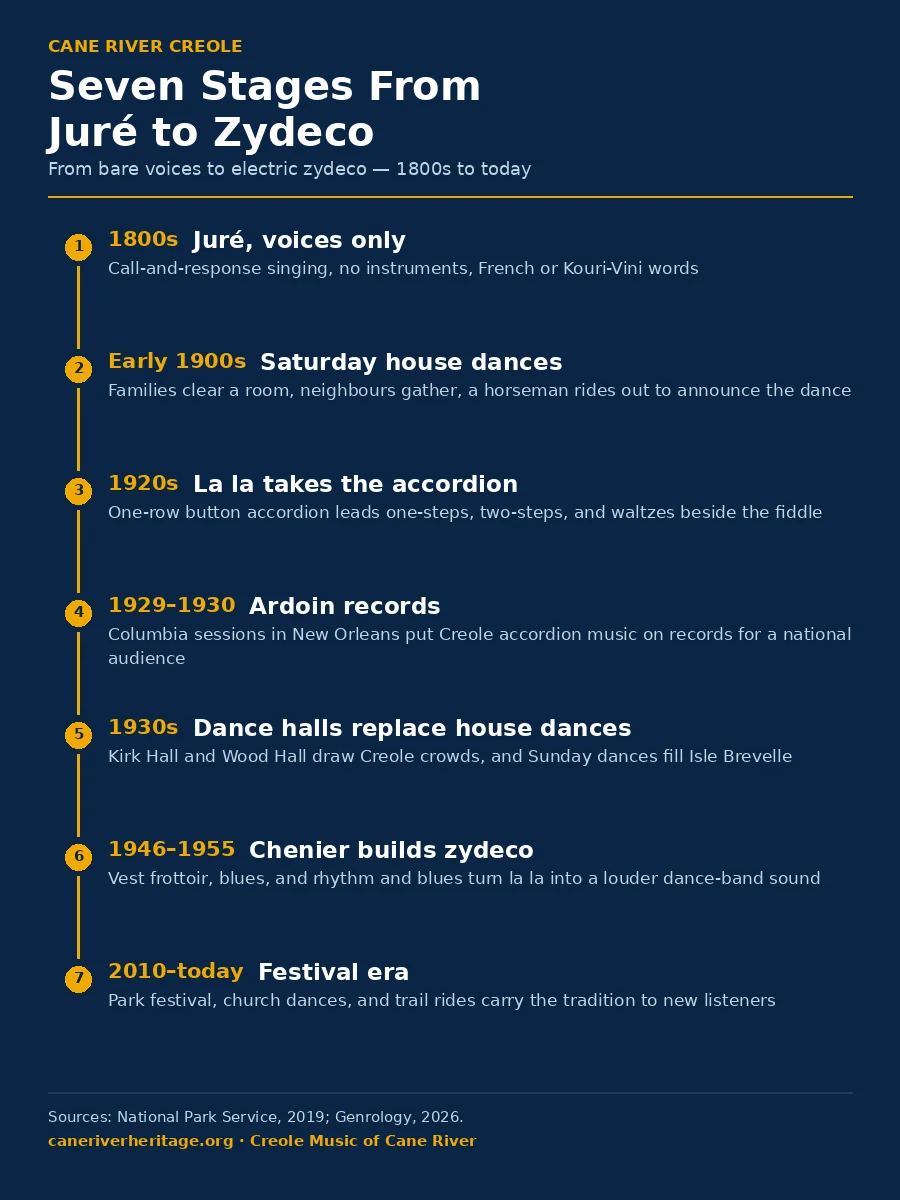
From juré singing to zydeco, seven stages carry Creole music from bare voices in the 1800s to the park festival of today.
Notice what never disappears. Call-and-response survives in zydeco choruses, and the frottoir still scrapes the beat hands once clapped.
Dancing explains the changes better than recording does. Every new instrument arrived because dancers wanted a louder floor, not because musicians tired of the old sound.
Amédé Ardoin: The Voice That Left Home
Rougeau Farm, near Basile, Louisiana, was Ardoin’s birthplace in 1898 (National Park Service, 2019). He grew up in a French-speaking Black Creole farming family, and he spoke no English.
A high voice and swinging rhythm set him apart from every other player on the floor. Self-taught on the accordion, he played house dances with fiddlers while still young.
New Orleans hosted his first Columbia Records session in 1929, and it produced his first solo album (National Park Service, 2019). Six songs from the December 1929 session were among the first Acadiana recordings, and more sessions with McGee followed in 1930 (Genrology, 2026).
Ardoin and McGee had met as children, working on a farm near Eunice. In the segregated South, those records found listeners across the colour line.
About three dozen Ardoin recordings survive, on Brunswick, Vocalion, Decca, Melotone, and Bluebird (Genrology, 2026). European song forms mixed with African swing in his playing, and that mix set the template for Creole and Cajun music alike.
Acadiana, not Cane River, was Ardoin’s home ground. Yet his records remade the music Cane River dances to, so his story belongs in this guide.
Violence cut his career short. Relatives and fellow players said he was beaten in a racial attack around 1939 and never fully recovered (Genrology, 2026).
Reports of his death in 1942 differ from one another. What no account disputes is the debt later players owe him: his songs remain core repertoire for Creole and Cajun musicians.
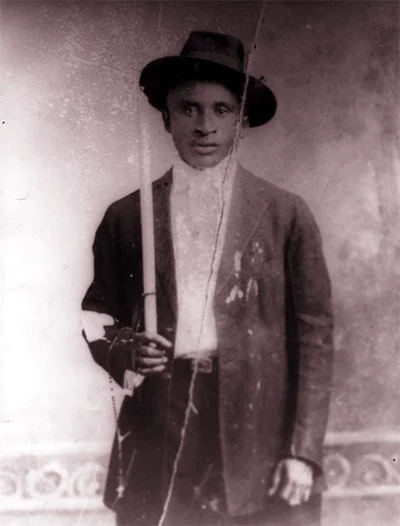
Amédé Ardoin in 1912, the only known photograph of him.
La La: The House-Dance Sound
La la is the sound of a cleared front room. An accordion leads, a fiddle answers, and a triangle rings above the dancers’ feet.
German makers built the one-row button accordion for this music. By the 1920s it came in the keys of C and D, so it could pair with the fiddle (Genrology, 2026).
One-steps, two-steps, and waltzes filled the evening. Until the Second World War, the repertoires ran close together, and Creole players often played for white audiences.
Parish halls, rural dance halls, and nightclubs took over from house parties (Genrology, 2026). Saturday dances stayed the heart of the week, wherever the floor stood.
Kitchens and dance floors kept French alive after schools banned it. Louisiana’s 1864 constitution ordered English-only schooling, and the bans of 1916 and 1921 kept French out of classrooms (National Park Service, 2019).
Only the 1974 constitution acknowledged the right to preserve French origins. Song, not schoolbooks, had carried the language for a century by then.
Zydeco: The New Name for an Old Party
Zydeco grew from la la and juré in the early 1950s. Blues, rhythm and blues, jazz, and gospel joined the old dance tunes, and electric instruments followed.
Opelousas country produced the man who led the change. Working at a refinery in Port Arthur, Texas, Clifton Chenier commissioned the first vest frottoir in 1946 (Genrology, 2026).
Welder Willie Landry built that first rubboard from corrugated metal. Worn on the chest, it became zydeco’s signature percussion.
Boozoo Chavis cut Paper in My Shoe in 1955. A Goldband subsidiary released it in 1955, among the earliest zydeco songs sold commercially (Genrology, 2026).
Spelling followed sound. Musicologist Mack McCormick used zydeco in 1960 liner notes.
Its likely source is les haricots ne sont pas salés, an idiom for hardship (Genrology, 2026).
Mainstream success arrived in 1983, when Chenier won a Grammy Award (Genrology, 2026). Rounder Records later released Chavis through the 1980s and 1990s, and zydeco acts now play roots festivals worldwide.
Do not mistake zydeco for the whole Creole tradition. La la and juré still live beside their electrified child, played in the old style at festivals and family dances.
Creole and Cajun Are Not the Same Sound
Two traditions share a dance floor here, but they are not the same thing. They overlapped heavily before the Second World War, then split into separate dance-band sounds.
Acadian settlers farther south built the Cajun tradition. African American rhythm and the blues run through Creole music, and that weight pulled it toward zydeco.
Ardoin’s songs belong to both repertoires. Fiddler Canray Fontenot and accordionist Alphonse Ardoin kept the old house-dance style alive on records and film into the 1990s (Genrology, 2026).
Listeners who want the old style should start with the Fontenot-Ardoin duo. Folklorist Ralph Rinzler arranged their 1966 Newport appearance, which carried house-dance music outside Louisiana for the first time (Genrology, 2026).
Where to Hear It Today
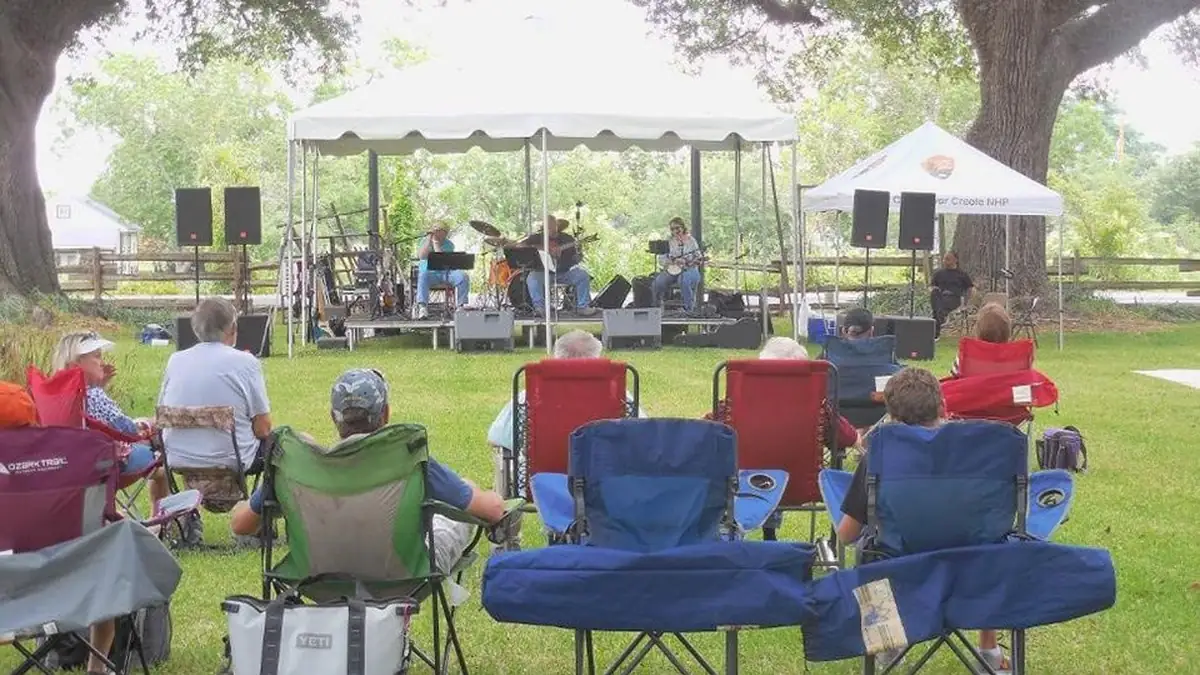
Cane River Creole National Historical Park began its music festival in 2010 (National Park Service, 2019). Held annually at Oakland Plantation, it features local artists on the ground the music came from.
Goldman Thibodeaux and the Lawtell Playboys played the 2010 festival (National Park Service, 2019). Cheesebox guitars, rare and round-bodied, appeared at the 2012 festival, a reminder that homemade instruments still shape the sound.
Between festivals, the music lives on at church dances and trail rides. The St Augustine fair brings zydeco back to Isle Brevelle each October.
Hunter’s paintings show the singers of this music, at house dances and church gatherings. Her nine African House murals hang at Melrose, a short drive from the festival grounds.
Contemporary bands play traditional Creole music with new influences. Electric guitar and drums now join the accordion, yet the call-and-response heart stays audible.
Before You Listen
Start with a juré recording, then a la la two-step, then a zydeco band. Hearing the three in order makes the family resemblance hard to miss.
Check the park’s own pages before travelling, since festival dates change. Hours, prices, and addresses are skipped here; all three change too often to print.
The Sound Carries On
Testimony without instruments became house-dance music, then records, then zydeco. It still gathers neighbours on a Saturday night, on ground their grandparents danced.
Keep listening for the voices underneath the accordion. They are the oldest sound on Cane River, and they have never stopped.
Frequently Asked Questions
What is juré singing?
Unaccompanied call-and-response, sung in French or Louisiana Creole, is juré singing. Hands and feet provide the rhythm, and the name comes from the French jurer, meaning to testify.
How is la la different from zydeco?
Early twentieth-century house-dance music, led by a one-row accordion and fiddle, is la la. From that house-dance base came zydeco, plugging in electric instruments and adding the vest frottoir to blues and rhythm and blues.
Who was Amédé Ardoin?
Born in 1898 near Basile, Ardoin sang and played accordion, cutting his first Columbia sides in New Orleans in 1929. Local players still call him the father of French music, and his songs sit at the core of both repertoires.
Is Creole music the same as Cajun music?
The two traditions overlapped heavily before the Second World War, then split apart. Creole music carries African American rhythm and the blues, while Cajun music descends from Acadian settlers farther south.
Where can I hear Creole music on Cane River today?
Start at the park music festival at Oakland Plantation, held annually since 2010. Church dances, trail rides, and the St Augustine fair in October carry the same tradition.
Methodology
National Park Service pages supplied the Cane River facts, and Genrology supplied the wider Louisiana lineage. Speaker counts for Kouri-Vini come from the site’s statistics article, linked in the text.
Verification ran on 26 November 2026: every date and figure below traces to at least one of the two sources read in full. When sources disagreed, both versions appear here and the reader can judge.
Limits: no verified attendance figures exist for the park festival or the St Augustine fair. His death in 1942 is reported differently by different accounts, so this article gives the year both agree on.