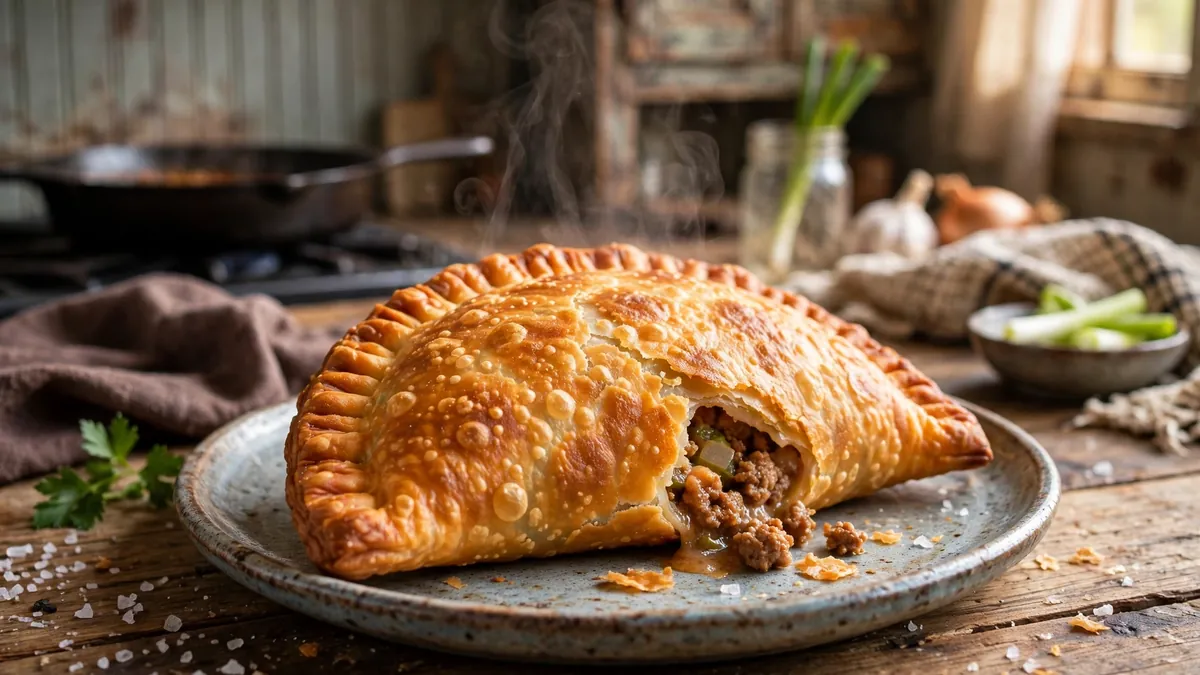
Main image: AI illustration.
Say the words Natchitoches meat pie in Louisiana, and most people picture a golden half-moon, hot from the fryer.
Crisp pastry gives way to seasoned ground beef and pork, with onion, bell pepper, and garlic folded in.
That hand pie is the signature dish of Cane River Creole culture, a farming community along Cane River in north Louisiana.
Behind one snack stands a whole cuisine, built by French, Spanish, African, and Native cooks over three centuries.
Summary
- A Natchitoches meat pie is a half-moon hand pie of ground beef and pork in a flaky crust, traditionally deep-fried.
- Earliest written record of the pie sits in a missionary’s journal from 1826.
- Isle Brevelle’s Creole women of color made the pie famous decades before restaurants sold it.
- In 1967 a Natchitoches butcher named James Lasyone opened a pie kitchen, and the dish went national from there.
- Summer 2003 brought a unanimous vote, and Louisiana gave the pie a state title.
- Beyond the pie, Cane River Creole cooking stands on gumbo, filé, tamales, sausage, gravy, and gardens.
What a Natchitoches Meat Pie Is
Pronounced NACK-uh-tish, the pie is a savory turnover, shaped like a half-moon and sized to fit one hand.
Inside the crust sits a filling of ground beef and pork, cooked with onion, bell pepper, garlic, and seasonings.
Flour binds the browned meat and vegetables into a savory mixture, and the filling rests a day before frying.
Tradition calls for deep-frying until the crust turns golden and crisp, though some kitchens bake the pie instead.
Lasyone’s still uses a four-to-one ratio of ground beef to ground pork, the mix James Lasyone settled on (JSTOR Daily, undated).
Crawfish pies came later, and they now sit beside the classic beef-and-pork pie on Natchitoches menus.
Spanish empanadas offer the closest comparison, since both wrap seasoned meat in pastry for eating by hand.
Unlike an empanada, though, this pie carries the holy trinity of Louisiana cooking in every bite.
Where the Pie Came From
No single inventor stands behind the pie, and its roots likely stretch back to the 1700s.
Soldiers at Los Adaes, the Spanish outpost just west of Natchitoches, may have carried the empanada into the region (64 Parishes, 2023).
Louis Juchereau de St. Denis, the French-Canadian founder of Natchitoches, may have brought a taste for tourtière (64 Parishes, 2023).
Native cooks shaped the dish too, according to the city’s own 2026 proclamation, which traces the pie’s concept to the mid-1700s (City of Natchitoches, 2026).
Crossroads explain the mixture better than any single ancestor, since French, Spanish, African, and Native cooks traded food here for generations.
A missionary named Timothy Flint wrote about meat pies near Natchitoches, and his journal reached print in 1826 (64 Parishes, 2023).
By then the pie was already a local habit, not a new invention.
The Women Who Kept the Pie Alive
Restaurants did not invent this pie, and they were not its first sellers either.
Home kitchens came first, and street vendors carried pies through town in the early twentieth century (Wikipedia, 2026).
Isle Brevelle, about twelve miles south of Natchitoches on Cane River, supplied the most famous pie makers (64 Parishes, 2023).
When Ascher Rouqier died in 1913, the Natchitoches Enterprise ran a column lamenting her death (64 Parishes, 2023).
Visitors in the 1950s and 1960s ordered pies from Louise Sarpy after spotting her classified advertisements (64 Parishes, 2023).
That work matters because famous foods usually live in home kitchens long before restaurants adopt them.
These women cooked in the community that Coincoin’s descendants built, a story told in Marie Thérèse Coincoin and the Métoyer Family.
Without their hands, the pie might have stayed a farmhouse habit instead of becoming a town’s signature.
Lasyone’s: From Butcher Shop to Landmark
James Lasyone sold ground meat to women who made pies at home, and he watched the demand grow (JSTOR Daily, undated).
He opened Lasyone’s Meat Pie Kitchen and Restaurant at 622 Second Street in 1967, and cooked-to-order pies became a daily fact (64 Parishes, 2023).
More dining rooms followed, seating up to one hundred guests, as travellers learned the address (64 Parishes, 2023).
House Beautiful praised Natchitoches and its meat pies in February 1974, and national writers followed (64 Parishes, 2023).
Craig Claiborne wrote about the pie for the New York Times, and Calvin Trillin wrote about it for the New Yorker (64 Parishes, 2023).
Good Morning America, Glamour, and Southern Living carried the story onward through the 1970s and 1980s (64 Parishes, 2023).
In 2002 the kitchen was serving between four hundred and one thousand meat pies each day (64 Parishes, 2023).
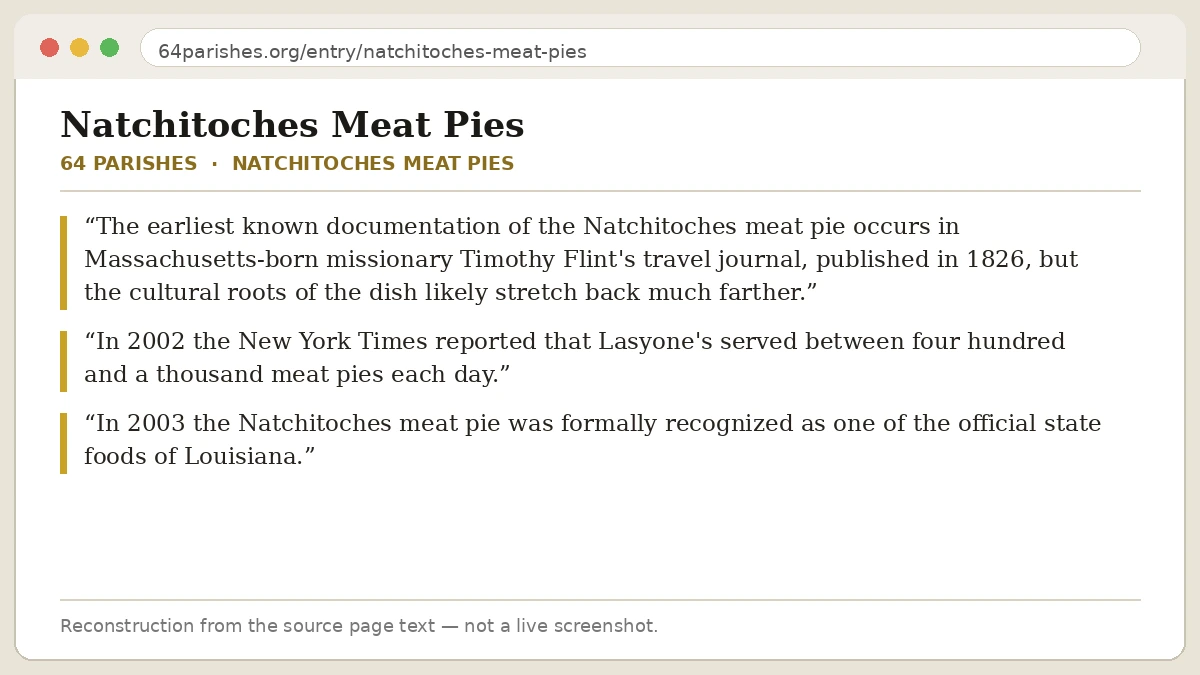
64 Parishes on the meat pie: Flint’s 1826 journal, Lasyone’s 400–1,000 pies a day in 2002, and the 2003 state title. Reconstruction from the source page text.
James Lasyone died in 2015 at eighty-four, and his daughters Angela and Tina still run the restaurant on his recipe (64 Parishes, 2023).
Today the restaurant keeps daytime hours, opening at seven in the morning and closing in the early afternoon (Travelmag, 2026).
Its menu still centres on the pie, with crawfish étouffée, chicken and sausage gumbo, and red beans and rice (Only In Your State, undated).
An Official State Food
The legislature voted without dissent in the summer of 2003, and the pie became a state symbol by law (JSTOR Daily, undated).
State representative Taylor Townsend, a Natchitoches native, carried the bill that made the pie official (JSTOR Daily, undated).
Twelve years later, the legislature named a mini Natchitoches meat pie the appetizer of North Louisiana’s official meal (Louisiana State Legislature, 2015).
Natchitoches now calls itself the Meat Pie Capital of Louisiana, and the title fits the town’s history (Tour Louisiana, undated).
Few Louisiana foods carry a state title, and fewer still belong so clearly to one small city.
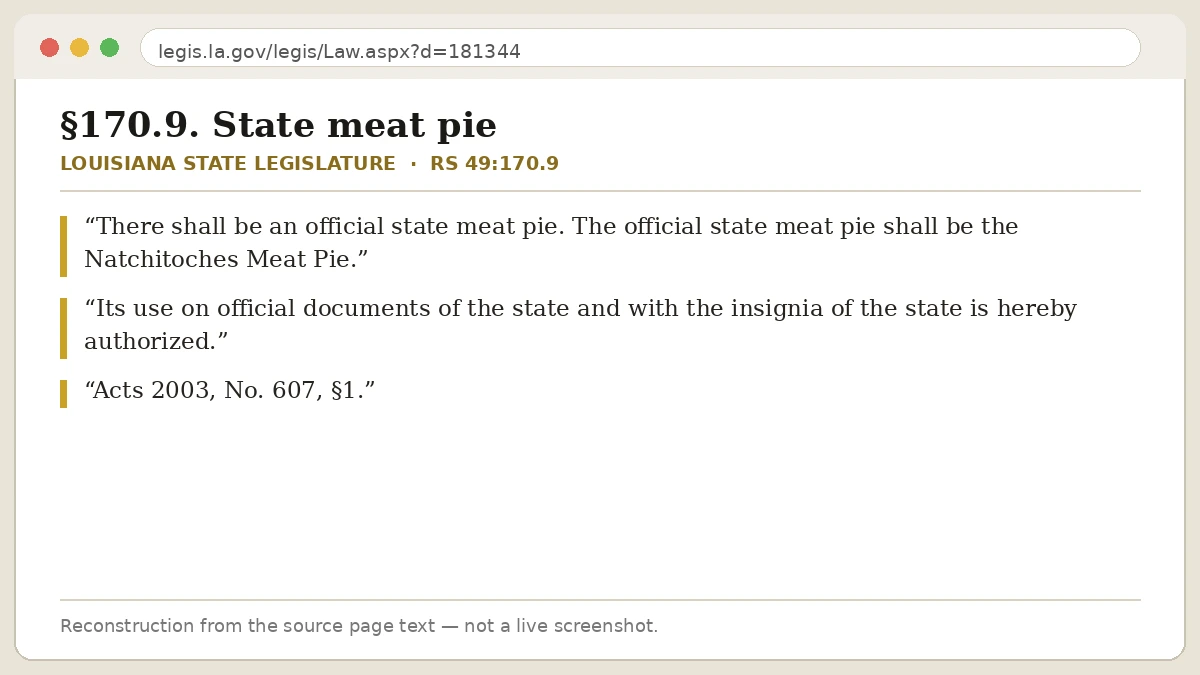
Louisiana law RS 49:170.9 names the Natchitoches Meat Pie the official state meat pie. Reconstruction from the source page text.
Gumbo: The Pot That Feeds a Crowd
Gumbo feeds crowds here, and church fairs, Mardi Gras gatherings, and family events all call for a large outdoor pot (EatBayou, 2026).
Chicken gumbo leads the tradition, cooked outdoors in pots big enough for a whole congregation (EatBayou, 2026).
Sausage or other meats join according to occasion and availability, and every cook guards a family version (EatBayou, 2026).
Roux gives the pot its body, okra gives it a West African root, and filé gives it a Native one (Historic New Orleans Collection, undated).
Each cook seasons by habit rather than by book, so no two church-fair gumbos taste quite alike.
Arguing over the pot is part of the meal, and the argument itself proves how much the dish matters.
Filé: The Native Ingredient in the Pot
Filé powder is dried sassafras leaf, ground fine, and it carries Native knowledge into the gumbo pot (EatBayou, 2026).
Cane River families once gathered sassafras in the uplands, and Native sellers brought filé and herbs to Creole kitchens (EatBayou, 2026).
John Oswald Colson, a Cane River Creole recognised as a Louisiana Tradition Bearer, still harvests sassafras in Kisatchie National Forest (Atlas Obscura, undated).
Dustin Fuqua, who manages resources at Cane River Creole National Historical Park, learned the craft as Colson’s apprentice for over ten years (Atlas Obscura, undated).
Choctaw practice shapes the method, and the harvest follows lessons Colson learned from his parents (Atlas Obscura, undated).
Add filé at the end of cooking, never while the pot boils, or the gumbo turns stringy (Historic New Orleans Collection, undated).
Sassafras grows wild across this parish, which is why one expert calls Cane River country the hotbed of gumbo filé (Historic New Orleans Collection, undated).
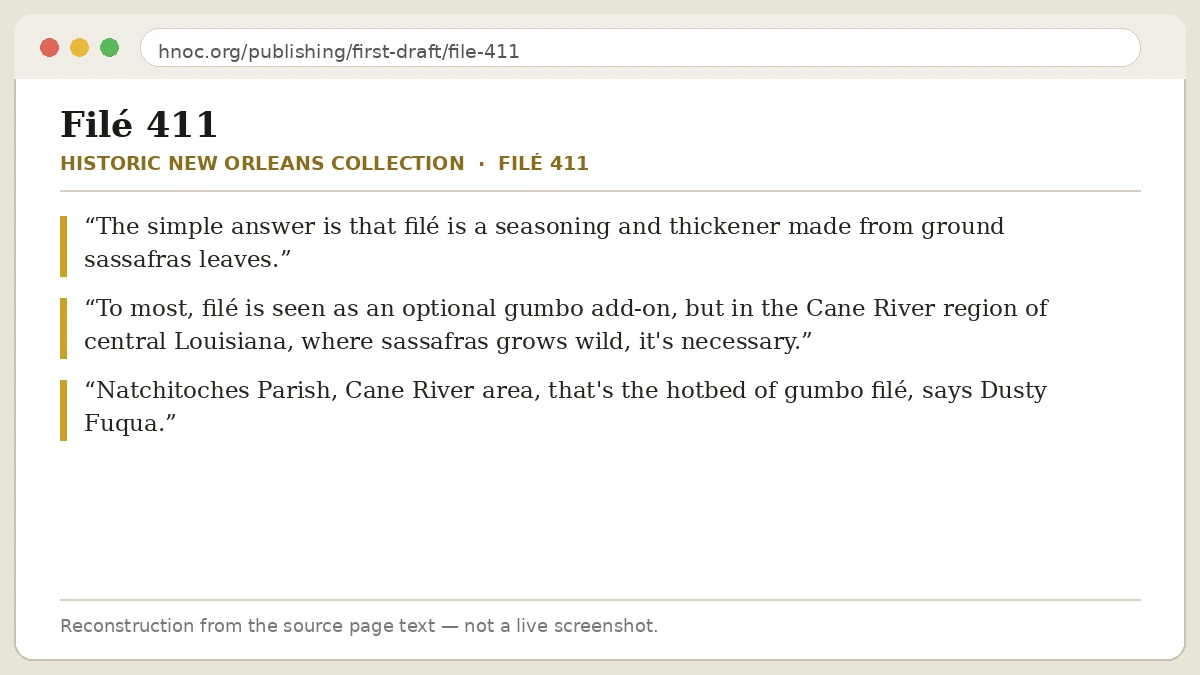
Historic New Orleans Collection on filé: ground sassafras leaves, necessary in Cane River gumbo, the hotbed of gumbo filé. Reconstruction from the source page text.
Okra came another way, from West Africa, where the word ki ngombo likely gave gumbo its name (Atlas Obscura, undated).
Tamales, Sausage, and Gravy
Tamales surprise first-time visitors, yet they belong at St Augustine Catholic Church gatherings beside gumbo and meat pies (EatBayou, 2026).
Old crossroads explain the tamale, since French, Spanish, Indigenous, and African foodways met in this parish.
Pork fed the community through the year, and a single hog could supply chops, ribs, ham, sausage, and smoked meat (EatBayou, 2026).
Several sausage types were known along Cane River, and cooks preserved pork by smoking it or storing it in rendered fat (EatBayou, 2026).
Tasso, the smoked and dried meat now linked with Cajun cooking farther south, also has a Cane River history (EatBayou, 2026).
Gravy tied the table together, since smothered meats turned modest cuts into dishes worth serving with bread or rice (EatBayou, 2026).
Rice and gravy remains the everyday plate of central and north Louisiana, and Cane River cooks claim it as their own (EatBayou, 2026).
The Rest of the Cane River Table
Caddo farmers came first, growing corn, beans, squash, and sunflowers while hunting deer and catching fish (EatBayou, 2026).
Their knowledge of land, water, crops, and trade routes shaped the region Europeans later entered (EatBayou, 2026).
Enslaved families kept garden plots beside the cotton fields, raising sweet potatoes, watermelons, turnips, and other vegetables (EatBayou, 2026).
After emancipation, Black cooks, gardeners, farmers, and labourers carried those foodways into tenant farms, church kitchens, and family tables (EatBayou, 2026).
Fried chicken, greens, beans, cornbread, freshwater fish, and sweet potatoes all belong to that history (EatBayou, 2026).
Gardens still feed the parish, with greens, beans, peas, tomatoes, corn, squash, peppers, and sweet potatoes in season (EatBayou, 2026).
Pecan trees ringed Creole homes long before commercial orchards, and families gathered the nuts for pies, cakes, and pralines (EatBayou, 2026).
Catfish, crappie, bream, and bass fill the parish waters, and gar becomes a boulette, ground and smothered in gravy over rice (EatBayou, 2026).
Barbecue belongs to the wider parish table too, and Grayson’s Barbeque in Clarence has smoked meat for more than half a century (EatBayou, 2026).
Not Cajun, Not New Orleans Creole
Two labels follow Louisiana food everywhere, and both fit Cane River badly.
Cajun cooking grew from Acadian exiles who settled the prairies and bayous of south Louisiana after 1755 (Explore Louisiana, undated).
New Orleans Creole cooking grew in a port city, with tomatoes, butter roux, and Caribbean and European imports at hand (Explore Louisiana, undated).
Cane River Creole cooking grew in a farming community, where families and church kitchens set the table.
Natchitoches sits outside the traditional Cajun prairie, and its historic French-speaking food tradition is Creole (EatBayou, 2026).
The 1901 Picayune Creole Cook Book, with over a thousand New Orleans recipes, contains no Natchitoches meat pie at all (Wikipedia, 2026).
| Cajun | New Orleans Creole | Cane River Creole | |
|---|---|---|---|
| Heartland | Acadiana prairies and bayous | New Orleans, a port city | Cane River valley, north Louisiana |
| Cooks | Acadian exiles after 1755 | City cooks, free people of color, Caribbean traders | Farm families, Creole women of Isle Brevelle |
| Thickener | Dark oil roux | Butter roux, tomatoes | Roux, okra, filé |
| Setting | One-pot country cooking | Restaurants, city tables | Church fairs, family kitchens |
| Signature dish | Boudin, dark gumbo | Shrimp creole, tomato gumbo | Natchitoches meat pie, chicken gumbo |
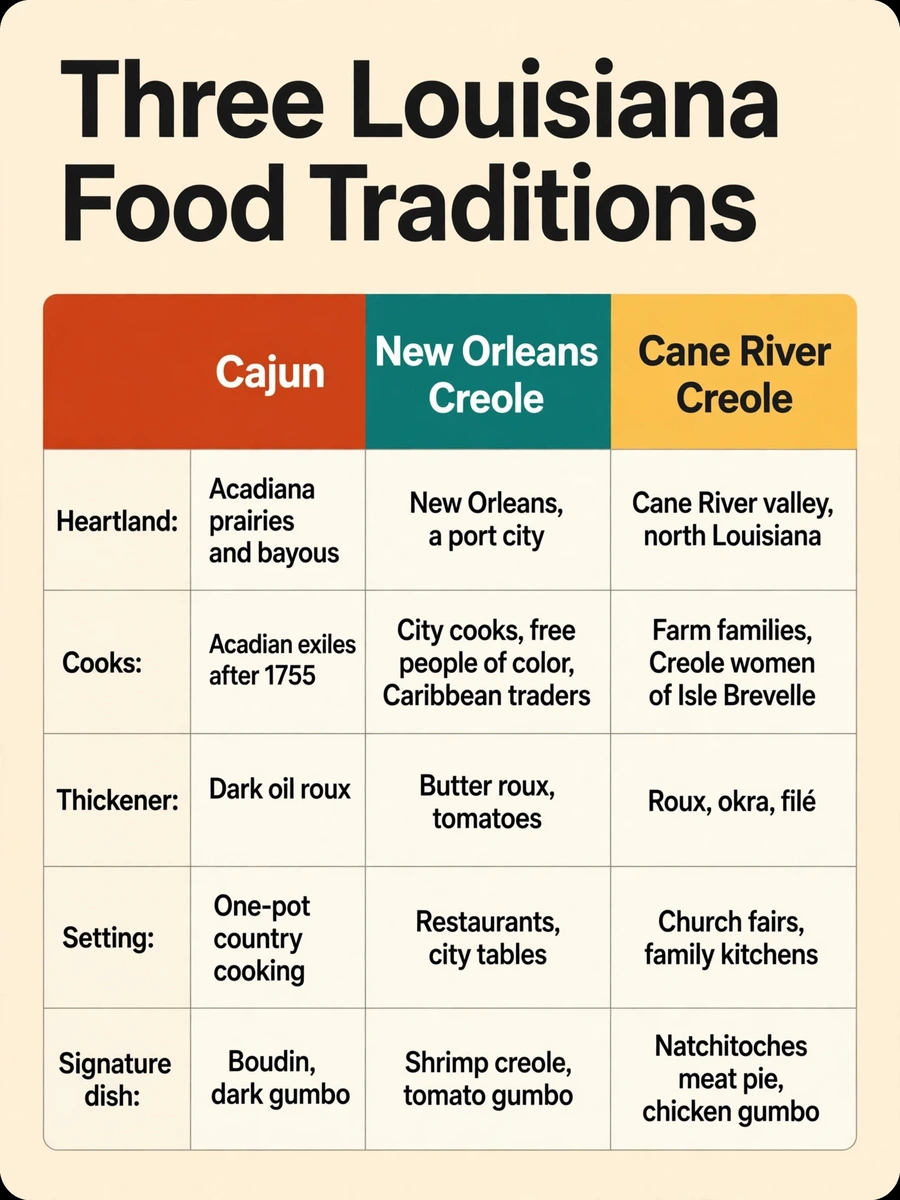
Three Louisiana food traditions side by side: Cajun, New Orleans Creole, and Cane River Creole — heartland, cooks, thickener, setting, and signature dish.
A Timeline of the Cane River Table
| Year | Event |
|---|---|
| 1714 | Natchitoches founded, the oldest permanent European settlement in the Louisiana Purchase |
| 1826 | Timothy Flint describes meat pies near Natchitoches |
| 1913 | Ascher Rouqier dies, and the local paper mourns her pies |
| 1950s–1960s | Louise Sarpy sells pies through classified advertisements |
| 1967 | James Lasyone opens Lasyone’s Meat Pie Kitchen |
| 1974 | House Beautiful praises Natchitoches meat pies |
| 2002 | Natchitoches Meat Pie Festival formed |
| 2003 | Louisiana names the pie its official state meat pie |
| 2015 | North Louisiana’s official meal names a mini meat pie its appetizer |
| 2026 | The festival marks its 25th year, 18–19 September |
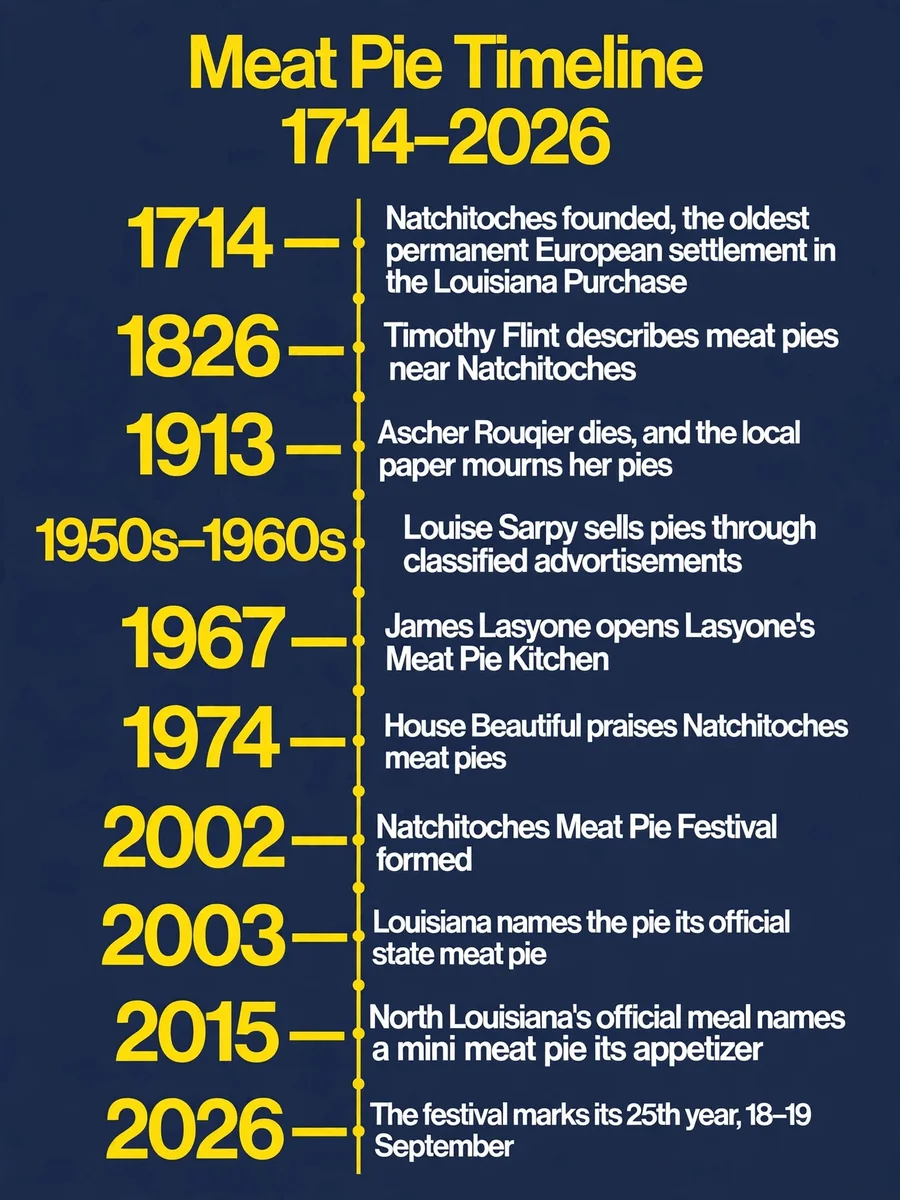
Meat pie timeline, 1714–2026: Natchitoches founded, Flint’s 1826 journal, Lasyone’s 1967 opening, the 2003 state title, and the 25th festival in 2026.
Where to Taste It Today
Start downtown, where Lasyone’s still serves the pie at 622 Second Street, Monday through Saturday (Travelmag, 2026).
Maglieaux’s offers mini meat pies on a patio above Cane River Lake, at 805 Washington Street (This Is My South, undated).
Merci Beaucoup, at 127 Church Street, serves mini meat pies and sells chicken and sausage gumbo by the gallon (TravelAwaits, undated).
French Market Express, off Interstate 49, sells regular, spicy, and crawfish pies around the clock (This Is My South, undated).
Front Street Marketplace gives the same downtown another quick stop for a pie on foot (This Is My South, undated).
South of town, the St Augustine church fair still gathers descendants each autumn, with gumbo, meat pies, and tamales on the tables (EatBayou, 2026).
September brings the Meat Pie Festival to the downtown riverbank, free to enter, with cooking and eating contests (City of Natchitoches, 2026).
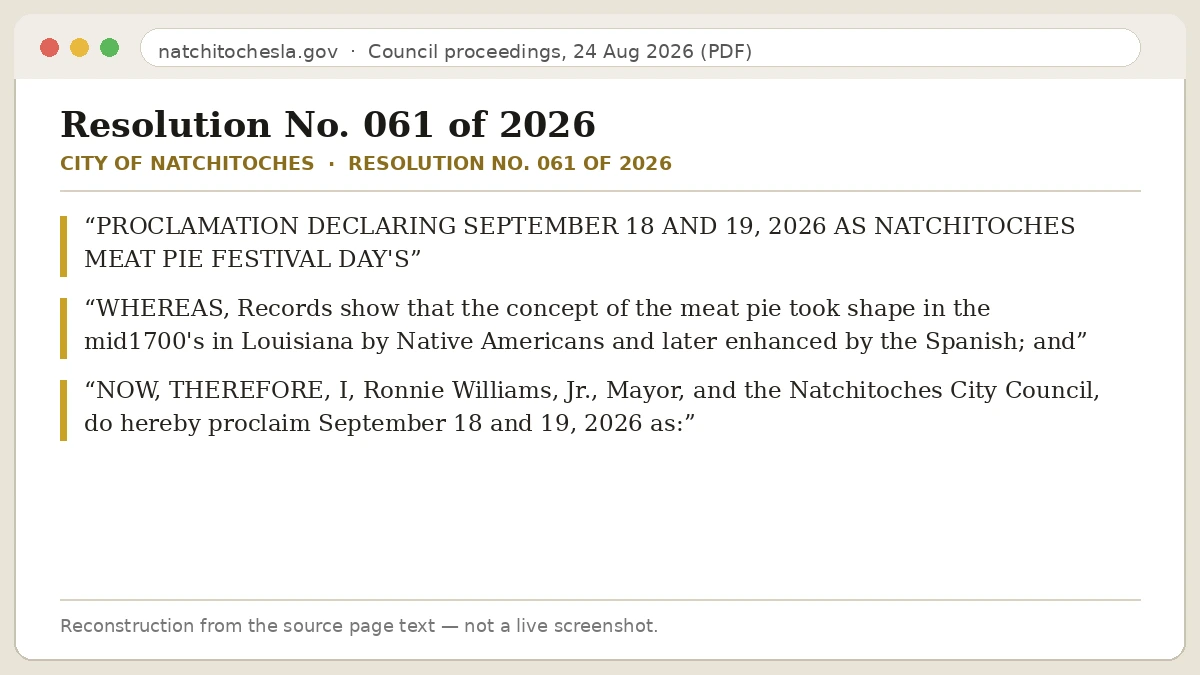
Resolution No. 061 of 2026 proclaims 18–19 September 2026 as Natchitoches Meat Pie Festival Days. Reconstruction from the source PDF text.
December brings the Christmas Festival of Lights, when meat pies join holiday meals along the river (EatBayou, 2026).
Pies also travel, since Lasyone’s ships them and frozen pies reach grocers across north Louisiana (This Is My South, undated; Wikipedia, 2026).
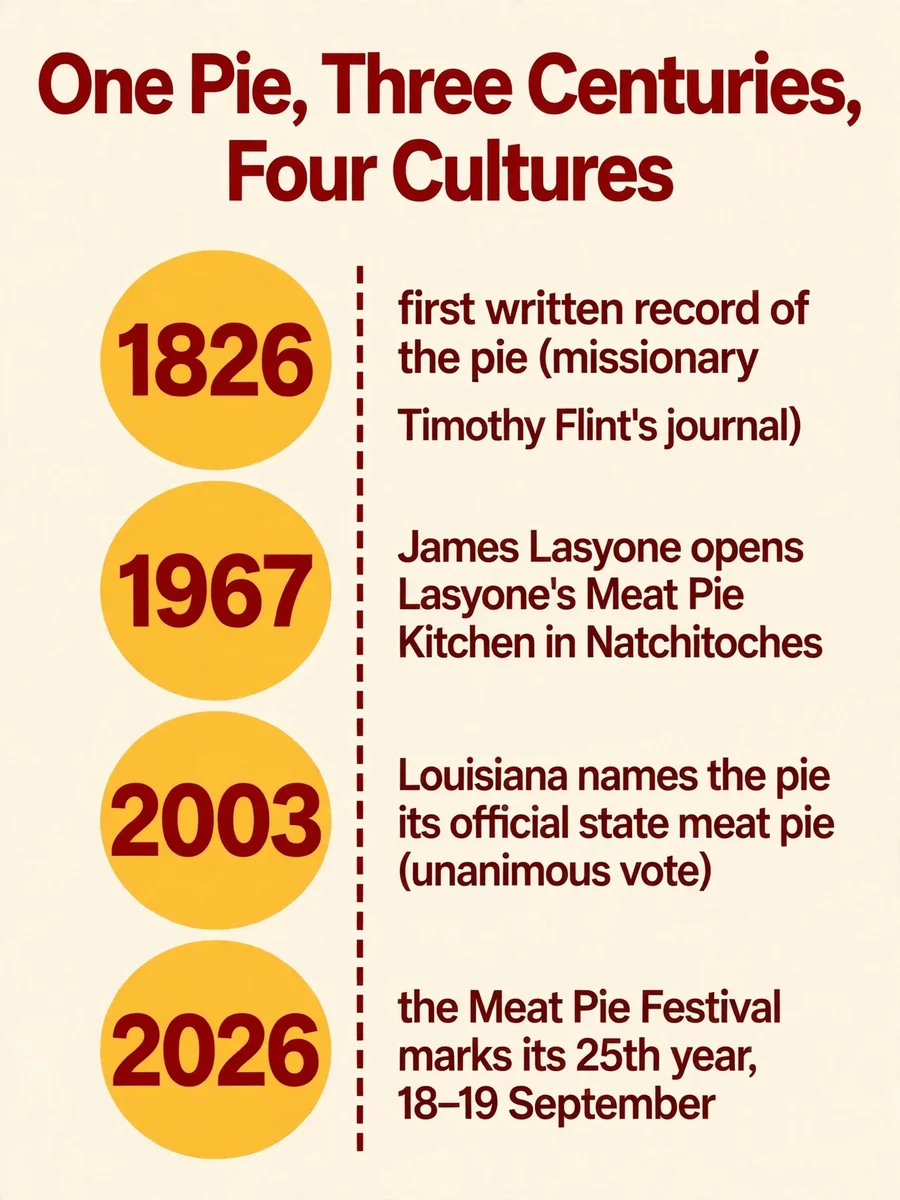
One pie, three centuries, four cultures: 1826, 1967, 2003, and the 25th festival in 2026.
Frequently Asked Questions
What is a Natchitoches meat pie?
It is a half-moon hand pie of seasoned ground beef and pork in a flaky crust, deep-fried until golden.
Where can I eat a Natchitoches meat pie?
Lasyone’s in downtown Natchitoches is the classic stop, and Maglieaux’s, Merci Beaucoup, and French Market Express also serve them.
Why is Cane River Creole food not Cajun food?
Cajun cooking comes from Acadian exiles on the south Louisiana prairies, while Cane River cooking comes from a Creole farming community.
What makes filé different from okra in gumbo?
Filé is ground sassafras leaf from Native tradition, added at the end, while okra is a West African vegetable cooked in the pot.
When is the Natchitoches Meat Pie Festival?
Each September, on the downtown riverbank, with free entry and a meat pie cooking contest.
Methodology
Every date and figure in this article comes from a named source, and each source appears in the References below.
Histories of the pie rest on 64 Parishes, the Louisiana Endowment for the Humanities encyclopedia, and the city’s own 2026 festival proclamation.
Foodways beyond the pie rest on EatBayou’s parish survey, which draws on National Park Service research, and on the Historic New Orleans Collection.
Search volume, keyword difficulty, and cost per click for the target phrase remain unverified, and no figure of that kind appears here.
Where sources disagree, the article prints the firmer record and names the other account.
Hours and menus change, so readers should check the latest details before travelling.
References
- Natchitoches Meat Pies, 64 Parishes
- The Food Traditions of Natchitoches Parish, EatBayou
- A Food Lover’s Guide to Cane River Country, EatBayou
- The Multi-Cultural Origins of Louisiana’s Official State Meat Pie, Food Republic
- What is a Natchitoches Meat Pie and Where Can I Eat It?, This Is My South
- How Delicious Meat Pies Put Natchitoches on the Map, JSTOR Daily
- Natchitoches meat pie, Wikipedia
- Louisiana State Meat Pie, Louisiana State Legislature
- House Concurrent Resolution No. 88 (2015), Louisiana State Legislature
- Resolution No. 061 of 2026, City of Natchitoches
- History of the Meat Pie, Natchitoches Meat Pie Festival
- Native-American Origins of Gumbo, Atlas Obscura
- Filé 411, Historic New Orleans Collection
- Cajun vs. Creole Food, Explore Louisiana
- At Lasyone’s in Natchitoches, One Golden Meat Pie Is Worth the Whole Drive, Travelmag
- Louisiana’s Best Kept Culinary Secret Is a Dish Out-of-Staters Never Heard Of, Only In Your State
- Natchitoches Area Convention & Visitors Bureau, Tour Louisiana
- Best Things To Do In Natchitoches, TravelAwaits
- Cane River Creole Culture and History: The Complete Guide, Cane River Heritage
- Cane River Creole in Numbers 2026, Cane River Heritage
- Isle Brevelle: The Free Creole Community That Built Cane River, Cane River Heritage
- Marie Thérèse Coincoin and the Métoyer Family, Cane River Heritage