One room at Melrose Plantation holds the whole Cane River story on its walls. Nine murals wrap the upper floor of the African House, and every scene in them comes from a life lived on the river.
Clementine Hunter painted them in the summer of 1955 (Smithsonian American Art Museum, 2022). She was about 67, a cook and former field worker who painted after her kitchen work (Louisiana Office of Culture, Recreation and Tourism, 2015).
The Clementine Hunter African House murals fill one room with work, worship, weddings, and wakes. This article reads the nine scenes one by one, then tells the life behind them and the art colony around her.
For the land and the families behind these murals, see the full guide, Cane River Creole Culture and History: The Complete Guide. For the music itself — juré singing, la la, zydeco — see the guide Creole music of Cane River.
Summary
- Nine room-size murals line the upper room of the African House. Painting ran from 8 June to 21 July 1955, mostly night work after kitchen duties (Louisiana Office of Culture, Recreation and Tourism, 2015).
- Night work, mostly, from her own sketches and memory — 44 days in all (Louisiana Office of Culture, Recreation and Tourism, 2015).
- About 67 then, a cook and former cotton picker who had never learned to read or write (Louisiana Office of Culture, Recreation and Tourism, 2015).
- Melrose was an artists’ colony as well as a plantation, and its guests supplied the paint Hunter began with.
- François Mignon, the plantation curator, proposed the murals and kept Hunter supplied with paint and brushes.
Nine African House Murals, One Room
Large panels ring the upper room, nine of them, with smaller panels between doors and windows. At 48 by 96 inches, the two largest panels set the scale (Louisiana Office of Culture, Recreation and Tourism, 2015).
Mignon proposed the project in 1955 (Open Road Guide, 2026), and Hunter painted from 8 June to 21 July. Work ran from her own sketches, mostly at night, after her kitchen work ended.
Eight panels are named scene by scene in the published accounts. Funeral and wake fill the ninth, subjects her paintings return to again and again.
- Map: a disc-shaped view of Cane River country, with its cotton, pecans, and churches (Open Road Guide, 2026).
- Cotton harvest: the work Hunter knew firsthand, picking 150 to 200 pounds a day for 75 cents.
- Wedding: one of the gatherings her paintings return to, beside baptisms and wakes.
- River baptism: the river rite that welcomed new members into the church.
- Wash day: laundry work done outdoors, in the open air of the plantation yard.
- Pecan harvest: the autumn gathering that followed the cotton season.
- Saturday night at the honky-tonk: music and dancing after the week’s work ended.
- Grounds of Melrose: the plantation buildings and yard Hunter lived among.
- Funeral and wake: the community gathers to mourn, as it gathers to celebrate.
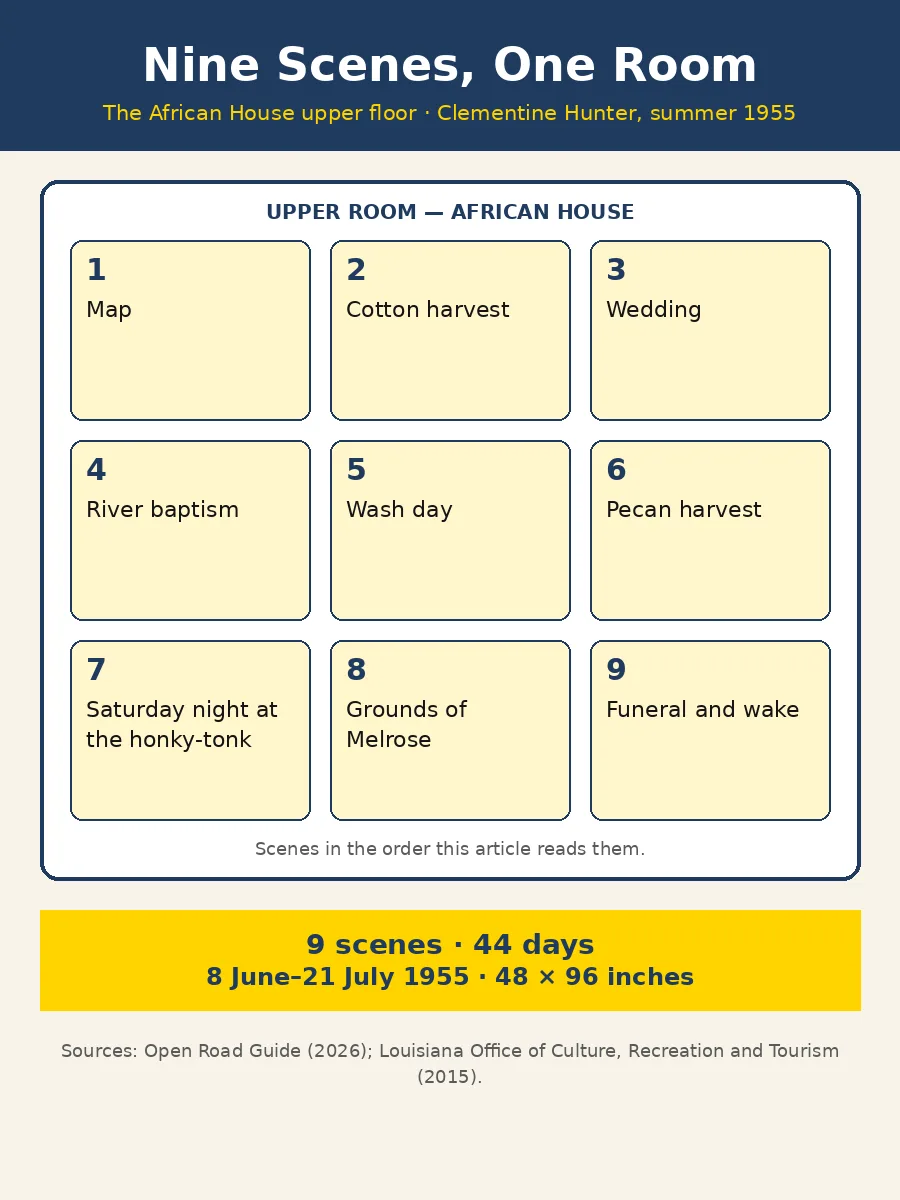
Nine scenes ring one room: map, cotton, wedding, baptism, wash day, pecans, honky-tonk, Melrose grounds, and wake.
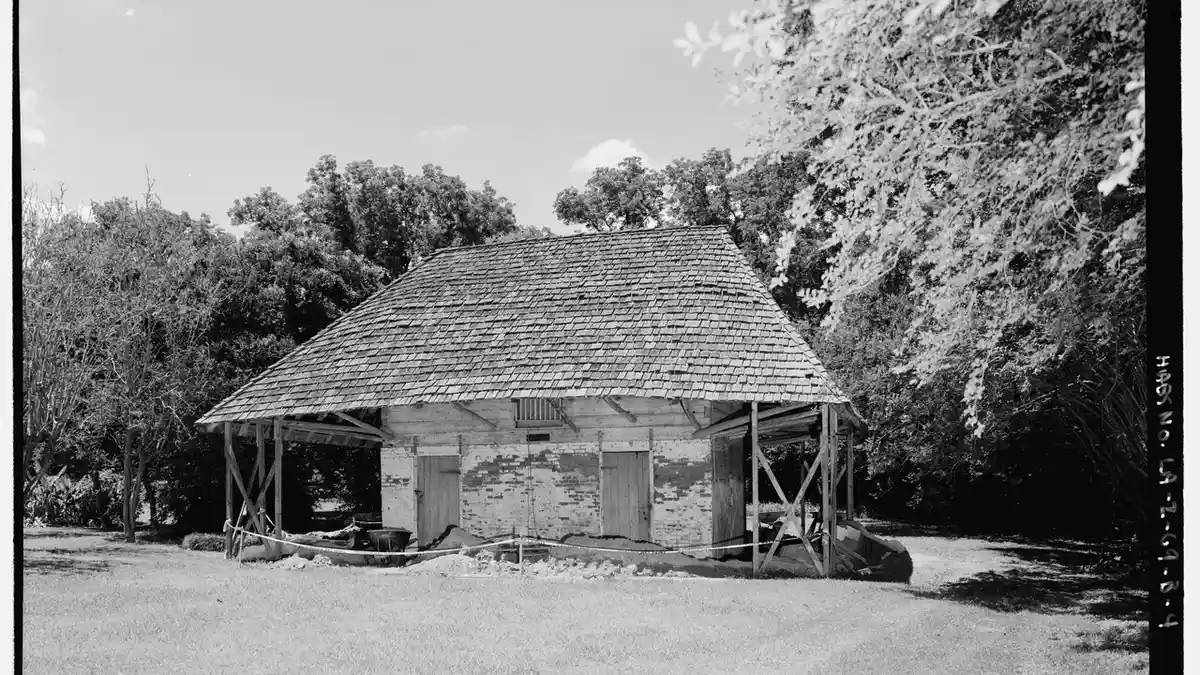
African House itself rose between 1800 and 1830 (SAH Archipedia, 2026). Brick below and timber above, its hipped roof reaches ten feet past the walls.
Design sources for the building are still debated. Long held African in origin, the house is now read as local practice by some scholars (SAH Archipedia, 2026).
Together the nine scenes form a room-size narrative, not nine separate pictures. Viewers stand inside the life Hunter remembered, instead of looking at it from outside.
Panels built for the room carry the scenes, and the room itself is part of the work. Conservation brought the murals down in 2014; the roof was rebuilt in 2015 and new lighting followed in 2016 (Open Road Guide, 2026).
A Life Before the Brush
Hidden Hill Plantation was her birthplace, in late December 1886 or early January 1887 (64 Parishes, undated). Eldest of seven children of French-speaking Creoles of color, she grew up near Cloutierville on the river.
Her time at school lasted under a year, and reading and writing never came. Field work began at eight, picking cotton beside her father.
The family moved to Melrose Plantation in 1902, when she was about fifteen (Wikipedia, 2026). John Hampton Henry, the plantation owner, had hired her father as a wage laborer (Wikipedia, 2026).
Six days a week she picked cotton, 150 to 200 pounds a day for 75 cents (Wikipedia, 2026). Pecan harvests filled the autumn, and night classes with other workers filled some evenings.
Cooking and housekeeping for Cammie Henry came in the late 1920s (Wikipedia, 2026). Creole recipes, clothes, dolls, and the vegetable garden all passed through her hands.
Two children came with Charles Dupre, and marriage to Emmanuel Hunter followed in 1924 (64 Parishes, undated). Five more children followed, and she spoke only Creole French until her husband taught her American English (Wikipedia, 2026).
The Melrose Art Colony
Melrose owes its fame as much to its people as to its buildings. Cammie Henry, widow of John Hampton Henry, turned the plantation into an artists’ colony after her husband died (64 Parishes, undated).
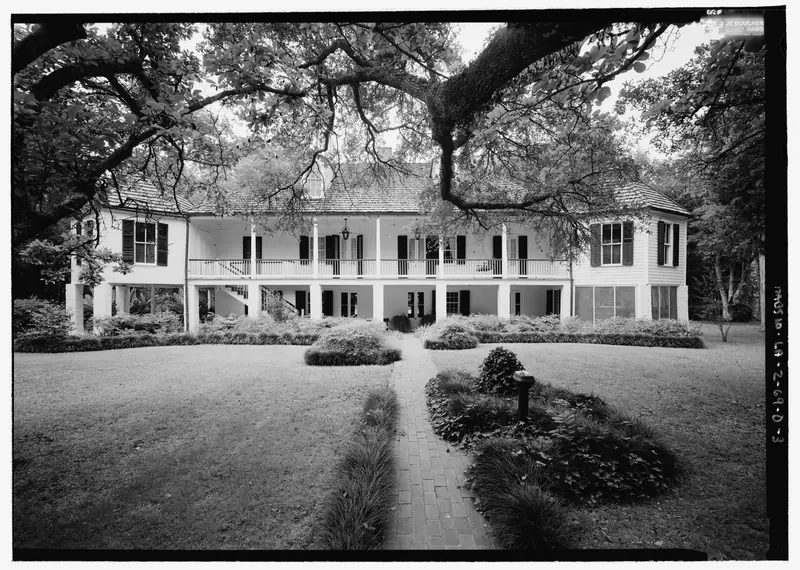
Big House at Melrose Plantation, built under Louis Métoyer and finished by his son in 1833.
Source: Historic American Buildings Survey, public domain.
Artists and writers stayed at Melrose, often in the Yucca House. Guests included Lyle Saxon, Gwen Bristow, Erskine Caldwell, Caroline Dorman, William Faulkner, Alberta Kinsey, William Spratling, and John Steinbeck (SAH Archipedia, 2026).
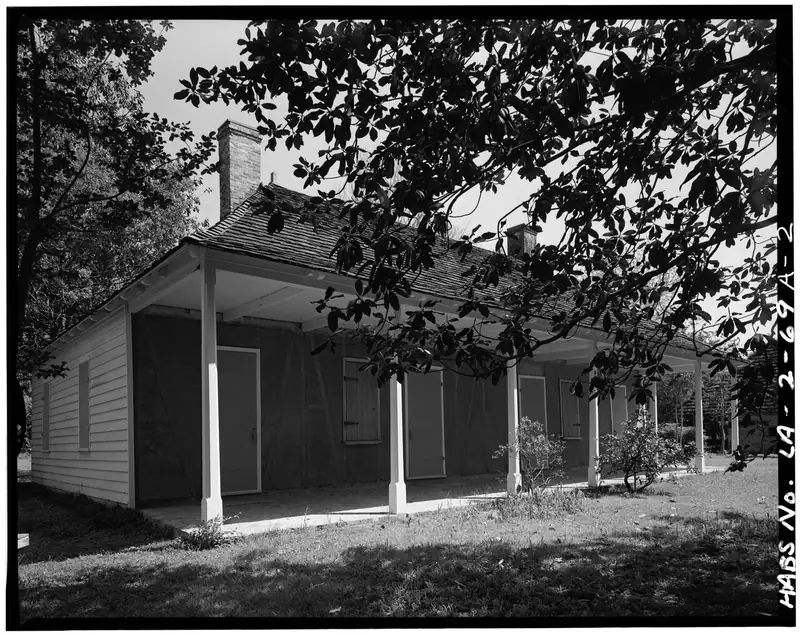
Yucca House at Melrose, one of the plantation’s oldest surviving buildings.
Source: Historic American Buildings Survey, public domain.
Lyle Saxon’s novel Children of Strangers (1937) portrays the Cane River area (SAH Archipedia, 2026). His book carried the river’s story to readers who never saw the plantation.
At Melrose she worked as an employee, not a guest. Cotton picking, cooking, laundry, and childcare filled her days while the colony’s visitors painted.
Contact with the visiting artists inspired Hunter to begin marking pictures. Discarded paint tubes left by Alberta Kinsey in 1939 gave her the first materials she painted with (Open Road Guide, 2026).
Hunter herself said she had painted earlier than that. Kinsey’s visit marks the moment others noticed, not necessarily the moment she began.
François Mignon: The Man Beside the Murals
François Mignon served as curator and librarian at Melrose. A friend of Cammie Henry, he arrived for a six-week visit and stayed thirty-two years (SAH Archipedia, 2026).
Mignon supplied Hunter with paint and materials and promoted her work widely. He hosted her first Cane River Valley show in 1949, in the upstairs African House (Wikipedia, 2026).
He proposed the African House murals in 1955, and Hunter accepted at an age when most people retire (Open Road Guide, 2026). Together they produced the nine panels that depict the history of the Cane River Valley.
Cookbook work followed in 1956, when Mignon and Hunter coauthored the Melrose Plantation Cookbook (Wikipedia, 2026). Recipes from her kitchen, photographs of the plantation, and her own illustrations filled its pages (Wikipedia, 2026).
Warnings travel with Mignon’s name. National Register papers for St Augustine say no primary source proves Louis Métoyer designed the church.
They suggest Mignon may have supplied the idea (National Register nomination, 2014).
1955: The Breakthrough Year
Look magazine gave Hunter national exposure in June 1953 (Open Road Guide, 2026). In 1955 the Delgado Museum gave her a solo show, the first for an African American artist there (64 Parishes, undated).
Segregation kept her from attending her own opening. Jim Crow law barred her from the room where her work hung.
That museum is now the New Orleans Museum of Art.
First shows had come earlier, in Texas in 1945 (Wikipedia, 2026). Rosenwald Grant, Brownwood, and Waco hosted her work before New Orleans did (Wikipedia, 2026).
Beyond the valley, her work drew notice at a 1949 New Orleans Arts and Crafts Show exhibit (Wikipedia, 2026). Four years later Look carried her name across the country.
How to Read the Murals
Memory, not a model, supplied every scene. No model stood before her; the whole valley lived in her head instead.
Black women stand large in the work, strong and caring, holding the community together (Smithsonian American Art Museum, 2022). Fleming notes that Hunter painted women large and men small (Open Road Guide, 2026).
Protest runs under the pretty surfaces (Smithsonian American Art Museum, 2022). Race and gender shape the scenes, and the paintings carry undertones the artist never announced outright.
Religion anchors the cycle. Revival meetings, weddings, wakes, funerals, and crucifixion scenes mark the community’s calendar of faith (64 Parishes, undated).
What the murals leave out matters as much as what they show. No white guest of the salon appears on the walls; the room belongs to the Black community alone.
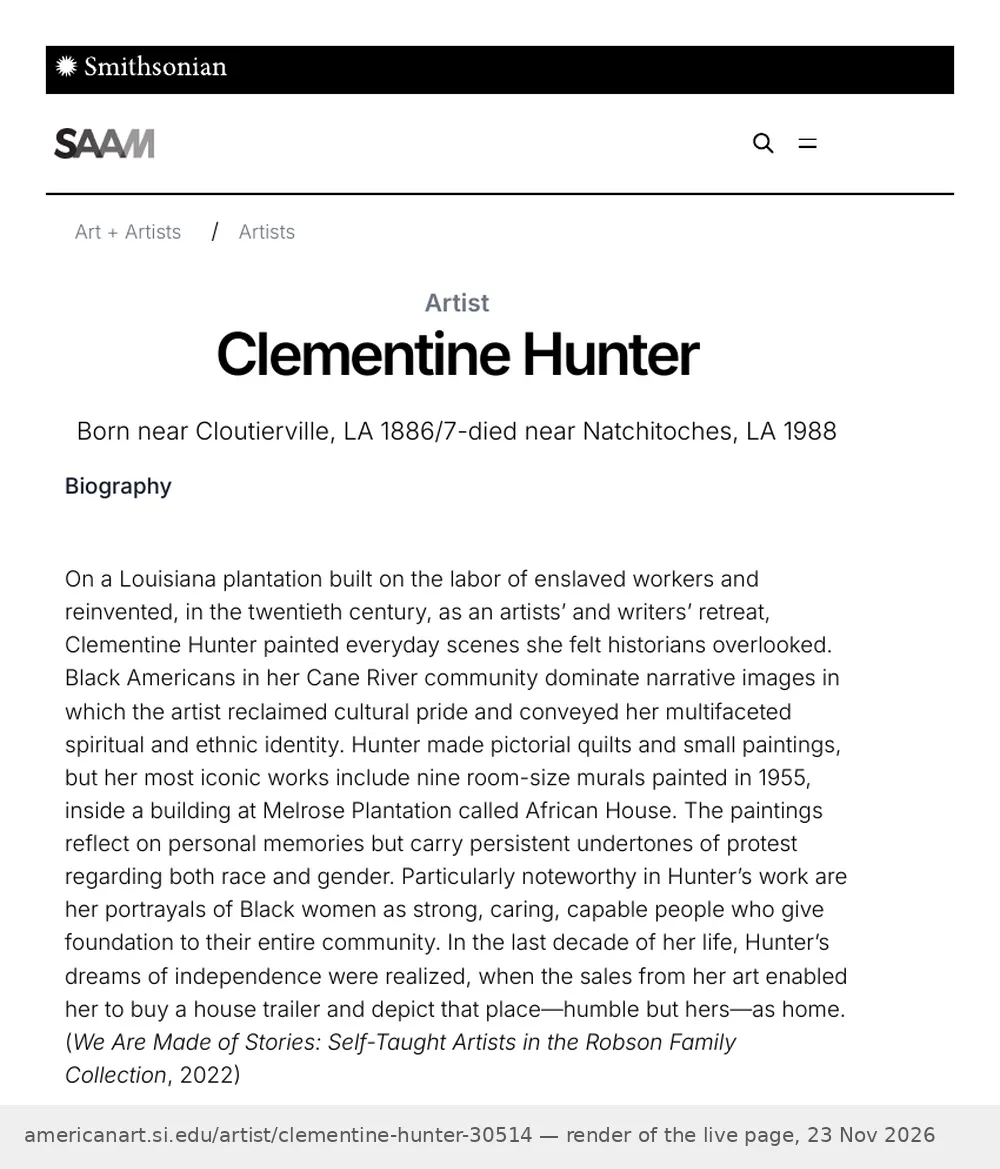
Smithsonian calls the nine murals Hunter’s most iconic work, painted in 1955.
Source: Smithsonian American Art Museum, Clementine Hunter (render of the live page, 23 November 2026).
Two Counts of One Summer
Counts of the same summer differ, and this article follows the dated one. Dated 8 June–21 July 1955, the work spans 44 days (Louisiana Office of Culture, Recreation and Tourism, 2015).
Those dates come from the press release (Louisiana Office of Culture, Recreation and Tourism, 2015). About 67 that summer, she worked mostly at night.
Another account stretches the work to three months and puts her age at 68 (Wikipedia, 2026).
Dated days beat round months as evidence. This article keeps the 44 days, and it records the disagreement here instead of hiding it (Louisiana Office of Culture, Recreation and Tourism, 2015).
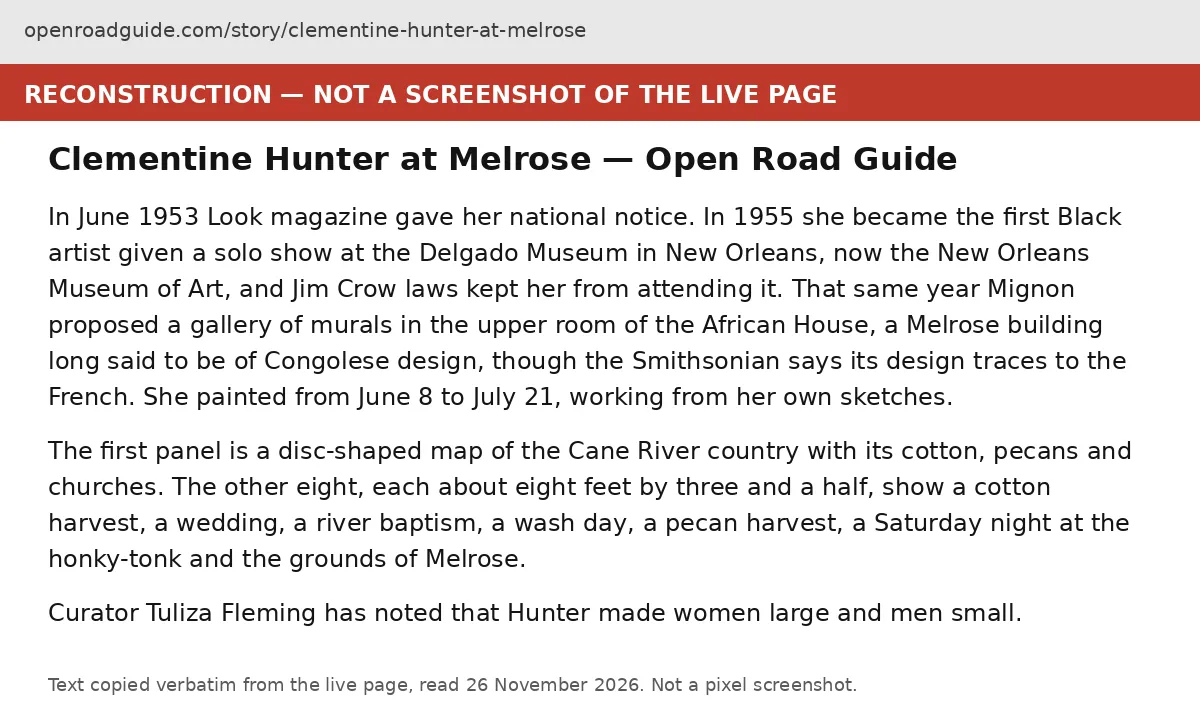
Open Road Guide names eight scenes and dates the painting 8 June to 21 July 1955.
Source: Open Road Guide, Clementine Hunter at Melrose (reconstruction).
After 1955: Recognition and Return
Honours accumulated late. An honorary Doctor of Fine Arts came from Northwestern State University in 1986 (Wikipedia, 2026).
Cane River Baptism sold for 19,980 dollars at a New Orleans auction in 2007 (Open Road Guide, 2026). That price set a record for her work at the time.
She turned down a White House invitation from President Jimmy Carter. Travel outside Louisiana did not appeal to her, so the honour stayed unclaimed (Open Road Guide, 2026).
Death came on 1 January 1988, when she was about 101 (Open Road Guide, 2026). Lifetime output runs past 5,000 paintings (64 Parishes, undated), with some estimates reaching 10,000 (Wikipedia, 2026).
In 2025 the murals marked seventy years, and they still tell the Black community’s story on Cane River (Smithsonian American Art Museum, 2022). Our news report on the 70th anniversary carries the counts behind the panels: Clementine Hunter Murals 70 Years: Nine Panels, 44 Days, 1955.
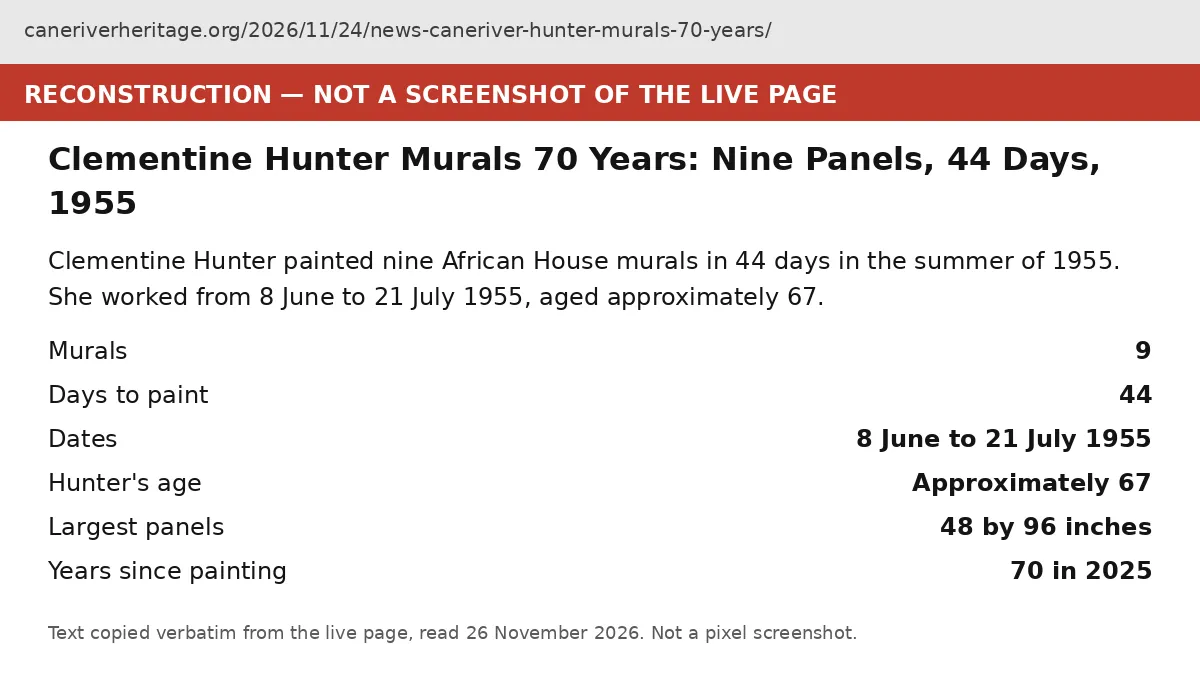
Our 24 November report carries the counts: nine panels, 44 days, 1955.
Source: Cane River Heritage, Clementine Hunter Murals 70 Years (reconstruction).
Before You Visit
South of Natchitoches stands the plantation Hunter painted for a lifetime. Check the plantation’s own pages before travelling, since hours and access change.
African House murals hang where Hunter painted them, on the upper floor. Photography rules, tour times, and entry fees change, so confirm them before you go.
The Room Still Speaks
Panels turned one worker’s memory into a public record. Museums do not own the room; the plantation keeps it, and the river keeps the story.
Go to Melrose to stand inside the work, not just to look at it. Standing inside the work, rather than looking at it, is the point of everything Hunter painted.
Frequently Asked Questions
How many murals did Hunter paint in the African House?
Large panels number nine, plus smaller panels between doors and windows on the upper floor. Two of the nine panels (Louisiana Office of Culture, Recreation and Tourism, 2015) run 48 by 96 inches; the rest fall just short.
How long did Hunter take to paint them?
Forty-four days covered the work (Louisiana Office of Culture, Recreation and Tourism, 2015), from 8 June to 21 July 1955. Night work carried most of it, with scenes painted from memory.
Who was François Mignon?
Curator and librarian at Melrose, he was a friend of Cammie Henry. His thirty-two years at Melrose included proposing the murals, supplying Hunter with paint, and promoting her work.
Was Hunter a guest of the art colony?
Employee, not guest, describes her place at Melrose. Picking cotton, cooking, laundry, and childcare filled her days while visitors painted.
Where can the murals be seen today?
Still in the African House at Melrose Plantation, the murals hang where they were painted. Conservation work in 2014–2016 took them down and returned them to the upper floor (Open Road Guide, 2026).
Methodology
Seven sources read in full stand behind this article, all opened in November 2026. Smithsonian, 64 Parishes, SAH Archipedia, and Open Road Guide supplied the facts, with Wikipedia as a secondary check.
Dates and figures were verified one by one against those sources on 26 November 2026. When sources disagreed about the summer of 1955, both sides appear here instead of a single verdict.
Limits: the Louisiana culture office press release was read through the live news report quoting it, after a rate limit blocked the direct open. One caution about Mignon comes from the gate-passed St Augustine draft’s reading of the National Register nomination, not from a fresh opening.
References
- Clementine Hunter — Smithsonian American Art Museum
- Clementine Hunter — 64 Parishes
- Clementine Hunter — Wikipedia
- Melrose Plantation — SAH Archipedia
- Clementine Hunter at Melrose — Open Road Guide
- Clementine Hunter Murals — Louisiana Office of Culture, Recreation and Tourism
- St. Augustine Catholic Church and Cemetery — National Register of Historic Places Inventory-Nomination Form (National Park Service)