

Say the name slowly, and it runs: Kouri-Vini, from the French verbs for “to run” and “to come”.
Fewer than 10,000 people still speak it as a native tongue.
About 5,000 of them learned it first, at home, before any other language.
This river once spoke it too, from the founding of Natchitoches to the last generation of fluent elders.
Summary
- Under ten thousand native speakers remain as of 2023, about five thousand of them first-language (Wendte, 2024).
- Its name comes from the Creole pronunciation of the French verbs “courir” (to run) and “venir” (to come).
- Born from French words and West African grammar on Louisiana plantations in the 18th century.
- UNESCO lists it as severely endangered, and the EGIDS scale rates it 8a, Moribund.
- Speakers cluster in three pockets of south Louisiana, while Cane River has nearly stopped passing it to children.
- A revival movement now teaches younger speakers through classes, music, radio, and an online guide.
How Many Speakers Are Left
Start with the count, because the count frames everything else.
Wendte’s 2023 count puts native speakers under ten thousand (Wendte, 2024).
Several hundred more use it as a second language, while roughly five thousand speak it from birth (Mayeux, 2019, in Wendte, 2024).
Nathan Wendte’s 2024 language snapshot, in Language Documentation and Description, supplies the figures.
| Measure | Figure |
|---|---|
| Native speakers | Fewer than 10,000 (2023) |
| First-language speakers | About 5,000 (2019) |
| Second-language users | Several hundred (2019) |
| EGIDS vitality rating | 8a, Moribund |
| UNESCO listing | Severely Endangered |
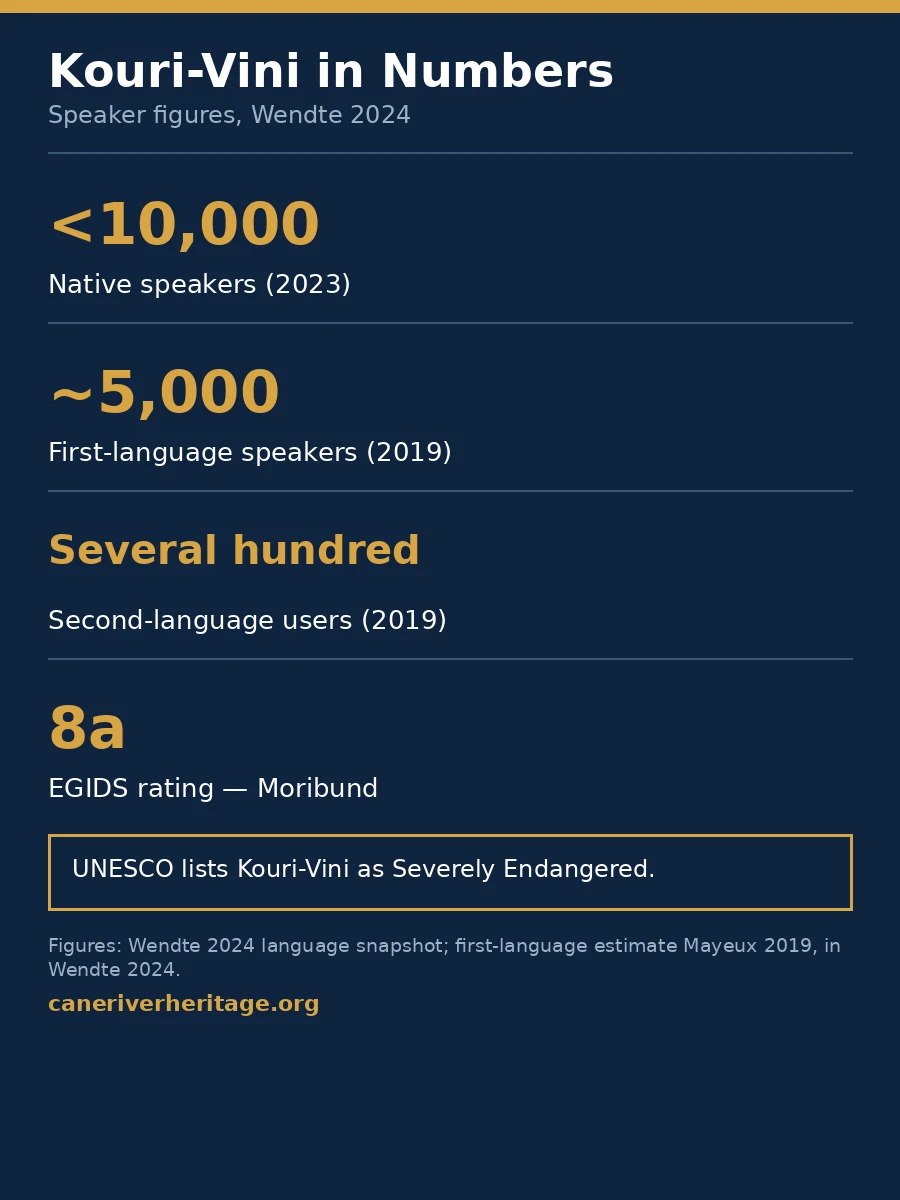
Under 10,000 people still speak Kouri-Vini, and about 5,000 learned it first. EGIDS rates it 8a, Moribund, and UNESCO lists it as severely endangered.
Every figure above comes from the same snapshot, and the first-language figure rests on Mayeux’s 2019 estimate.
No count exists for Natchitoches Parish alone, so the statewide figures stand here.
What Kouri-Vini Is
Kouri-Vini grew from French words and African grammar on the plantations of 18th-century Louisiana, and it belongs to no other place.
Enslaved Africans from many peoples needed one tongue to speak to each other, and French supplied the words.
Their own languages supplied much of the grammar, and the mixture hardened into a full language within a few generations.
That makes Kouri-Vini a creole language, not a dialect of French.
Louisiana French is its sister, not its twin: a dialect of French, carried by white Creoles and Cajuns alike.
Confusing the two hides the story, since one grew from the plantation and the other from the colony.
A Name That Means “To Run, To Come”
For most of its life, the language had no single name.
Speakers called it Kréyòl most often, and French speakers called it Créole.
Both names blurred into everything else called Creole: the people, the food, the music, the houses.
Language activists in the 2010s began promoting “Kouri-Vini” to end that blur.
Creole speakers turned the French verbs “courir” (to run) and “venir” (to come) into the name (BBC Travel, 2023).
Today the name marks the language as its own thing, separate from the ethnicity and the cuisine.
Born on the Plantations
Louisiana came under French rule in 1699, and plantations followed within a generation.
Enslaved labourers arrived from many West African peoples, each with its own tongue.
French served as the shared vocabulary, and African grammar shaped how the words fit together.
Pidgin carried the first conversations, and children born on the plantations turned it into a creole.
By the late 18th century, the language belonged to the whole colony, spoken by Black, white, mixed, and Native Louisianans alike.
How the Language Was Silenced
Stigma did the damage first, and law finished it.
Slavery tied Kouri-Vini to the plantation in white minds, and speakers learned to hide it for fear of ridicule.
After the Louisiana Purchase, American officials pushed English, and French tongues of every kind lost ground.
Louisiana’s 1921 constitution made English the language of public schools, and French vanished from classrooms (Wikipedia, 2026).
Children who spoke Creole at school faced punishment, fines, and public shame.
Parents stopped teaching it, hoping English would open doors for their children.
Each generation spoke less, and the youngest fluent speakers are now the exception.
Where Speakers Remain
Three pockets hold most of the remaining speakers, all of them south of Cane River.
One pocket follows Bayou Teche through Saint Martin Parish, and a second follows False River through Pointe Coupee Parish.
Down the Mississippi, one more pocket runs from New Orleans toward Baton Rouge (Wendte, 2024).
Natchitoches once spoke Creole from its founding, but parents there have nearly stopped passing it to their children (Wendte, 2024).
Cane River keeps the records, the family names, and the songs, while the living speech has moved south.
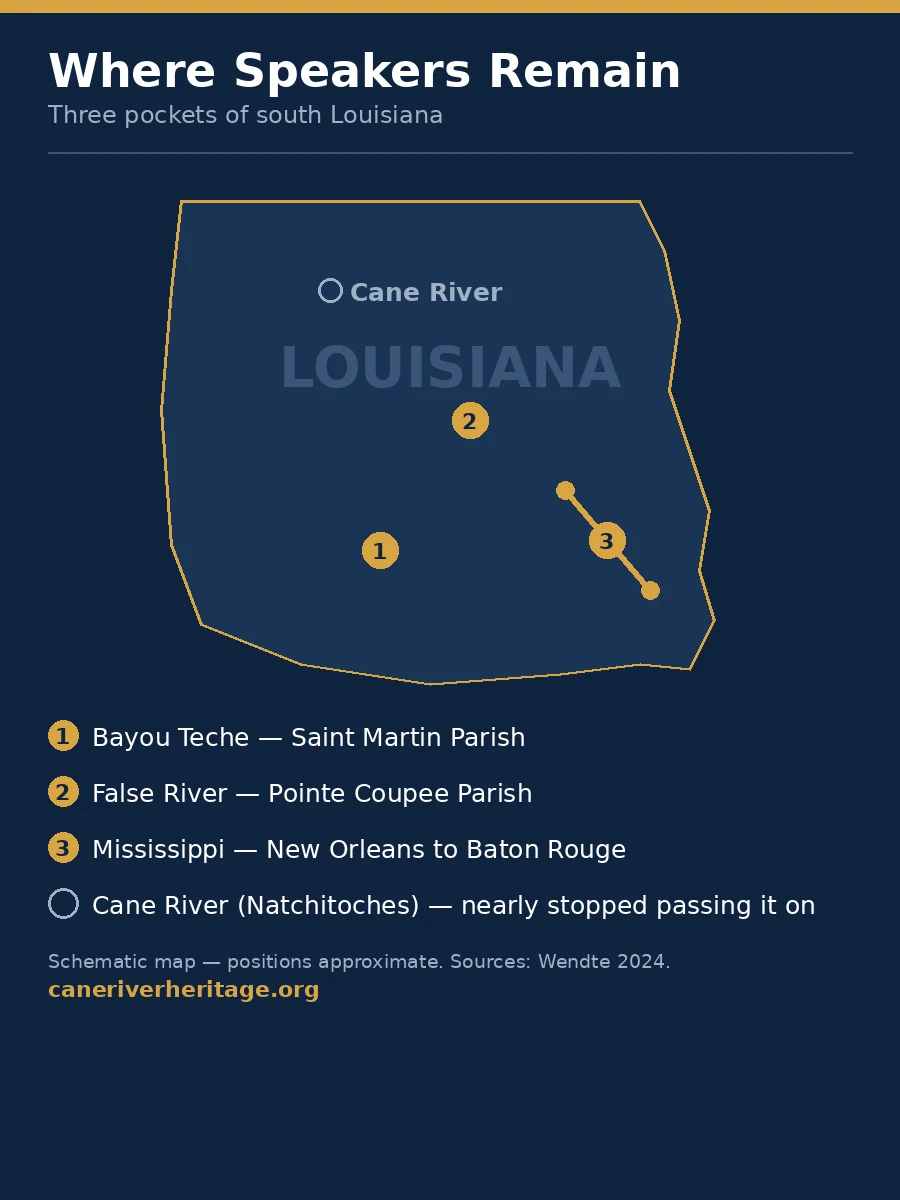
Most remaining speakers cluster in three pockets of south Louisiana. Cane River keeps the records, the family names, and the songs, while the living speech has moved south.
The Revival
Decline is not the whole story, because a revival movement now pushes the other way.
Wendte calls that movement established, and its classes have turned out many fluent young voices even as elder speakers age (Wendte, 2024).
C.R.E.O.L.E., Inc., founded in Lafayette in 1982, preserves Creole heritage, and founder Herbert Wiltz hosted a table where learners practiced Kouri-Vini (BBC Travel, 2023).
Chinbo, Inc., works to reclaim the language through teaching and community events.
Music carries it furthest: Cedric Watson sings in Kouri-Vini and hosts “La Nation Créole” on Lafayette radio station KRVS-88.7.
Linguist Oliver Mayeux, himself the son of a Louisiana Creole, champions the language as a mark of survival.
A first online guide appeared in 2016, and young Louisianans now learn the tongue their grandparents were punished for speaking.
Kouri-Vini at Cane River
The river holds a special place in this story, as the home of the language’s northern memory.
Northwestern State University built the Creole Heritage Center in 1998 to gather the records of Louisiana Creole families.
In 2008 the center launched a movement to document Louisiana Creole itself, not Louisiana French (64 Parishes, 2026).
Its resource library holds more than 5,000 items (Northwestern State University, 2026). More than 9,500 names fill the family database, the university reported in a May 2026 press release.
Albert Valdman of Indiana University published a Dictionary of Louisiana Creole in 1998, giving the language a printed record.
Today the center’s work keeps Cane River’s Creole past searchable, even as the spoken language fades from the parish.
How to Hear It Today
Start with music, since musicians led the revival.
Cedric Watson’s albums sing in Kouri-Vini, and his radio show plays Creole music from Louisiana, Haiti, and Guadeloupe.
Classes run through Chinbo’s community programs and through the Louisiana Historic & Cultural Vistas online courses (BBC Travel, 2023).
Online guides and dictionaries now let a beginner learn the first words without leaving home.
The town offers the quieter path: the Creole Heritage Center, the family records, and the church where the language once filled the pews.
Frequently Asked Questions
How many people speak Kouri-Vini?
Fewer than 10,000 native speakers as of 2023, with about 5,000 speaking it as a first language (Wendte, 2024).
What does “Kouri-Vini” mean?
It comes from the Creole pronunciation of the French verbs “courir” (to run) and “venir” (to come).
Is Kouri-Vini the same as Cajun French?
No, Kouri-Vini is a French-based creole language, while Cajun French is a dialect of French.
Is Kouri-Vini still spoken on Cane River?
Yes, from its founding — but parents there have nearly stopped passing it to their children.
Who is keeping the language alive?
Classes from Chinbo’s community programs and the Louisiana Historic & Cultural Vistas online courses (BBC Travel, 2023). Cedric Watson keeps it in music, and the Creole Heritage Center keeps its records.
Methodology
Every date and figure in this article comes from a named source, and each source appears in the References below.
Speaker figures rest on Nathan Wendte’s 2024 language snapshot, read in November 2026, with first-language numbers from Mayeux’s 2019 estimate inside it.
History of the language rests on the Louisiana Creole encyclopedia entry and on 64 Parishes.
Revival details rest on the BBC Travel profile of Cedric Watson and on 64 Parishes.
Search volume, keyword difficulty, and cost per click for the target phrase remain unverified, and no figure of that kind appears here.
Where sources disagree, the article prints the firmer record and names the other account.
References
- Louisiana Creole (Louisiana, USA) — Language Snapshot, Wendte 2024
- Louisiana Creole, Wikipedia
- Kouri-Vini: The return of the US’ lost language, BBC Travel
- Creoles, 64 Parishes
- Francophone Louisiana, 64 Parishes
- Creole Heritage Center — Northwestern State University of Louisiana
- May 26 NGHA talk will focus on resources at NSU’s Creole Heritage Center, Northwestern State University
- Cane River Creole Culture and History: The Complete Guide, Cane River Heritage
- Cane River Creole in Numbers 2026, Cane River Heritage
- Kouri-Vini Counts About 5,000 First-Language Speakers, Wendte Snapshot Finds, Cane River Heritage