Order gumbo in Natchitoches, and the cook may correct you before the bowl arrives.
Call the food Cajun, and the answer comes back fast: no, it is Creole, and Cane River Creole at that.
Louisiana hands visitors two words that sound interchangeable, then punishes anyone who swaps them.
Most guides stop at two peoples, Cajun and Creole, and treat the difference as a matter of tomatoes.
Here a third party joins the comparison, and it changes the whole picture.
Summary
- “Cajun” comes from “Acadien”: French settlers expelled from Canada between 1755 and 1763, about 3,000 of whom reached south Louisiana.
- Anyone born in the Louisiana colony, of any race, first counted as Creole, and only later did the word narrow to New Orleans families.
- At Isle Brevelle, a farming community of free people of color grew Cane River Creole, not a port city.
- Natchitoches dates to 1714, four years before New Orleans and four decades before the Acadian expulsion.
- Food gives the quickest test: Creole gumbo takes tomatoes, Cajun gumbo does not, and Cane River keeps its own table.
- Language gives the deeper test: Kouri-Vini, Cajun French, and Louisiana French are three different tongues.
Two Words, One Confusion
Start with the words themselves, because the confusion lives inside them.
“Creole” began as a birthplace, not a bloodline.
In colonial Louisiana, a child born in the colony was Creole, whether the parents were French, Spanish, African, or mixed (64 Parishes, 2026).
A white planter’s son in New Orleans counted as Creole. So did an enslaved child born on a River Parish plantation.
Only after 1803 did the label shrink toward the mixed-race, French-speaking Catholic families of New Orleans and the River Parishes.
From a place name to a people: that is the road “Cajun” took.
“Acadien” named the French colonists of Acadia, in what is now Nova Scotia, New Brunswick, and Prince Edward Island.
British officers expelled more than 10,000 of them between 1755 and 1763, in the forced removal called Le Grand Dérangement.
“Acadien” softened in Louisiana mouths to “Cadien”, then to “Cajun”.
One word describes where a person was born, and the other describes where a person was driven from.
The Acadians Arrive Late
Timing alone separates the two stories by two generations.
French traders founded Natchitoches in 1714, on the Red River in present-day north Louisiana.
Four years later, in 1718, French engineers laid out New Orleans at the Mississippi.
Acadians began arriving only in the 1760s, after years of wandering through the American colonies, England, and France.
Spanish officials welcomed the exiles in the 1760s, and Governor Luis de Unzaga placed them on riverfronts and swamps the colony needed settled.
Roughly 3,000 reached south-central Louisiana, where they built homes on stilts and learned the pirogue (64 Parishes, 2026).
By then, Natchitoches already had a church, a fort, farms, and a Creole community taking shape.
Acadiana is younger than Creole Louisiana by half a century, and the gap matters.
New Orleans Creole: A Port City Culture
New Orleans made Creole culture urban, layered, and tied to trade.
French officials, Spanish merchants, enslaved Africans, Caribbean immigrants, and later Germans and Italians all came through the same docks.
Free people of color in the city held property, spoke polished French, and took part in civic life decades before emancipation.
Spain ruled the city from 1763 to 1803, and the United States bought it in 1803.
Wealth from sugar and cotton paid for restaurants, townhouses, and a cuisine built on imports.
Butter, tomatoes, seafood, and wine reached city tables that country kitchens never saw.
City kitchens made it layered and refined, seasoned with what the port could supply.
Cane River Creole: A Farming Community
This river tells a different story, and the difference starts with the land.
Farm fields, not docks, shaped this culture, and free families of color built its center.
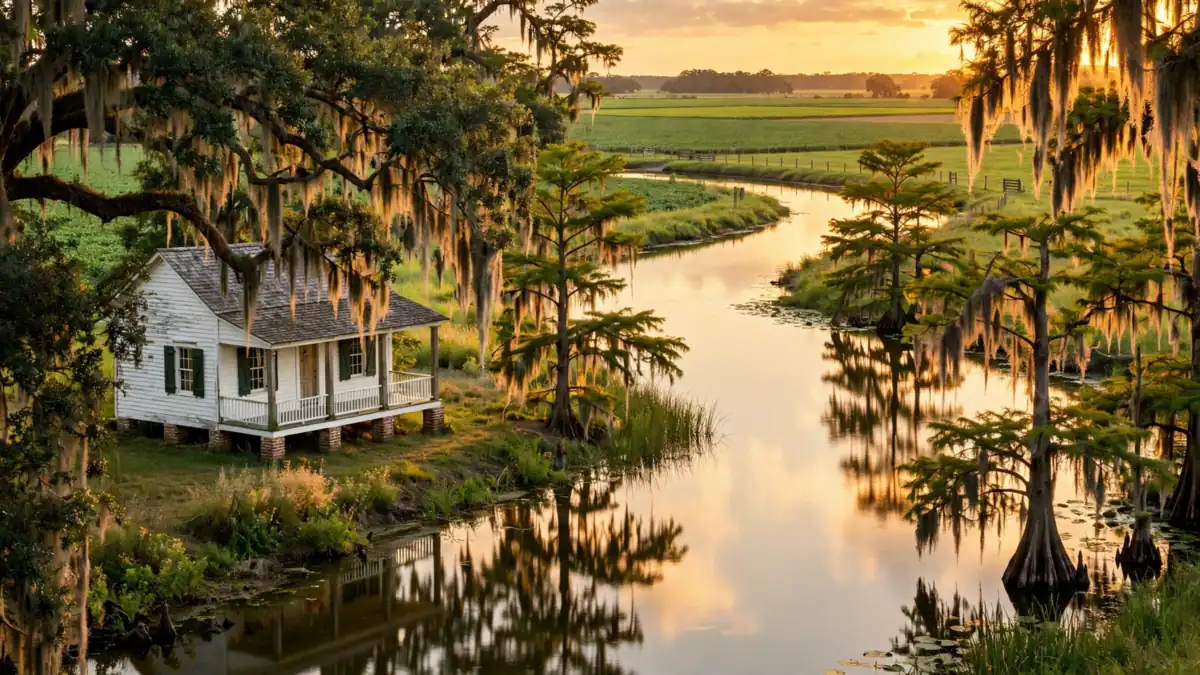
Isle Brevelle sits about twelve miles south of Natchitoches, between Cane River and Bayou Brevelle.
About 16,000 of those 18,000 acres remain in the hands of the first families’ descendants (Library of Congress, HABS LA-1361).
Church kitchens set the table, not restaurants, and family land passed from parent to child for generations.
Marie Thérèse Coincoin and the Métoyer Family built that community from three land grants, not from trade.
Natchitoches lies north of the Cajun prairie, and its old French-speaking kitchens cook Creole food (EatBayou, 2026).
Rural, Black, Catholic, and French-speaking: four words that fit Cane River and fit neither New Orleans nor Acadiana in the same way.
Three Arrivals, Three Homelands
Put the three peoples side by side, and the pattern turns clear.
| New Orleans Creole | Cane River Creole | Cajun | |
|---|---|---|---|
| Heartland | New Orleans, a port city | Cane River valley, north Louisiana | Acadiana prairies and bayous |
| Arrival | French colonists from 1718 | French post 1714, free families from the 1770s | Acadian exiles from 1755 |
| Community | City merchants, free people of color, Caribbean traders | Farm families of Isle Brevelle | Rural exiles, mostly white-identified |
| Language | French, then Kouri-Vini | French, then Kouri-Vini | Cajun French |
| Signature | Shrimp creole, tomato gumbo | Natchitoches meat pie, chicken gumbo | Boudin, dark gumbo without tomatoes |
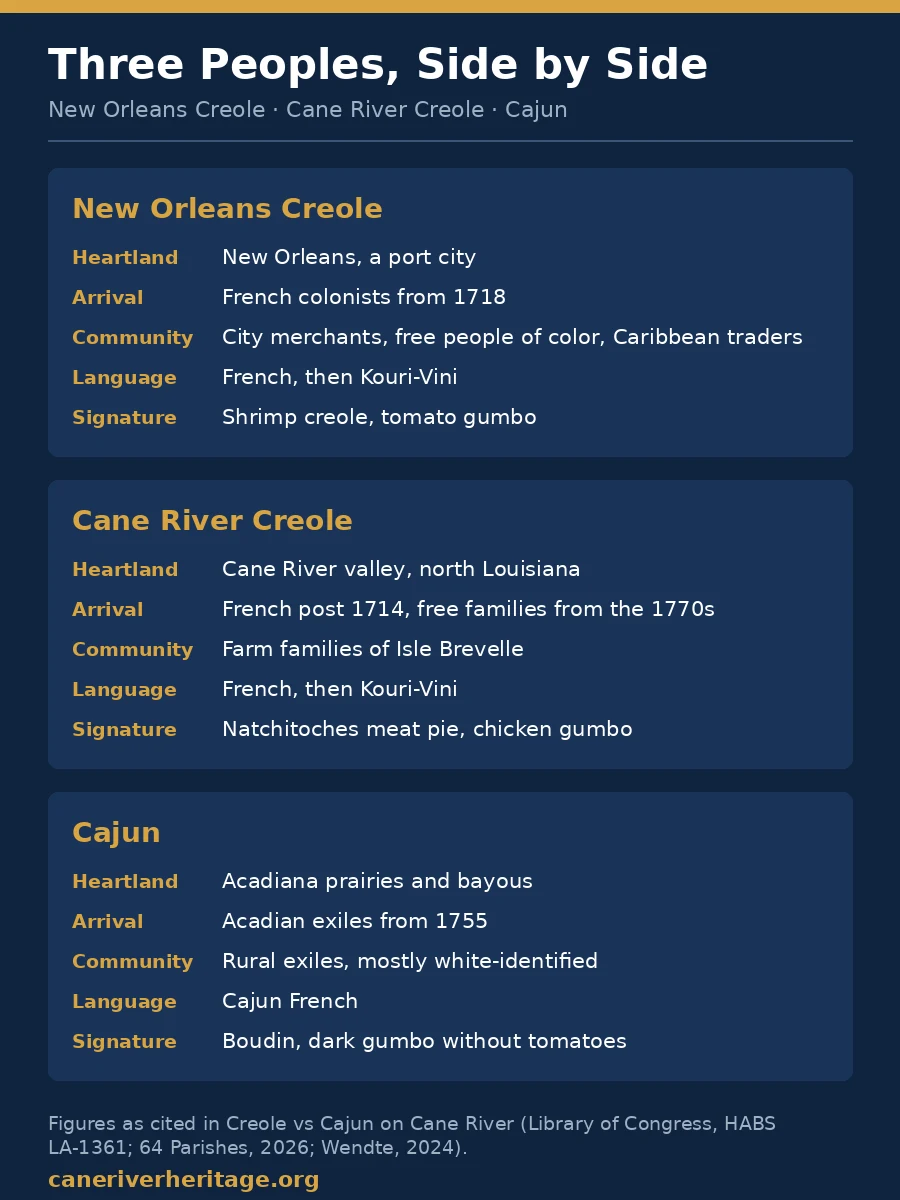
Five rows set the three peoples side by side, from heartland to signature dish. Cane River Creole keeps its own column: farm families, Isle Brevelle, and the meat pie.
One row alone decides nothing, and every row points the same way.
Geography made the cultures, not the other way around.
The Language Test
Food confuses people, but language settles the question faster.
Kouri-Vini is a French-based creole language, shaped on the plantations of French Louisiana in the 1700s.
Its words come mostly from French, and its grammar comes mostly from West Africa.
Native speakers have thinned to under 10,000, and roughly 5,000 of them speak it from birth (Wendte, 2024).
The French of the exiles is a different tongue: a dialect carried from Acadia, not a creole at all.
Louisiana French is a third: the French of colonial Louisiana, spoken by white Creoles and Cajuns alike.
Three peoples, three tongues, and one shared habit of speaking French at home.
Visitors who hear Kouri-Vini in Natchitoches are hearing Cane River Creole, not Cajun speech.
The Food Test
Gumbo gives the fastest answer at the table, and the answer has three parts.
Tomatoes mark the Creole pot, and Cajun gumbo does without them.
That rule comes straight from the port: tomatoes reached New Orleans tables, while prairie kitchens cooked without them.
Gumbo here takes a third road, built on roux, okra, and filé.
Okra came from West Africa, and filé came from Native sassafras knowledge.
Outdoor pots of chicken gumbo feed whole congregations here, and church fairs still call for them (EatBayou, 2026).
Beyond gumbo, the Natchitoches meat pie belongs to Cane River alone, and no Cajun or New Orleans table claims it.
That story appears in full in Cane River Creole Food, from the 1826 journal entry to the state title of 2003.
The Faith and Family Test
Churches and family land give a second test, slower but just as sure.
St. Augustine Catholic Church stands on Isle Brevelle land, built by the free families who farmed it.
Its pews once reversed the southern order, seating free people of color where white planters sat elsewhere.
Acadiana built its own churches too, but its parishes grew from exile settlements, not from freed families buying land.
New Orleans built cathedrals for a city, while Cane River built a chapel for a farming community.
Land tells the same story: Isle Brevelle families kept their acres in the same hands for two centuries.
Exile scattered Acadian families across four parishes, and the port scattered New Orleans families across the Atlantic world.
Why the Confusion Persists
If the differences run this deep, why does everyone mix them up?
Tourism did much of the damage, and it did the damage in the 1970s.
Music, food, and festivals from Acadiana became Louisiana’s brand, and the brand swallowed the map.
Guidebooks now stretch “Cajun Country” across 22 parishes, past the old Acadian settlements.
The word itself became a flavour label, not a people, and restaurant menus use it for anything spicy with tomatoes.
Cane River sits far north of Acadiana, so visitors assume the whole state shares one French culture.
Schoolbooks helped too, since Louisiana history often jumps from New Orleans to the Acadians and skips the river in between.
How to Tell Them Apart in Natchitoches
Walk downtown Natchitoches with three questions in mind.
Ask when the community began: 1714 points to Cane River Creole, 1718 to New Orleans, and the 1760s to Cajun.
Ask who built it: free families of color point to Cane River, city merchants to New Orleans, and Acadian exiles to Acadiana.
Check what fills the pot. A meat pie points to Cane River, tomatoes point to New Orleans, and a dark roux without tomatoes points to Cajun.
Listen for the language too, since Kouri-Vini belongs to Creole families and Cajun French belongs to Acadian ones.
None of the three tests works alone, and all three together rarely miss.
A Timeline of Three Peoples
| Year | Event |
|---|---|
| 1714 | Natchitoches founded on the Red River, the oldest permanent European settlement in the Louisiana Purchase |
| 1718 | New Orleans founded at the Mississippi |
| 1755 | British begin expelling Acadians from Canada |
| 1760s | Acadian exiles reach Spanish Louisiana and settle the prairies |
| 1763 | France cedes Louisiana to Spain |
| 1778 | Coincoin gains her freedom and begins buying land |
| 1803 | United States buys Louisiana |
| 1994 | Congress creates the Cane River heritage area and park |
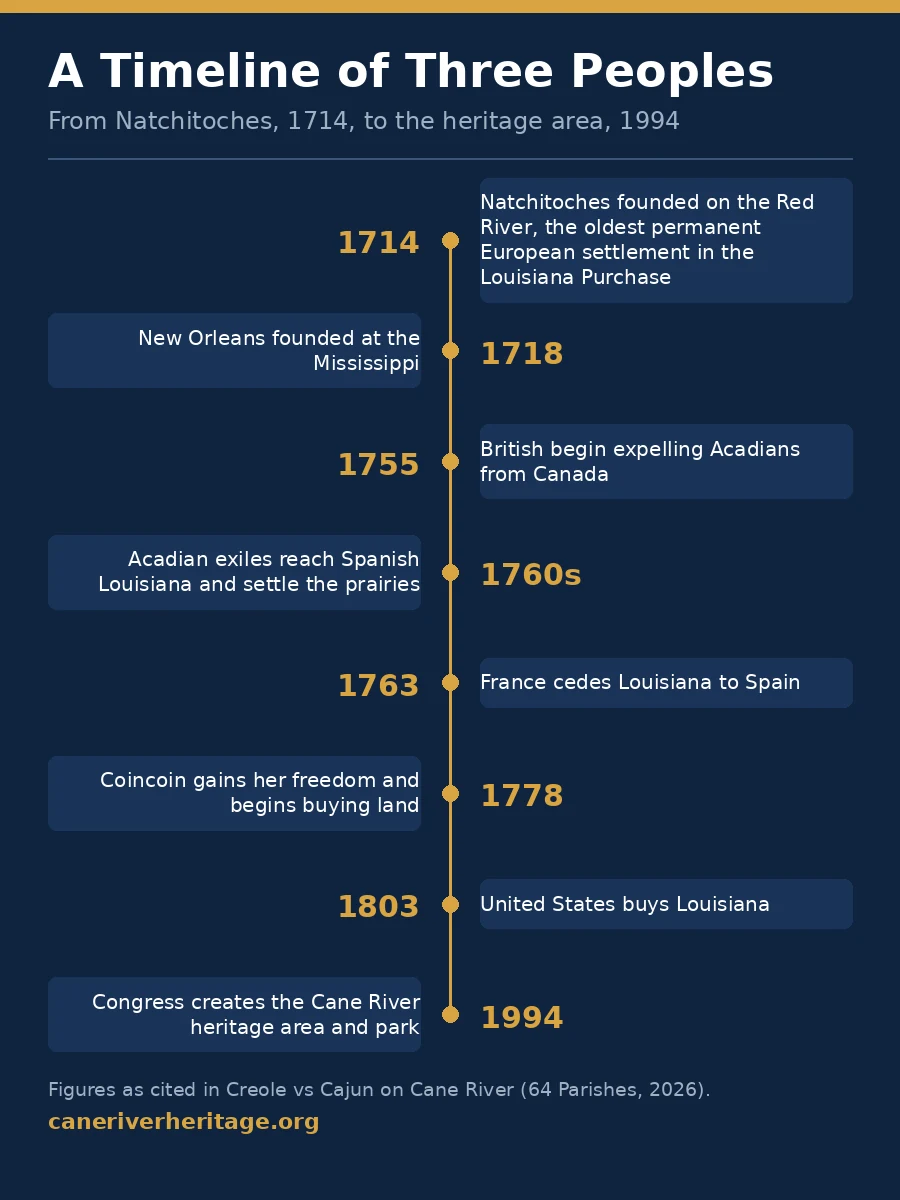
Eight dates carry three peoples from the Natchitoches post of 1714 to the heritage area of 1994. The Acadian expulsion of 1755 arrives a full generation after the river towns.
Frequently Asked Questions
What is the difference between Cajun and Creole?
Descendants of Acadians expelled from Canada after 1755 are Cajun, while Creole first meant anyone born in colonial Louisiana.
Is Cane River Creole the same as New Orleans Creole?
Free people of color in a rural farming community grew Cane River Creole, while New Orleans Creole grew in a port city.
Is Cajun food the same as Creole food?
Creole cooking uses tomatoes and Cajun cooking does not, and Cane River keeps a third table of its own.
Do Cajuns and Creoles speak the same language?
Cajuns speak Cajun French, while many Creoles speak Kouri-Vini, a French-based creole language.
Where can I see Cane River Creole culture?
Isle Brevelle, St. Augustine Church, and the Cane River heritage sites carry it, and Natchitoches celebrates it each October.
Methodology
Every date and figure in this article comes from a named source, and each source appears in the References below.
Population figures for the Acadian expulsion rest on 64 Parishes and on the histories it draws from.
Comparisons of the food rest on Explore Louisiana’s Cajun-versus-Creole guide and on EatBayou’s parish survey.
Language figures rest on Nathan Wendte’s 2024 language snapshot, as cited in the References.
Search volume, keyword difficulty, and cost per click for the target phrase remain unverified, and no figure of that kind appears here.
Where sources disagree, the article prints the firmer record and names the other account.
References
- Cajun vs. Creole Food, Explore Louisiana
- Creoles, 64 Parishes
- Francophone Louisiana, 64 Parishes
- Louisiana Creole (Louisiana, USA) — Language Snapshot, Wendte 2024
- The Food Traditions of Natchitoches Parish, EatBayou
- Cane River National Heritage Area — Historic American Buildings Survey, HABS No. LA-1361 (Library of Congress)
- Isle Brevelle: The Free Creole Community That Built Cane River, Cane River Heritage
- Marie Thérèse Coincoin and the Métoyer Family, Cane River Heritage
- Cane River Creole Food: Meat Pies, Gumbo, Tamales, Cane River Heritage