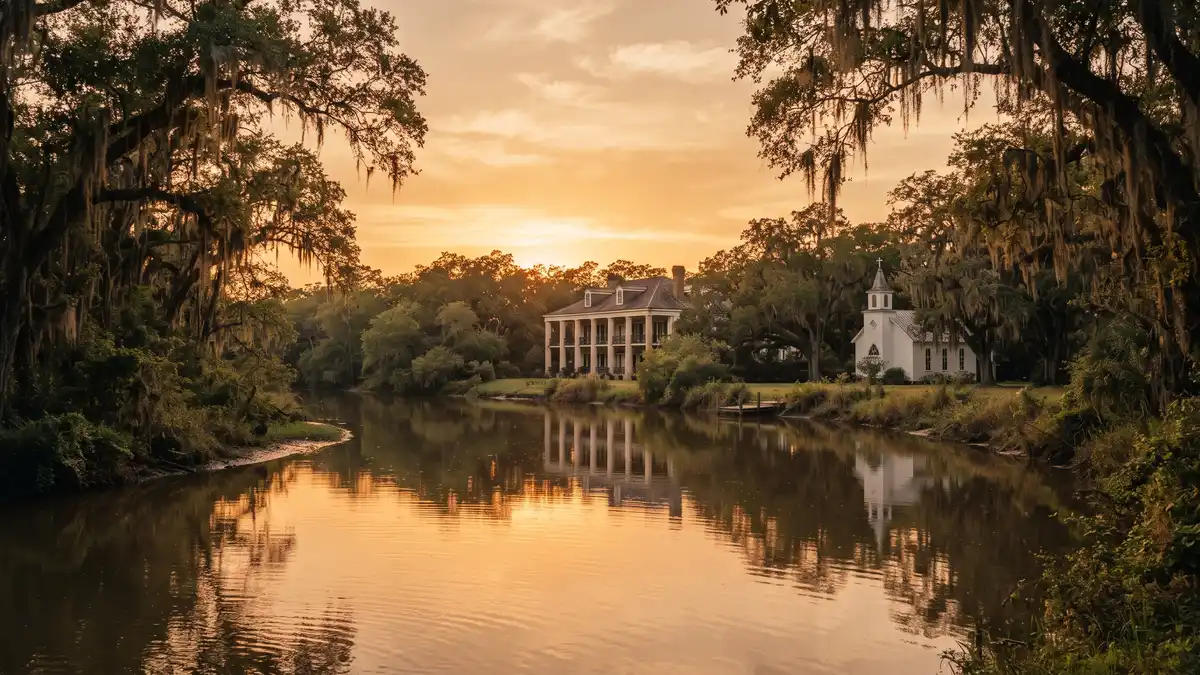
Main image: AI illustration.
Most people hear the word Creole and picture New Orleans. Jazz spills from a French Quarter doorway, a waiter sets down gumbo, and the story ends there.
Cane River tells a different story. Here the culture grew in a farming community, not a port city, and its center was a settlement of free people of color.
This guide follows that story from the founding of Natchitoches to the living community of today. It names the people, the church, the food, the language, and the music — and the places where each one still stands.
Summary
- Rural, not urban: the culture of Cane River grew in a farming community of free people of color at Isle Brevelle, distinct from New Orleans Creole and from Cajun culture.
- Its roots run from the founding of Natchitoches through the Coincoin–Métoyer family to the heritage area Congress created for it.
- Five strands carry it: people, faith, food, language, and music and art — each with its own places and names.
- The culture is still alive: descendants farm the same land, a university center keeps the records, and Natchitoches celebrates it every October.
What “Creole” Means on Cane River
In colonial Louisiana, Creole described anything born in the colony of Old World stock. The word covered people, houses, horses, and cattle alike, and it said nothing about race.
Over time the meaning narrowed to people born in Louisiana during the French and Spanish periods. That covers French settlers, Spanish officials, enslaved Africans, and Native peoples — and the children of all of them.
New Orleans took the word in one direction. Its Creole culture grew in a port city, fed by Caribbean arrivals, Sicilian and German immigrants, restaurants, and jazz.
Cane River took it in another. Here the culture grew around family farms, a country church, and a community of free people of color who held land for generations.
Cajun is a third story, not a synonym. Acadians arrived later and settled farther south, while Cane River’s story began decades earlier at a French frontier post.
Keep the three apart and the rest of this guide makes sense. Mix them up and Cane River disappears into New Orleans.
How Cane River Creole Culture Began
The story starts before any plantation. Caddo peoples — Natchitoches, Adai, and Hasinai — lived along this river for centuries before the French arrived.
French soldiers founded a post at Natchitoches in 1714. Congress later called it the oldest permanent settlement in the Louisiana Purchase territory (16 U.S.C. § 410ccc, 1994).
Spain took Louisiana in the 1760s, and Spanish land policy opened a door that French rule had kept shut. Enslaved people could buy their freedom, and free people of color could hold land.
Marie Thérèse Coincoin walked through that door. Born enslaved in 1742, she gained her freedom in 1778 and received an 80-arpent land grant in 1787, patented in 1794 (Mills, 1977).
Her ten children with Claude Thomas Pierre Métoyer became landowners, church builders, and plantation founders. Their family still holds the ground today.
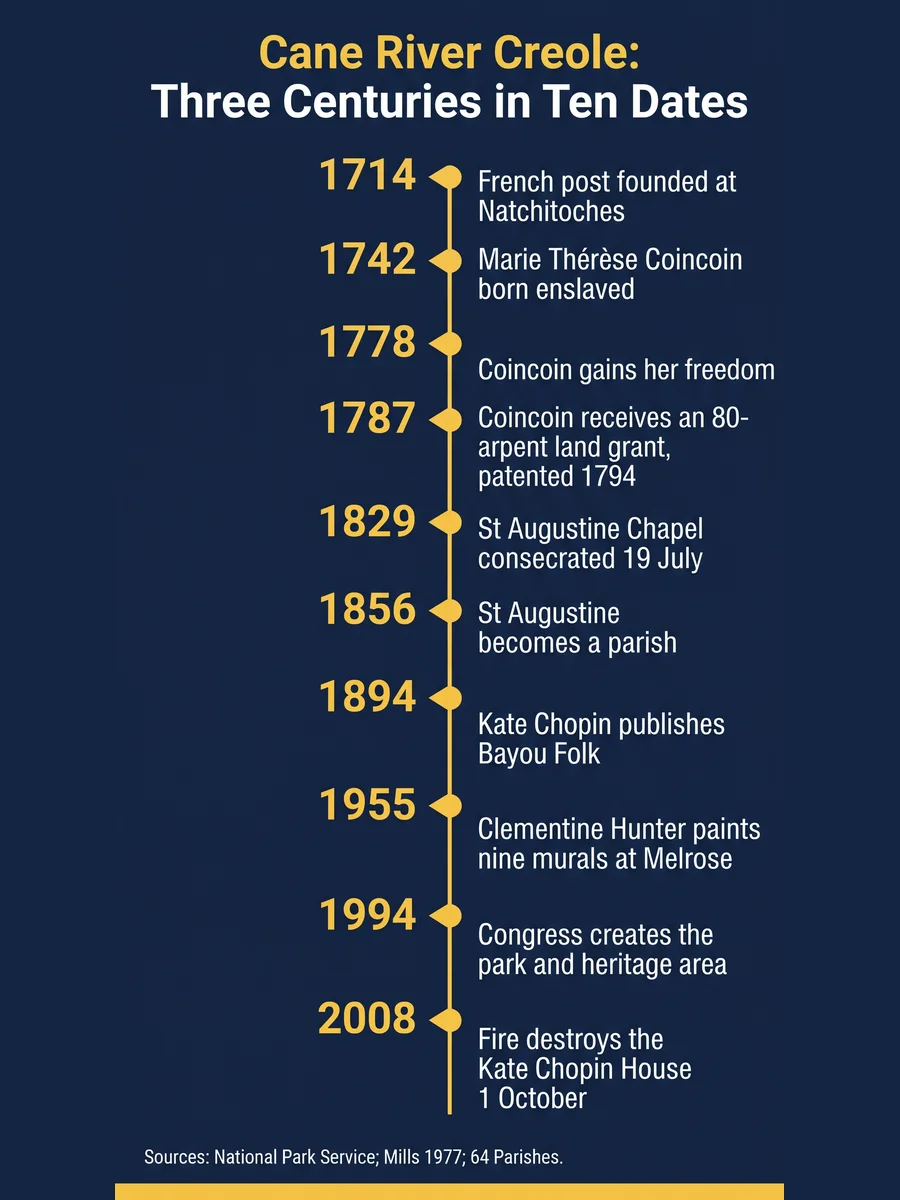
A timeline puts the whole arc in one place. It runs from the French post to the fire that took the Chopin house, and it ends with the law that protects the landscape today.
| Year | What happened |
|---|---|
| 1714 | French soldiers found the post at Natchitoches. |
| 1742 | Marie Thérèse Coincoin is born enslaved at Natchitoches. |
| 1778 | Claude Thomas Pierre Métoyer buys Coincoin’s freedom. |
| 1787 | Coincoin receives an 80-arpent land grant; the Crown patents it in 1794. |
| 1829 | St Augustine Chapel is consecrated on Isle Brevelle, 19 July. |
| 1856 | St Augustine becomes a parish in its own right. |
| 1894 | Kate Chopin publishes Bayou Folk, her Cane River story collection. |
| 1955 | Clementine Hunter paints nine murals in the African House at Melrose. |
| 1994 | Congress creates the Cane River Creole National Historical Park and the Cane River National Heritage Area. |
| 2008 | Fire destroys the Kate Chopin House at Cloutierville, 1 October. |
One date on that list needs a warning.
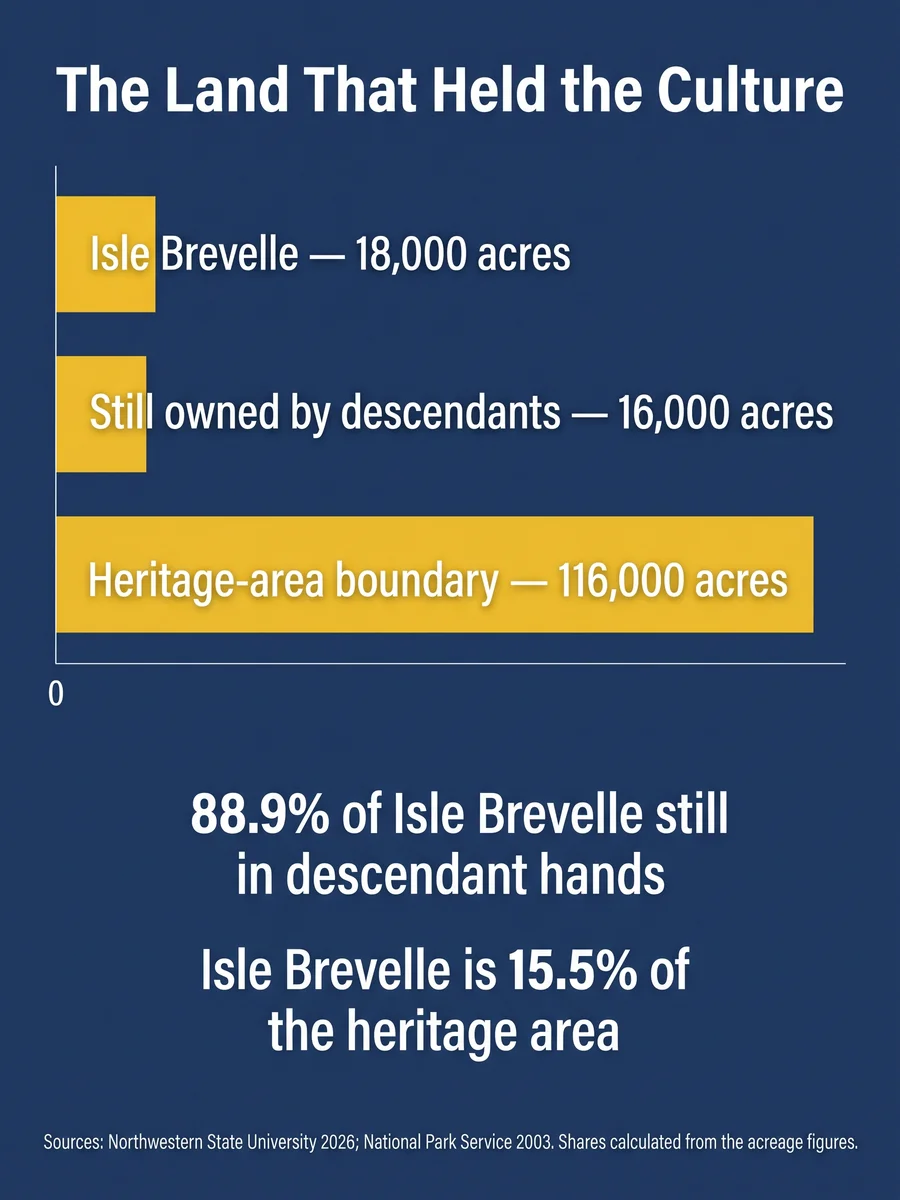
A single law covers both the heritage area and the park: Public Law 103-449, signed 2 November 1994. That law’s boundary now covers about 116,000 acres (National Park Service, 2003).
This law is why the landscape survives in one piece. Together they protect plantations, churches, and burial grounds — not isolated monuments.
- 1714French soldiers found the post at Natchitoches.
- 1742Marie Thérèse Coincoin is born enslaved at Natchitoches.
- 1778Claude Thomas Pierre Métoyer buys Coincoin’s freedom.
- 1787Coincoin receives an 80-arpent land grant; the Crown patents it in 1794.
- 1829St Augustine Chapel is consecrated on Isle Brevelle, 19 July.
- 1856St Augustine becomes a parish in its own right.
- 1894Kate Chopin publishes Bayou Folk, her Cane River story collection.
- 1955Clementine Hunter paints nine murals in the African House at Melrose.
- 1994Congress creates the Cane River Creole National Historical Park and the Cane River National Heritage Area.
- 2008Fire destroys the Kate Chopin House at Cloutierville, 1 October.
The People: A Free Community on Isle Brevelle
Isle Brevelle is the heart of this story. Between Cane River and Bayou Brevelle lies a strip of about 18,000 acres (Northwestern State University, 2026).
Descendants of the first Creole families still own about 16,000 of them (Northwestern State University, 2026). Ownership explains why the culture survived: the people never lost the ground.
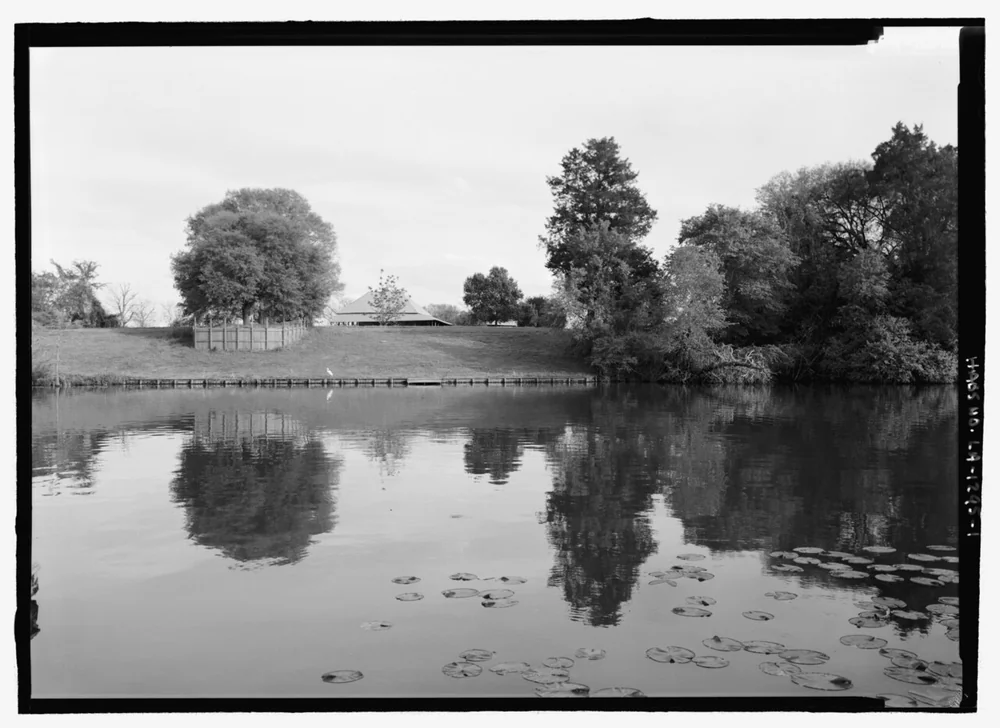
First came a Native and Creole settlement, older than the plantations around it. French and Spanish colonists, Africans, and Caddo peoples built it together, and their descendants still call it the birthplace of Creole culture.
One family made the community what it is: the Métoyers. Coincoin’s children bought land, freed relatives, and raised the church and the plantations that held the settlement together.
Isolation protected the community for a long time. Roads reached it late, and families stayed close.
Many who left after the war still return each year for the church fair. Returns like that are the point: Isle Brevelle is a neighborhood, not a ruin, where the same families still live on the same land.
The Faith: St Augustine and the Church at the Center
St Augustine Catholic Church stands at the center of Isle Brevelle. Nicolas Augustin Métoyer gave the land, and his brother Louis is traditionally credited with designing and raising the chapel.
Two dates compete for the church’s beginning, and both deserve a hearing. Tradition says 1803; parish records say the chapel was consecrated on 19 July 1829 (Mills, 1977).
Its walls tell the same story of reversal as the community. Pew records put the Métoyer family in the front seats and white planters behind them — the opposite of the usual Southern arrangement.
Union troops are said to have torched the first church during the Red River campaign in May 1864 (Mills, 1977). Today the present church, completed in 1917, still holds an active parish, and its fair still draws descendants home each autumn (Wikipedia, 2026).
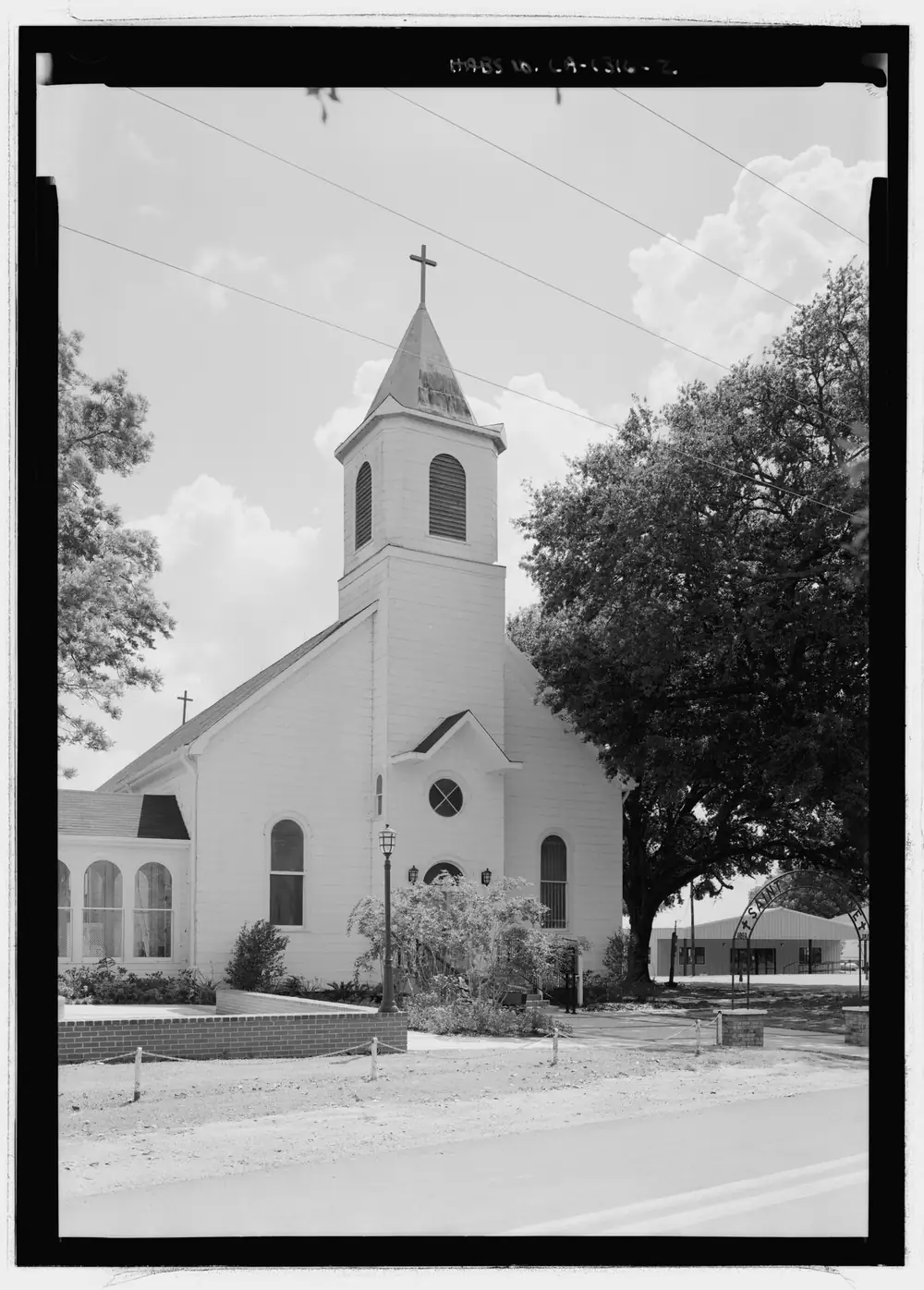
Historians celebrate it as the first church in Louisiana built by and for free people of color. Scholars also call it the oldest surviving Black Catholic church in the United States.
The Food: Meat Pies and a Cuisine of Its Own
Food on Cane River is farm cooking, not restaurant cooking. What families raised and traded shaped it, and French, Spanish, African, and Native flavors meet in every dish.
Missionary Timothy Flint described the Natchitoches meat pie in a travel journal published in 1826 (64 Parishes, 2023). Spanish empanadas and French Canadian tourtière both likely shaped its recipe.
Today the pie is the signature dish of Cane River Creole food.
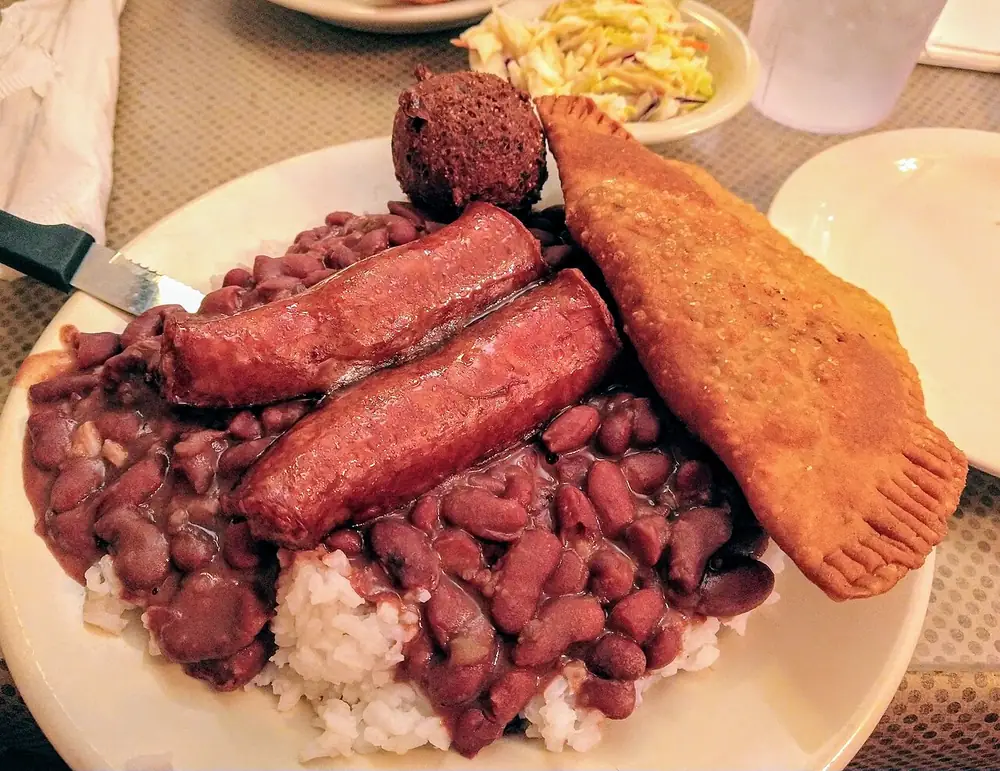
Creole women of color from Isle Brevelle kept the pie famous long before any restaurant sold it. Ascher Rouqier’s pies were mourned in the local paper when she died in 1913 (64 Parishes, 2023).
Louise Sarpy sold hers through classified advertisements in the 1950s and 1960s (64 Parishes, 2023). Butcher James Lasyone changed the scale in 1967, when he opened a meat pie kitchen in Natchitoches.
Louisiana made the pie an official state food in 2003 (64 Parishes, 2023). Gumbo, tamales, and sausage round out the table, and Caddo foodways came first.
No single dish is the point. What matters is a cuisine that grew where four peoples cooked together.
The Language: Kouri-Vini, Spoken by Fewer Than 10,000
Louisiana Creole — Kouri-Vini to its speakers — is a French-based creole language. Born in 18th-century Louisiana from French words and West African grammar, it belongs to Louisiana alone.
Neither a dialect of French nor Haitian Creole, it stands on its own.
Fewer than 10,000 people speak it today (Wikipedia, 2026), and about 5,000 of them are first-language speakers (Wendte, 2024). UNESCO lists it as severely endangered, and the youngest fluent speakers are now the exception (List of endangered languages in the United States, 2026).
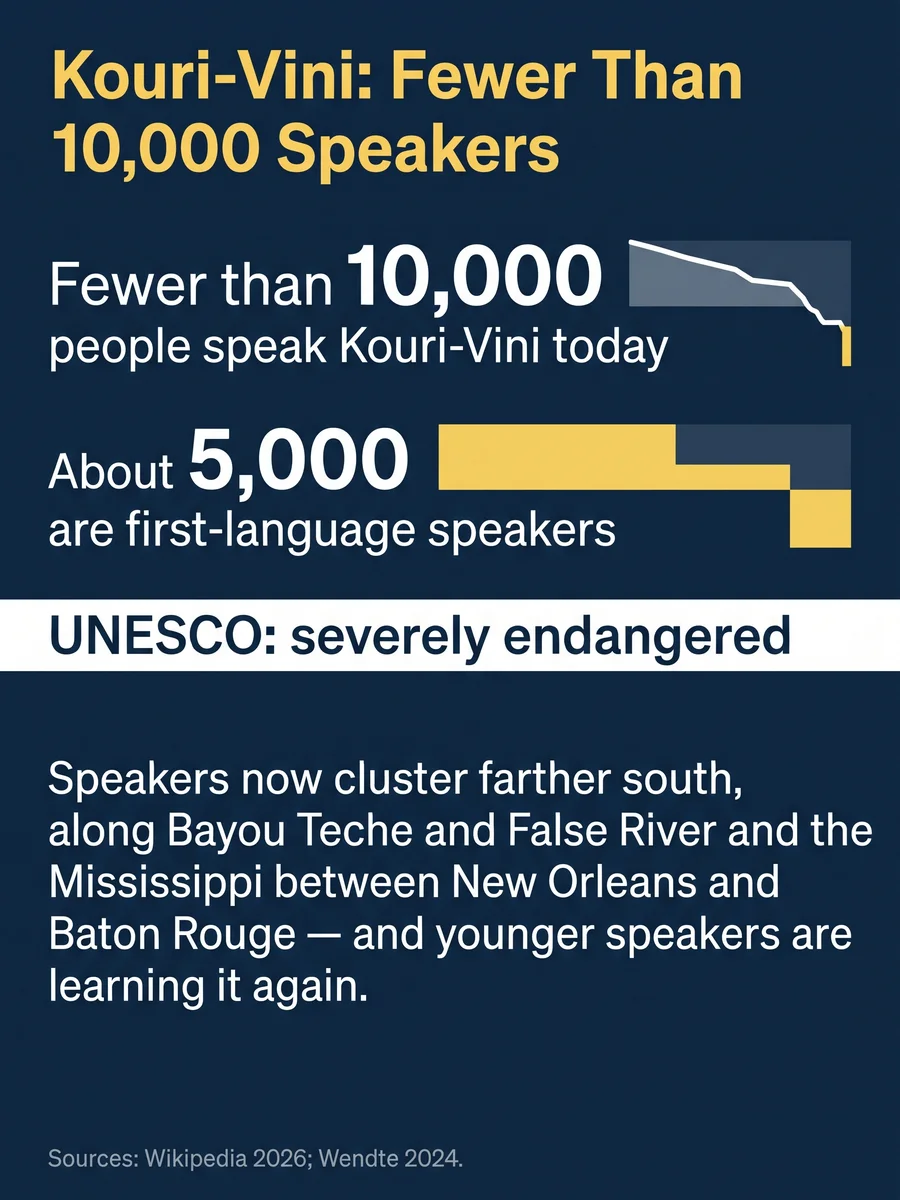
Natchitoches was once a Creole-speaking town from its founding. Speakers now cluster farther south, along Bayou Teche and False River and the Mississippi between New Orleans and Baton Rouge (Wendte, 2024).
Kouri-Vini is not gone, and that matters. Younger speakers are learning it again through a revitalization movement, and classes, dictionaries, and recordings are growing (Wendte, 2024).
Hearing Kouri-Vini is hearing the culture in its own voice. Those words carry the same mixture — French, African, and Native — that built the community itself.
The Music and Art: Juré, Zydeco, and Clementine Hunter
Creole music of Cane River began with voices alone. Juré singing — from the French jurer, to testify — was unaccompanied call-and-response, kept in time by hands and feet (National Park Service, 2019).
Singers used French or Kouri-Vini, with rhythms from Afro-Caribbean traditions. Amédé Ardoin carried that sound onto records.
Ardoin was born in 1898 near Basile and cut his first solo album for Columbia Records in New Orleans in 1929 (National Park Service, 2019). His accordion set the template for Creole and Cajun music alike (National Park Service, 2019).
Zydeco grew from the same roots in the 1930s and 1940s, when house-dance music called la-la took up the accordion and the washboard. Clifton Chenier pushed it into the mainstream in the late 1940s and 1950s.
Since 2010, the park’s own music festival has carried it on (National Park Service, 2019). Clementine Hunter painted the community the music came from.
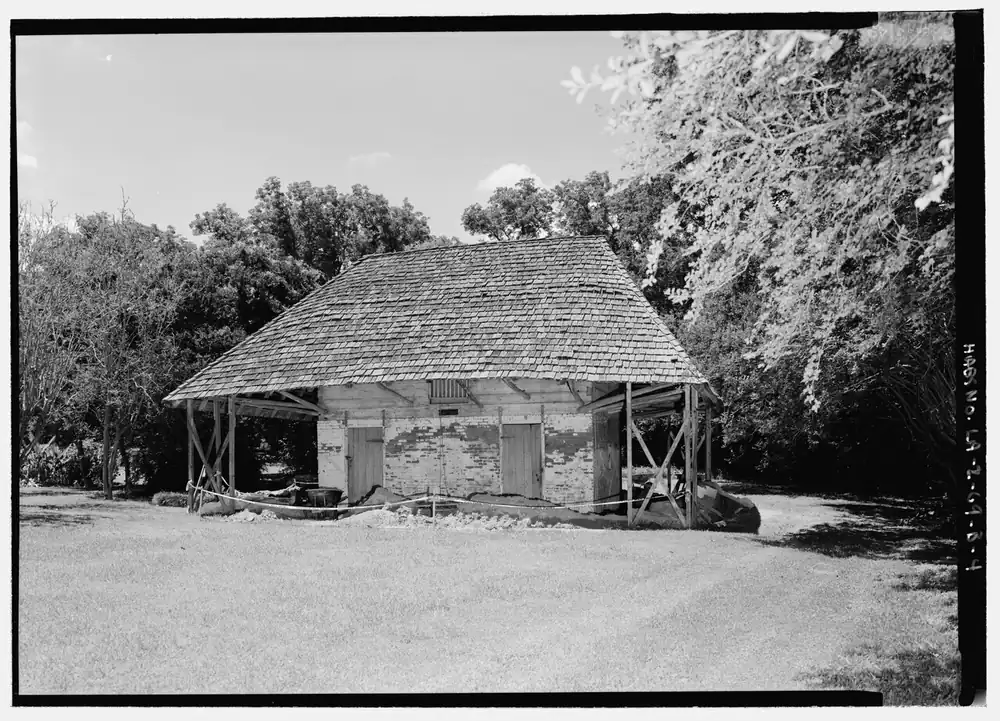
She worked the fields and the kitchen at Melrose Plantation (SAH Archipedia, 2026). Then she painted what she remembered — cotton harvests, baptisms, weddings, wash days — in a direct style no school taught her.
Six weeks in the summer of 1955 produced her largest work (Louisiana Office of Culture, Recreation and Tourism, 2015). Between 8 June and 21 July she covered the upper room of the African House with nine murals.
She worked mostly at night (Louisiana Office of Culture, Recreation and Tourism, 2015). Melrose itself needs a straight telling: the plantation’s salon welcomed writers and artists, but Hunter was an employee there, not a guest (SAH Archipedia, 2026).
Those paintings record the Black community’s life, not the salon’s. Keeping that distinction is the point of her work, and of this guide’s telling of Melrose (Smithsonian American Art Museum, 2022).
The Places That Carry the Culture
Culture needs ground to stand on, and Cane River keeps its ground. Seven places carry the story, and each one proves a different part of it.
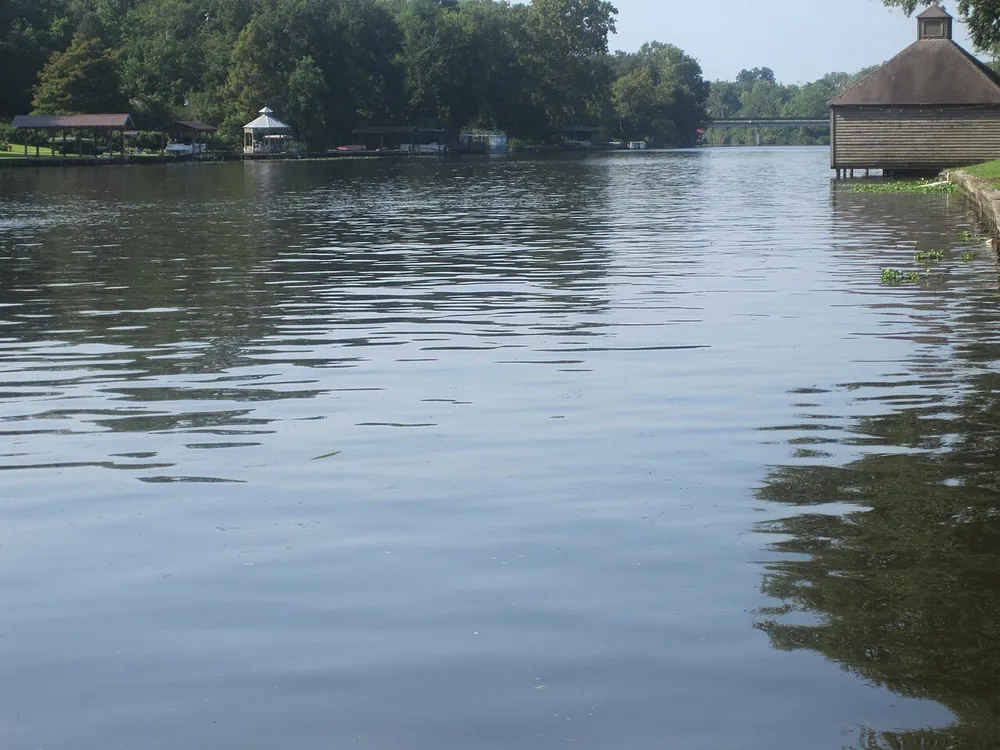
Even the river’s name tells the story. River cane gave the river its name: thickets of Arundinaria gigantea, not sugar cane.
Native peoples wove the cane into baskets (National Park Service, 2022). Start with Isle Brevelle, and the rest of this section walks the other six.
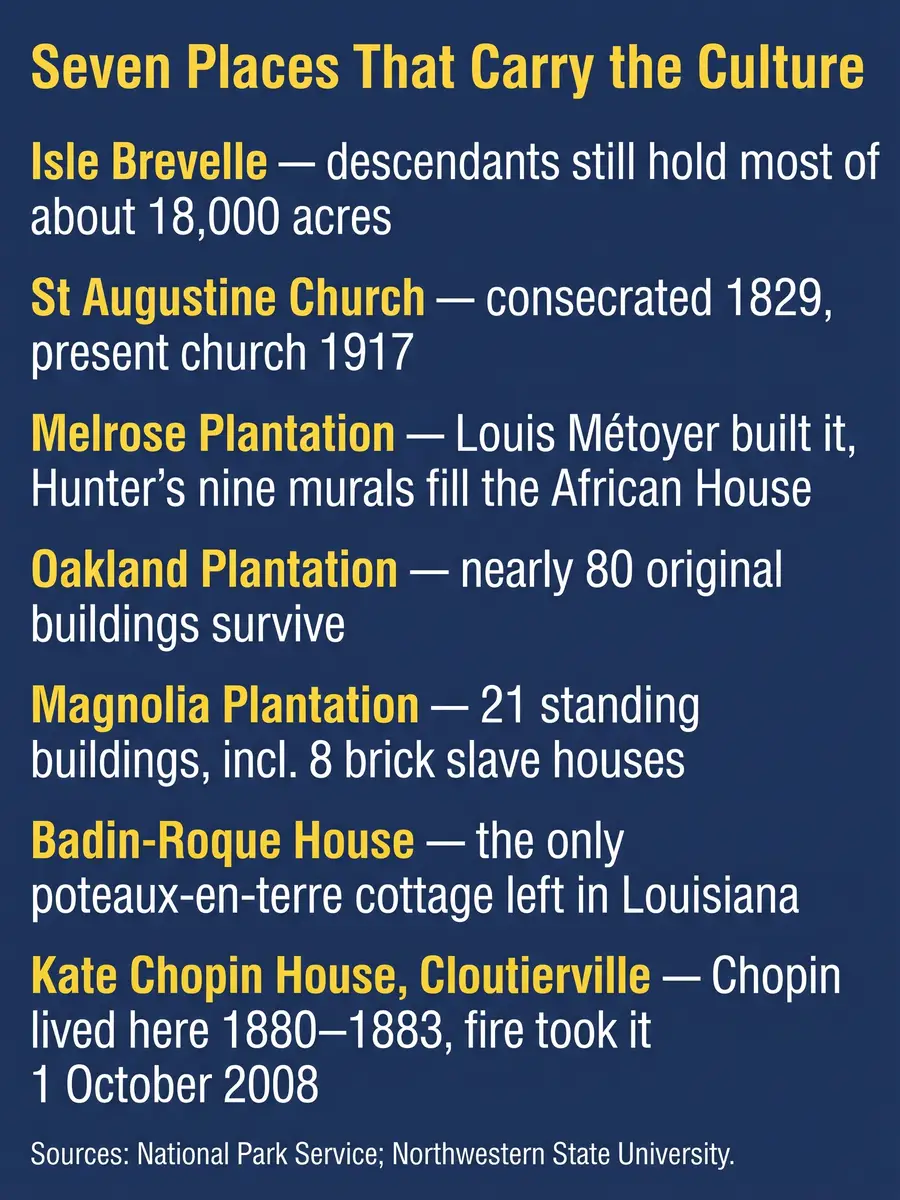
Isle Brevelle: Descendants still hold most of about 18,000 acres between river and bayou (Northwestern State University, 2026). Heritage-area signs mark it as the birthplace of Creole culture.
St Augustine Church: Since 1829 it has been the community’s spiritual center, and its pew records reverse the usual Southern order (Mills, 1977). Each autumn its fair still brings descendants home.
Melrose Plantation: Louis Métoyer built this plantation; his mother Coincoin did not, whatever legend says (African American Registry, 2026). Hunter’s murals fill its African House, and its salon once hosted the writers of Cane River.
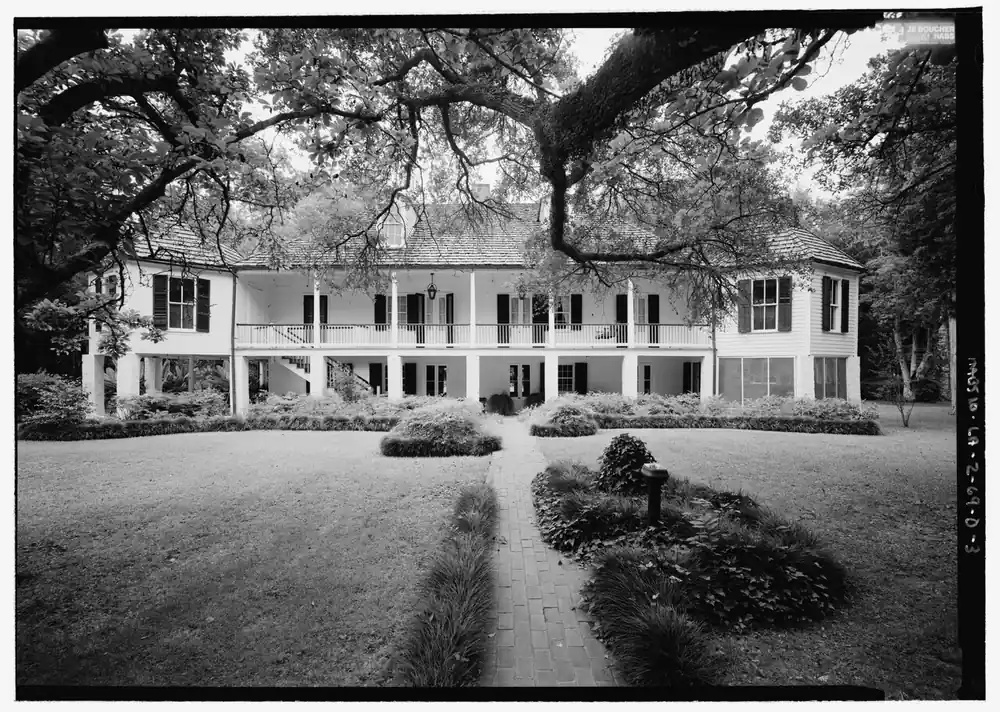
Oakland Plantation: Enslaved people and later tenant farmers worked this Prud’homme family cotton plantation. Visitors can tour its main house on a limited self-guided basis, and nearly eighty original buildings survive across the park (National Park Service, 2022).
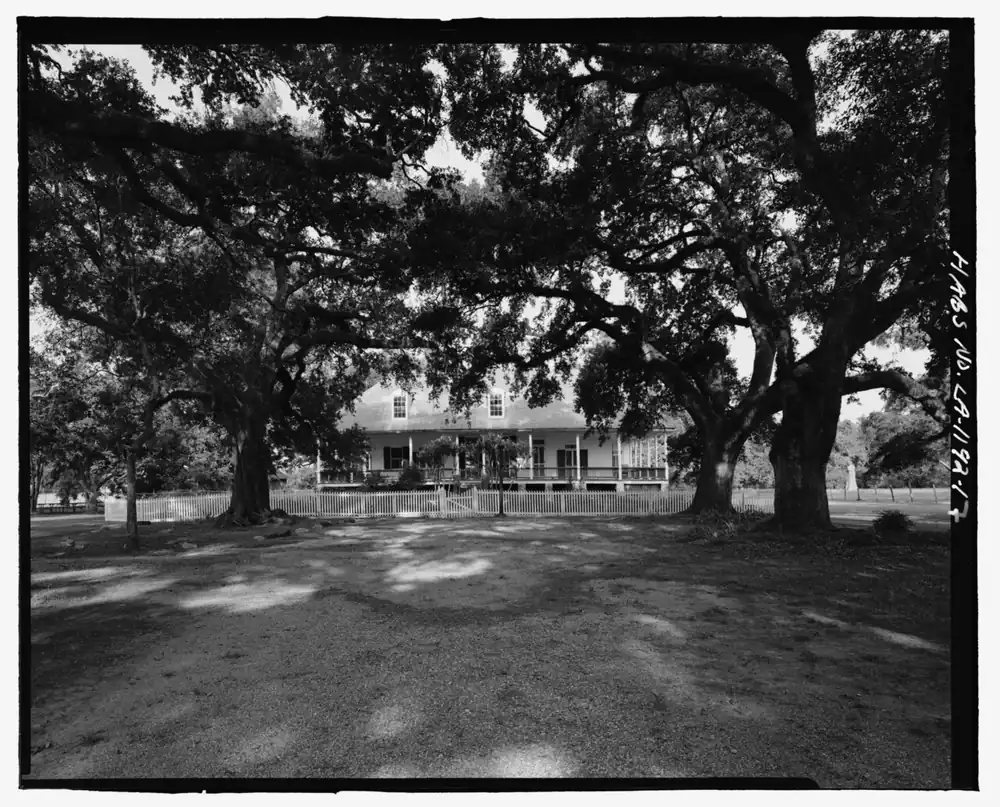
Magnolia Plantation: Twenty-one standing historic buildings survive on the LeComte family’s plantation, including eight brick slave houses (National Park Service, 2017). Family owners still hold the main house, which stays closed to the public (National Park Service, 2026).
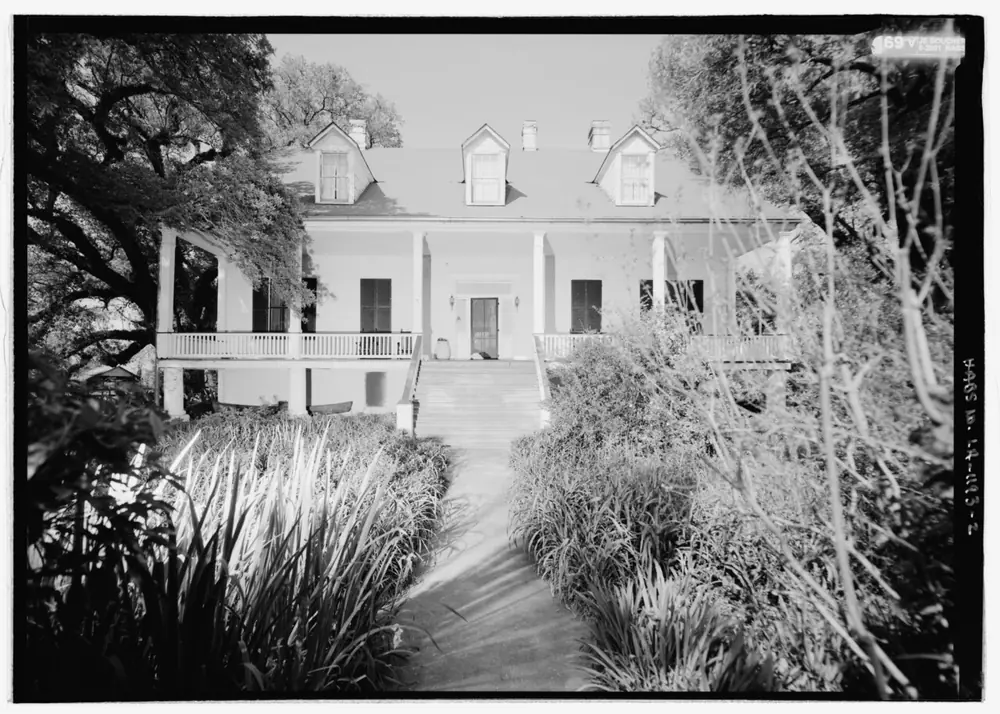
Badin-Roque House: Mud, moss, and deer-hair walls fill this poteaux-en-terre cottage, the only one of its kind left in Louisiana.
Scholars date it anywhere from the 1770s to the early 1800s. No source settles the argument (National Park Service; National Register of Historic Places, 1980).
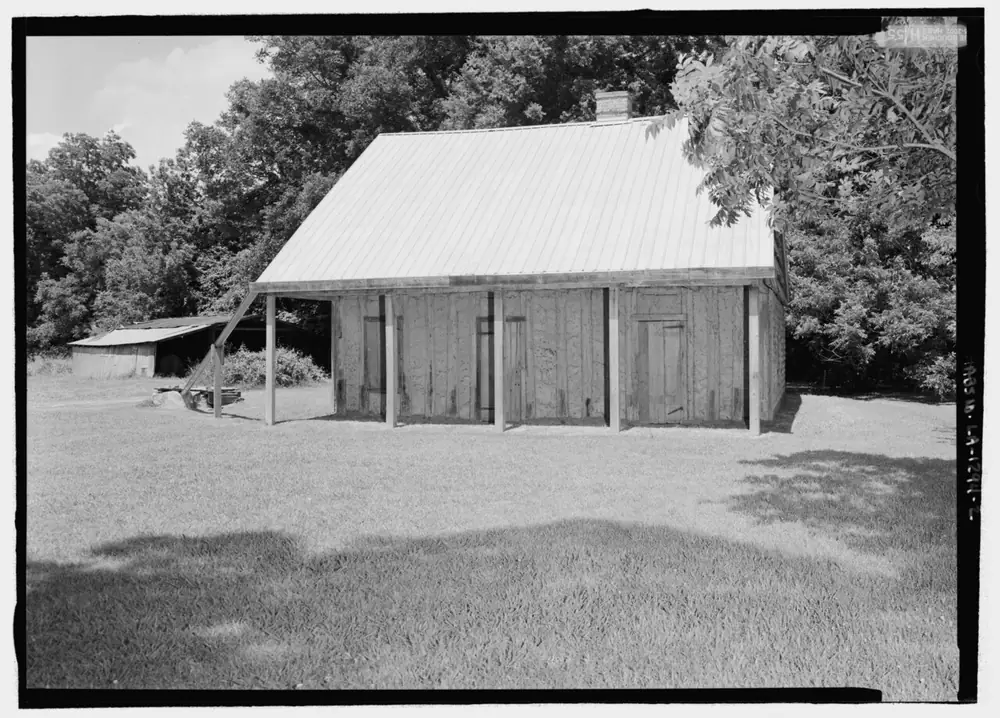
Kate Chopin in Cloutierville: Kate Chopin lived here from 1880 to 1883 and set Bayou Folk on this river (National Park Service, 2019). Fire took the house on 1 October 2008, so the town keeps her memory in books, not buildings.
The Culture Is Still Alive
Past tense would be the wrong tense for this guide. Families descended from the first Creoles still farm the land their ancestors bought, and the church fair still fills Isle Brevelle each autumn.
At Northwestern State University, the Creole Heritage Center keeps the paper trail. More than 5,000 items fill its resource library, and more than 9,500 names fill the National Creole Family database (Northwestern State University, 2026).
Every October, Natchitoches celebrates the living culture the center documents (National Park Traveling, 2026). Food, zydeco, storytelling, and genealogy meet at its annual Creole Heritage Celebration — and the St Augustine fair follows close behind.
Anyone tracing Creole roots starts here, with the records and the reunions. Center staff can point a family researcher to church registers, cemetery records, and family histories that are hard to find anywhere else.
An independent guide runs this site, not the heritage area or the park. Every date and figure above was checked against the sources in References on 23 November 2026.
Frequently Asked Questions
Is Cane River Creole the same as New Orleans Creole?
New Orleans Creole culture grew in a port city around restaurants, jazz, and the French Quarter. Downriver, the culture grew in a farming community of free people of color, centered on Isle Brevelle and its church.
Is Cane River Creole the same as Cajun?
Cajuns descend from Acadians who arrived later and settled farther south. Upriver, the story began in 1714 at a French frontier post, and its people were French, Spanish, African, and Native — not Acadian.
Who was Marie Thérèse Coincoin?
Coincoin was born enslaved in 1742, gained her freedom in 1778, and built a landholding family on Cane River. Her children founded the community, its church, and Melrose Plantation.
Can I visit the plantations?
Oakland’s grounds and outbuildings are open for self-guided visits, and its main house opens for limited self-guided tours. Magnolia’s main house is privately owned and closed to the public — but its grounds and outbuildings are open (National Park Service).
Where do I start if my family is Creole?
Start with the Creole Heritage Center at Northwestern State University. More than 5,000 items fill the library, and more than 9,500 names fill the family database.
Then come to the October celebration and the St Augustine fair, where the families gather.
Methodology
November 2026 is when this guide was written, from published sources checked against each other. Public Law 103-449, National Park Service pages, National Register nominations, 64 Parishes, the NSU Creole Heritage Center, and the Smithsonian supplied the sources.
Mills’s 1977 history and Wendte’s 2024 language snapshot supplied the scholarship. Sources for the rest included the Louisiana Office of Culture, Recreation and Tourism, Explore Natchitoches, the African American Registry, and Wikipedia.
Each date and figure was checked against at least one of those sources on 23 November 2026. Where sources disagree, this guide reports both sides instead of choosing one.
Hours, prices, and addresses are left out, because those change; check the park’s own pages before a visit. Independence is the last fact: this guide is unaffiliated with the heritage area, the park, or the university.
References
- Public Law 103-449 — Cane River Creole National Historical Park and National Heritage Area Act (16 U.S.C. § 410ccc)
- Management Plan — Cane River National Heritage Area (National Park Service, 2003)
- Guided Tours — Cane River Creole National Historical Park (National Park Service)
- Frequently Asked Questions — Cane River Creole National Historical Park (National Park Service)
- Music Festival — Cane River (National Park Service)
- Water / Cane River Lake (National Park Service)
- Louisiana: Cane River Creole National Historical Park (National Park Service)
- Kate Chopin House (National Park Service)
- Preservation Plan for the Badin-Roque House (National Park Service)
- Badin-Roque House — National Register of Historic Places Inventory-Nomination Form (National Park Service)
- Maison de Marie Therese — National Register of Historic Places Inventory-Nomination Form (National Park Service)
- Natchitoches Meat Pies — 64 Parishes (Louisiana Endowment for the Humanities)
- Kate Chopin — 64 Parishes (Louisiana Endowment for the Humanities)
- Creole Heritage Center — Northwestern State University of Louisiana
- NSU Regional Folklife Program — Cane River Creole Community
- NSU Regional Folklife Program — Badin-Roque House
- May 26 NGHA talk will focus on resources at NSU’s Creole Heritage Center (Northwestern State University, 2026)
- Isle Brevelle — Explore Natchitoches
- Clementine Hunter — Smithsonian American Art Museum
- Clementine Hunter Murals — Louisiana Office of Culture, Recreation and Tourism (2015)
- Louisiana Creole (Louisiana, USA) — Language Snapshot, Wendte 2024
- Mills, Gary B., The Forgotten People: Cane River’s Creoles of Color (Louisiana State University Press, 1977).
- Marie Coincoin, Businesswoman born — African American Registry
- Melrose Plantation — SAH Archipedia
- Isle Brevelle — Wikipedia
- St. Augustine Parish (Isle Brevelle) Church — Wikipedia
- Louisiana Creole — Wikipedia
- List of endangered languages in the United States — Wikipedia
- Cane River Creole Recognized as Underground Railroad Site — National Park Service (2022)
- Creole Heritage Center — National Park Traveling